

If you’ve been putting off building an iPhone app for your business, you’re not the only one. Almost every business owner we speak with has said some version of the same thing: “We know we probably need this, but is it really the right time?”
Fair question. Budgets are tight, teams are stretched, and there’s always something more urgent on the list.
But somewhere in the middle of all that hesitation, customer behavior has quietly moved on without waiting for anyone’s approval. People are booking appointments, comparing prices, checking order status, and deciding who to buy from all from an iPhone, often before they’ve even opened a laptop that day. If your business isn’t part of that moment, there’s a good chance another one already is.
So this isn’t going to be a piece full of hype or scare tactics. It’s a straightforward look at why professional iOS app development has become a real business priority in 2026 and what actually separates a good investment from an expensive mistake.
Mobile-First Isn’t New. It’s Just Gone Deeper.
Nobody’s discovering mobile-first for the first time in 2026. What’s changed is how much weight a single app now carries in the customer relationship.
A patient booking a diagnostic scan. A customer reordering the same groceries every week. A client checking whether their service request has been picked up yet. None of these are one-time interactions anymore; they’re habits, and people expect those habits to work smoothly on the device already sitting in their hand.
That’s really the whole case for iOS app development, and mobile app development more broadly. It’s stopped being a “nice to have” tucked away in the digital strategy slide and become something closer to basic infrastructure.
Why iOS Users Specifically Are Worth Your Attention
It’s easy to lump Android and iOS users together and assume they behave the same way. They don’t, and the difference actually matters for business.
- iPhone users tend to spend more, on average, on apps, subscriptions, and in-app purchases than users on other platforms.
- They also show noticeably stronger brand loyalty once they trust a product.
- In sectors like healthcare, finance, and real estate, a large chunk of the highest-value customers are on iOS.
- Apple’s hardware ecosystem is far less fragmented, which makes testing and performance far more predictable.
None of this is an argument to ignore Android. It’s just a reminder that skipping iPhone app development, or treating it as a rushed afterthought, often means underserving a segment of customers who are genuinely worth the effort.
Security and Privacy Aren’t Optional Anymore
After a few years of data breaches and privacy scandals making headlines, people have become far more careful about what they install on their phones, especially in healthcare, diagnostics, fintech, and e-commerce, where sensitive personal information is part of daily transactions.
Apple already enforces strict privacy standards across its ecosystem, but that doesn’t mean every app built for iOS actually lives up to them. Done properly, iOS application development includes things like:
- Secure authentication and encrypted data handling
- Compliance with Apple’s App Store privacy requirements
- Careful, minimal use of permissions like location and camera access
- Ongoing security testing, not just a one-time check before launch
An app that mishandles user data doesn’t just risk getting rejected from the App Store. It risks something harder to recover from customer trust.
User Experience Has Basically Become the Product
For a lot of businesses today, the app is the first real impression a customer forms. Long before someone calls your office or walks into your location, they’ve already made up their mind based on how the app looked and felt.
Good UX in 2026 has less to do with flashy animation and more to do with the basics done well:
- Loading fast, even on an average connection
- Navigation that doesn’t need an explanation
- A design language that actually feels like your brand
- Thoughtful accessibility for people who need it
This is where experienced iOS app developers really earn their keep. They understand Apple’s design guidelines well enough to build something that feels native and familiar, not a generic layout that’s clearly been stretched across a screen it wasn’t designed for.
What a Good App Does for Your Credibility
There’s a quiet shift in perception that happens the moment a business has a genuinely well-built app. It signals stability. It says, without anyone stating it outright, that this business has invested in getting the details right.
Now picture the opposite, a clunky app, slow to load, sitting on the App Store with a string of one-star reviews. That’s public. It’s permanent. And in some cases, it does more damage to a brand than simply not having an app at all.
Custom iOS app development, when it’s done right, stops being just a utility and becomes part of how people see your brand.
Built for Growth, Not Just for Launch Day
Most businesses building their first app think mainly about launch day. Fair enough that’s the milestone everyone’s watching for. But the real test usually comes six months later, once the user base grows and someone asks for a new feature that the app simply wasn’t built to handle.
This is where the gap between a rushed build and proper iOS app development services becomes obvious. A well-architected app can:
- Handle a growing number of users without slowing down
- Take on new features without needing a full rebuild
- Connect cleanly with backend systems as the business scales
- Stay stable across successive iOS updates
Cutting corners early almost always ends up costing more later, once the “quick fix” turns into a full rebuild.
Where Modern Technology Fits In
iOS apps rarely stand alone anymore. Most are connected to a growing set of tools and technologies that extend what a business can actually offer its customers:
- AI-driven recommendations or support features
- Cloud integrations for real-time syncing across devices
- Apple Watch companion features for health and productivity apps
- Apple Pay and secure checkout flows
- Third-party integrations with CRM, analytics, or communication tools
A capable iOS app development company will know which of these genuinely add value for your business and which ones are just noise worth skipping.
Keeping Customers, Not Just Attracting Them
Getting a new customer costs money. Keeping one costs far less, and a well-designed app plays a bigger role in that than most people expect.
Push notifications, personalization, loyalty features, and a smooth repeat-purchase flow all give a business a direct line to its customers that a website simply can’t offer in the same way. Once your app sits on someone’s home screen, your brand has quietly become part of their daily routine.
Where the Revenue Actually Comes From
Everything above eventually circles back to one thing: revenue. A well-built iOS app can lead to the following:
- Higher conversions from a smoother checkout or booking flow
- New revenue streams through subscriptions or in-app purchases
- Lower support costs thanks to self-service features
- Better long-term customer value through consistent engagement
None of this happens automatically, though. It depends almost entirely on how thoughtfully the app was planned, built, and looked after once it’s live.
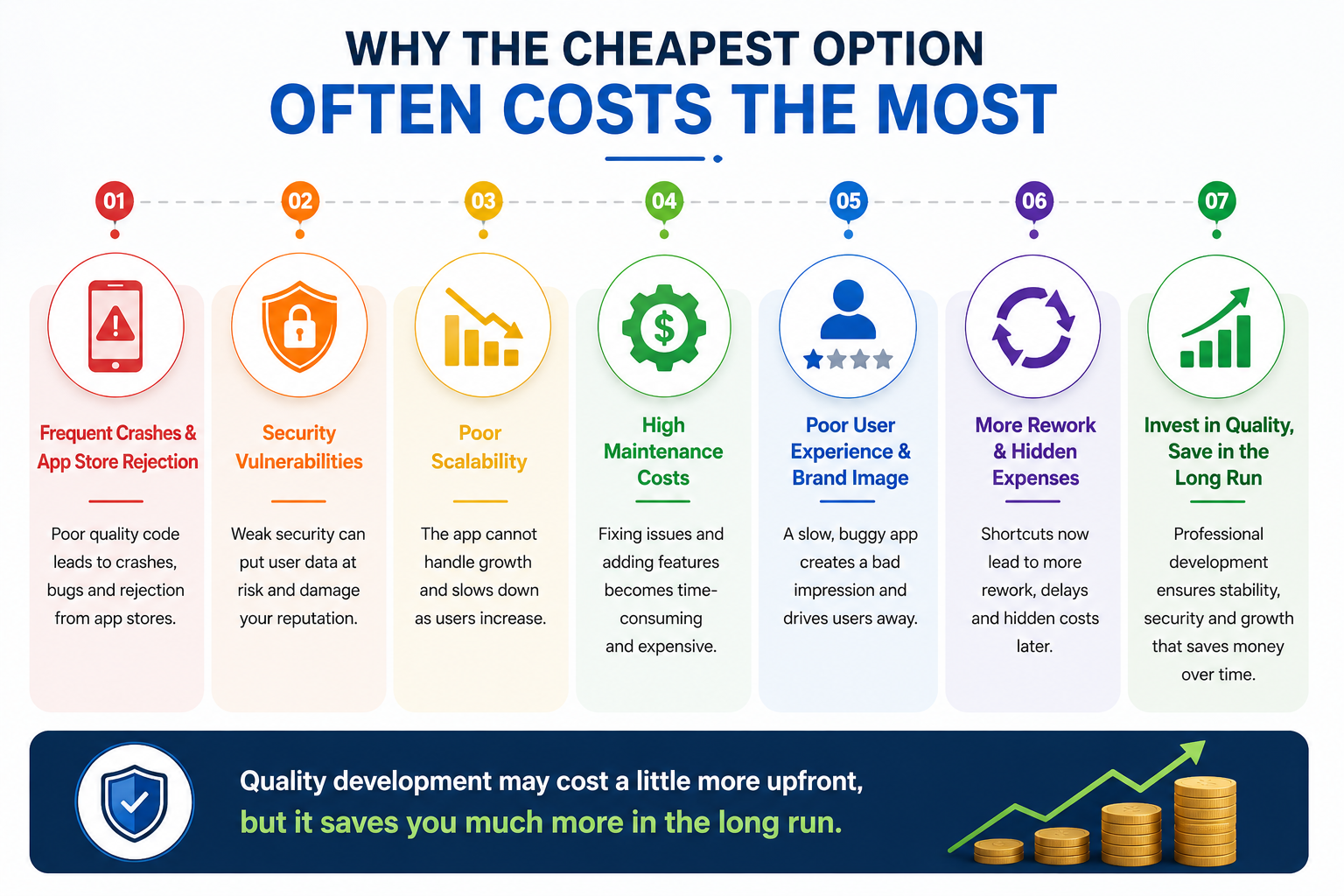
Why the Cheapest Option Often Costs the Most
It’s understandable why some businesses go with whoever quotes the lowest price. But low-cost, poorly planned development tends to lead to a familiar set of problems:
- Frequent crashes or App Store rejections
- Security gaps that only surface after launch
- An app that can’t handle growth once users start showing up
- Maintenance that becomes expensive and frustrating
- A weaker brand impression than having no app at all
Professional iOS app developers bring structured planning and long-term thinking to the process and that almost always works out cheaper over the life of the app, even if the upfront number looks a little higher.
How to Actually Choose the Right iOS App Development Company
This decision matters more than most business owners realize going in. Here’s what’s actually worth checking before signing anything.
Look for real experience in your industry
A team that’s worked on healthcare, fintech, or e-commerce apps before will already understand your compliance needs and user expectations far better than a generalist team starting from zero.
Ask about their actual process
Discovery, design, development, testing, and post-launch support: a good partner can walk you through each stage clearly. Vague answers here are worth paying attention to.
Check for real results, not just screenshots
Ask how their past apps have performed after launch: ratings, stability, and user retention, not just what the final delivery looked like in a demo.
Pay attention to how they communicate
You should always know roughly where your project stands, what’s coming next, and what challenges (if any) have come up along the way.
Confirm what happens after launch
An app isn’t finished the day it ships. iOS updates, bug fixes, and feature requests are ongoing. Make sure support is part of the conversation from the start, not something you have to negotiate later.
Be wary of unrealistic timelines
If someone promises a fully custom app in two weeks at a bargain price, that’s usually a sign of shortcuts, not efficiency. Good iOS app development takes a reasonable amount of planning; there’s no way around that.
2026 isn’t really a year where mobile can be treated as an afterthought anymore. Whether you’re a startup shipping your first product or an established business modernizing what you already have, professional iOS app development gives you a genuine edge through better security, smoother experiences, and stronger customer relationships that actually last.
The businesses investing in doing this properly now will simply be harder to compete with later.
If you’ve got an iOS app idea taking shape, or you already have requirements in mind and want to talk them through with a team that’s done this before, we’d be glad to have that conversation.
Looking to grow your business online?
Get in touch with Creatah today for a free consultation on iOS app development strategies tailored to your needs.
