

Almost every app conversation hits the same wall. Someone asks, “Android or iOS first?” and the room goes quiet. Launch on one platform and you’re telling half your customers to wait. Build for both and the budget balloons.
Flutter is a big part of why that argument has gotten easier to settle. If you’re searching for a Flutter app development company in Chennai, you’re probably weighing speed, cost, and quality all at once. This guide covers what Flutter does well, where it falls short, and how to pick a team you’ll still be happy with a year after launch.
What Is Flutter App Development?
Flutter is Google’s open-source UI toolkit. Developers use it, along with a language called Dart, to build apps for Android, iOS, the web, and desktop.
What you need to know as a business owner is the single code base. Normally, an Android app and an iOS app are two separate projects, with two sets of code, two rounds of testing, and two lists of bugs. Flutter lets a team write most of the app once and ship it to both platforms.
Imagine running a restaurant with one kitchen instead of two. The menu is the same, and the quality is the same. You just aren’t paying double for everything.
Why Businesses Are Choosing Flutter
Companies don’t adopt a technology because it’s trendy. They adopt it when it makes projects less painful. These are the reasons that keep coming up.
It’s quicker to build.
Writing code once saves an obvious amount of effort. Flutter also has “hot reload,” which shows a change on screen almost instantly. So when you say, “Can we try a darker header?” the developer doesn’t disappear for an afternoon. You can often see it in minutes.
You launch everywhere at once.
Cross-platform app development means Android and iPhone users get the app on the same day. In India, Android has the larger share, but plenty of high-value customers use iPhones, and few businesses are happy to ignore either group.
The costs are easier to manage.
One code base usually needs a smaller team than two, and that holds for the first build and for every update afterwards. How much you save varies by project. If anyone quotes you an exact percentage before they’ve understood your requirements, they’re guessing.
The app looks the same everywhere.
Flutter draws its own interface instead of borrowing each phone’s standard components. That’s why your app can look right on an older budget Android phone and on the latest iPhone. If your brand puts effort into how it looks, you’ll appreciate that.
Fixing things is simpler.
A bug gets fixed once. You won’t end up in the odd situation where the Android app has the new checkout while the iOS app is still on the old one.
Testing and updates move faster.
Many tests can be written once and run on both platforms. Fixes and new features then go out to everyone around the same time.
It can grow with you
Flutter handles more than simple apps. You can launch a lean version and add features, user roles, and integrations later. How well it scales depends mostly on how the app is architected and what sits behind it, which comes down to the team more than the toolkit.
The design options are wide.
There’s a large set of customization widgets and good animation support. If you want an app that feels designed rather than put together from stock parts, Flutter won’t hold your designers back.
Flutter vs. Traditional Native App Development
“Native” means building separate apps with each platform’s own tools: Kotlin or Java for Android and Swift for iOS. It’s the long-established route, and it’s still the right one for certain projects. Here’s the comparison of the things that affect a budget.
Development time. Flutter is usually shorter because most of the code is shared. “Native” means two builds, so it takes longer.
Maintenance. Flutter has one code base to look after. Native has two, and they need to be kept in step.
Consistency. Flutter gives you nearly identical behavior across devices. With native, matching the two apps takes deliberate effort.
Business cost. Flutter tends to cost less to build and run. Native tends to cost more, mainly because of the duplicated work.
Platform-specific features. The native gets first access to brand-new OS features. Flutter reaches most of them through plugins, though occasionally that takes extra work.
So when is Native the smarter call? Usually when your app depends on specialized hardware, needs the very latest OS capabilities on release day, or is seriously performance-heavy, like a demanding 3D game or an advanced AR tool. It also makes sense if you already have a mature native app and a team that knows it inside out.
For most business apps, though, such as customer portals, booking tools, and online stores, Flutter’s trade-offs are easy to live with. A good development partner will tell you which camp you’re in, even if the answer isn’t Flutter.
When Should a Business Choose Flutter?
Here are the situations where it tends to fit best.
- Startups: Money and time are both short, so reaching two platforms with one build is a real relief.
- MVPs and new products: If you’re testing an idea, you want real users’ reactions as soon as possible. Cross-platform gets you there sooner.
- E-commerce apps: Browsing, carts, payments, and order tracking work the same way on both platforms. There’s little point building them twice.
- Booking apps: Think clinics, salons, travel, or events. The booking logic is shared, so both versions stay in sync.
- On-demand services: Delivery and home-service apps change often. Updating one code base beats updating two.
- Internal business apps: Inventory, HR, and field-staff tools run on whatever phones people already have. Supporting both platforms removes a lot of friction.
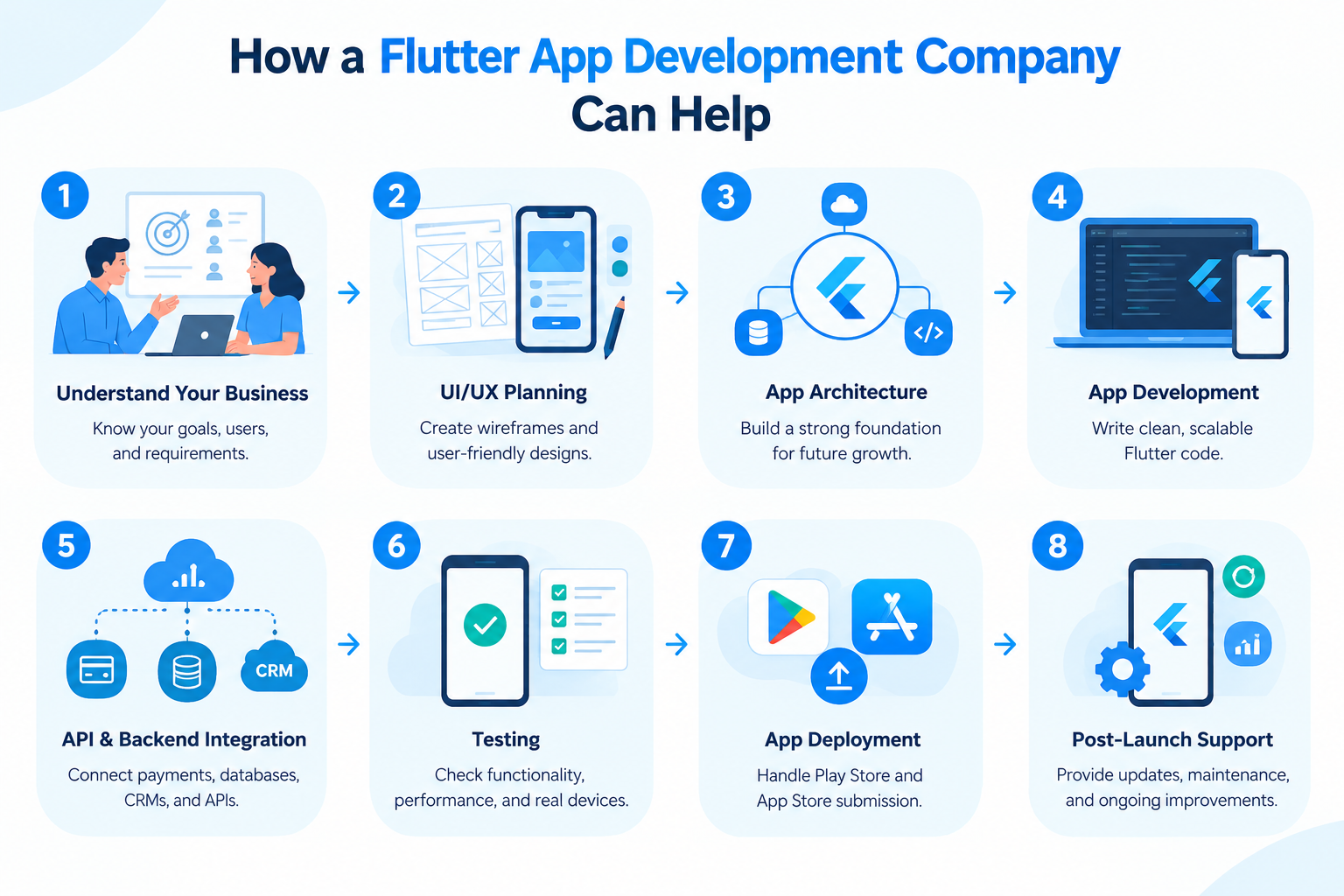
How a Flutter App Development Company Can Help
Choosing Flutter is one decision. Choosing who builds it is the bigger one. A solid partner should cover the following.
Understanding your business first. The best teams start by asking about your users, goals, and limits. If a quote arrives before anyone has asked you a question, be wary.
UI/UX planning. Wire frames and prototypes let you see the experience before any code exists. Moving a button on a sketch costs almost nothing. Moving it in a finished app does.
App architecture. Users never see it, but it decides how easily the app can grow. You tend to notice good architecture only when it’s missing.
Development. Clean, readable code that a different developer could pick up later without a long handover.
API and backend integration. Most business apps connect to payment gateways, databases, CRMs, or other services. This is often where the hard part hides.
Testing. Functional, performance, and real-device checks, so your customers aren’t the ones who find the bugs.
Deployment. The Play Store and App Store each have their own rules and review process. Experienced teams know how to avoid avoidable rejections.
Post-launch support. Operating systems update, users ask for changes, and things occasionally break. Ask about maintenance before you sign, not after launch.
A simple test when comparing companies: ask them to explain their process in plain words. If they can do that now, they’ll probably keep doing it throughout the project.
Why Choose a Flutter App Development Company in Chennai?
You can hire a team from anywhere, and plenty of businesses do. But working with a team in your own city has a few practical benefits.
Communication is easy. Same time zone, same working hours, usually the same language. Clearing a doubt takes a quick call instead of a three-day email thread.
They understand the market. A Chennai team knows how local customers behave. That covers things like regional language support, UPI and other local payment options, and how people here actually use apps day to day.
Collaboration is quicker. Some discussions, like requirement workshops or design reviews, simply go better in a room together, and that’s possible when your developers are nearby.
Support is close at hand. When something needs attention after launch, you’d rather have a team that can respond quickly than one you have to chase across time zones.
Creatah is a Chennai-based digital agency that provides mobile app development alongside web development and digital marketing. For businesses that would like the people building their app to work closely with the people promoting it, that can make life simpler. Whichever company you go with, choose one that listens, is honest about timelines and costs, and treats your app as a product that will keep evolving.
Frequently Asked Questions
What is Flutter used for?
Mostly for building Android and iOS apps from a single code base, though it also supports web and desktop apps. Businesses use it for e-commerce, booking platforms, on-demand services, internal tools, and customer-facing apps.
Is Flutter good for business apps?
In most cases, yes. It’s stable, looks consistent, and scales well enough for a wide range of business needs. Every project is different, though, so walk a developer through your must-have features before you commit.
Is Flutter suitable for startups?
Very much. It shortens development time and saves you from paying for two separate teams, which is exactly what an early-stage company needs. It’s also a good fit for launching an MVP and improving it based on user feedback.
Is Flutter cheaper than native app development?
Often, yes, because most of the code is shared and there’s less to maintain. The actual saving depends on how complex the app is, how much custom design it needs, and what it has to integrate with.
Can Flutter build both Android and iOS apps?
Yes, and that’s its biggest draw. One code base produces both apps, and developers can add platform-specific adjustments where they’re needed.
How long does Flutter app development take?
It depends on scope. A simple app may take a few weeks. An app with custom design, backend integration, and several user roles can take a few months. Clear requirements and quick design approvals do more to keep a project on schedule than anything else.
How do I choose a Flutter app development company in Chennai?
Start with their portfolio and client feedback. Then ask how they handle planning, testing, and post-launch support. Notice how clearly they communicate and whether they’re upfront about costs and timelines. A good partner will also tell you if Flutter isn’t right for your project.
Flutter has become popular because it deals with problems businesses actually have: getting to market quickly, keeping costs under control, delivering a consistent experience, and leaving room to grow. One code base shortens timelines, makes maintenance easier, and puts your app in front of Android and iOS users together. It won’t suit every project, but for startups, MVPs, e-commerce, booking, on-demand, and internal apps, it’s often a practical and efficient choice.
The team matters as much as the technology. A Flutter app development company in Chennai gives you easier conversations, a better feel for local needs, and support that’s close by after launch. Creatah offers mobile app development solutions for businesses that want to get from idea to launch through a clear, collaborative process.
Looking for a reliable Flutter app development company in Chennai? Contact Creatah to discuss your mobile app development requirements.
