

There’s a certain kind of client who comes in already knowing they want iOS only, and they usually know exactly why. Maybe their users are almost entirely on iPhone. Maybe they’re building something that leans on Apple’s ecosystem—Apple Pay, Face ID, HealthKit, or Apple Watch companion features—that works better or only works at all when it’s built natively. If that’s the conversation you’re having right now, you’re probably looking for an iOS app development company in Chennai that understands the difference between an app that runs on iPhone and one that actually feels like it belongs there.
That difference matters more than people expect going in. A native iOS app, built properly in Swift and SwiftUI, taps into the platform in ways a cross-platform build just can’t touch: better hardware access, tighter integration with Apple’s design language, and performance that never feels like a compromise. Chennai’s developer community has quietly built up real depth here over the years, and not as a side skill picked up alongside Android or Flutter work either. It’s grown into its own discipline.
This piece looks at why native iOS development still makes sense for the right kind of project, why Chennai has turned into a solid place to find that expertise, and what actually separates a good iOS partner from one that treats it as an afterthought.
Why Native iOS Development Still Wins for the Right Projects
Cross-platform tools have closed a lot of gaps over the years, but there’s still a category of app where native development is the obvious call, and it usually comes down to a few specific things.
Full Access to Apple’s Hardware and APIs
When an app needs the newest camera features, ARKit, HealthKit, or deep Face ID integration the day Apple ships it, there’s no waiting around for a cross-platform framework to catch up. Native development gets there first, and that matters a lot for apps where that capability is basically the whole point of the product.
Performance That Feels Effortless
Swift compiles straight down to native code, with no translation layer sitting in between. Scrolling through a long list, animating a transition, handling a heavy image feedit all moves the way Apple’s own apps move, because it’s built on the same foundation.
Design That Matches Apple’s Own Standards
Apple’s Human Interface Guidelines aren’t just a suggestion; they’re really the rules that shape how iPhone users expect apps to behave in the first place. A native SwiftUI app picks up on those conventions naturally: the gestures, the transitions, and the typography, so it feels familiar the second someone opens it rather than slightly off.
Stronger App Store Approval Odds
Apple’s review process is famously strict, and apps leaning too heavily on cross-platform wrappers, or ones that feel like they were built for another platform first, sometimes hit friction during review. A properly built native app tends to move through that process a lot more smoothly.
Better Long-Term Stability With OS Updates
When Apple releases a new iOS version, apps built with current Swift and SwiftUI practices tend to adapt with far less rework than ones sitting on top of a cross-platform layer that has to catch up separately, usually weeks behind.
A Cleaner Fit for Premium and Enterprise Products
For fintech apps, healthcare platforms, or enterprise tools where security, compliance, and polish all carry real weight, plenty of businesses find that native iOS just gives them one less variable to worry about.
Take a healthcare app storing patient records, wired into HealthKit, with biometric login. Every one of those pieces behaves more predictably, and usually more securely, when it’s built directly for iOS instead of bridged through some shared framework. That’s the kind of project where the extra cost of going native pays for itself pretty fast.
Why Chennai Has Become a Strong Base for iOS Development
Chennai’s reputation in iOS work didn’t happen by accident. A good chunk of it comes down to the sheer number of Swift developers the city has turned out over the last decade, plenty of whom got their start on fintech and healthcare apps, where Apple’s ecosystem tools were a genuine differentiator rather than a nice-to-have.
There’s a cost advantage too, and it’s hard to ignore. Skilled Swift and SwiftUI developers in Chennai come at a fraction of what the same experience level costs in the US, UK, or even a few other Indian metros, without any real dip in quality. Add the city’s mature IT infrastructure and decades of outsourcing experience, and you get teams that are genuinely used to working with international clients rather than just adjusting to it one project at a time.
Time zone overlap helps as well. Clients in the Middle East and parts of Asia get a full day of overlap, and European and US clients still get a workable window for calls and reviews. Throw in English-speaking teams, and it’s not hard to see why Chennai keeps showing up on shortlists for businesses that specifically want native iOS work done properly, rather than treated as a secondary platform tacked onto an Android build.
It’s also worth mentioning how many Chennai-based teams have shipped apps through Apple’s stricter review categories, health apps, financial apps, and anything touching sensitive personal data where getting it wrong the first time means weeks of delay. That kind of direct experience with App Store review specifically, not just app-building in general, tends to be what separates teams that have genuinely specialized in iOS from ones treating it as just one option among several.
What Makes a Good iOS App Development Company in Chennai
Plenty of agencies will tell you they “do iOS,” but there’s a real gap between a team that occasionally ships an iPhone app and one that actually specializes in it.
The strongest teams default to Swift and SwiftUI without anyone having to ask. They know Apple’s Human Interface Guidelines well enough to build interfaces that feel instinctively right to iPhone users, not just functional on paper. A real App Store experience counts for a lot too. Knowing which guidelines trip up first-time submissions saves weeks of back-and-forth that a less experienced team might not see coming until it’s already happening.
A good partner also treats security as a baseline, not an add-on, especially for anything touching payments, health data, or personal information that’s expected under Apple’s own review guidelines, and honestly, users expect it too by now. Support after launch matters just as much as the build itself. Apple ships a new iOS version every year, and apps need ongoing attention just to stay compatible, let alone take advantage of whatever new capabilities show up.
Communication style tends to say a lot as well. A team that can explain tradeoffs clearly, why a feature might need extra time, and why some App Store requirements exist the way they do is usually more dependable in the long run than one that says yes to everything and figures out the complications later.
iOS App Development Services We Offer
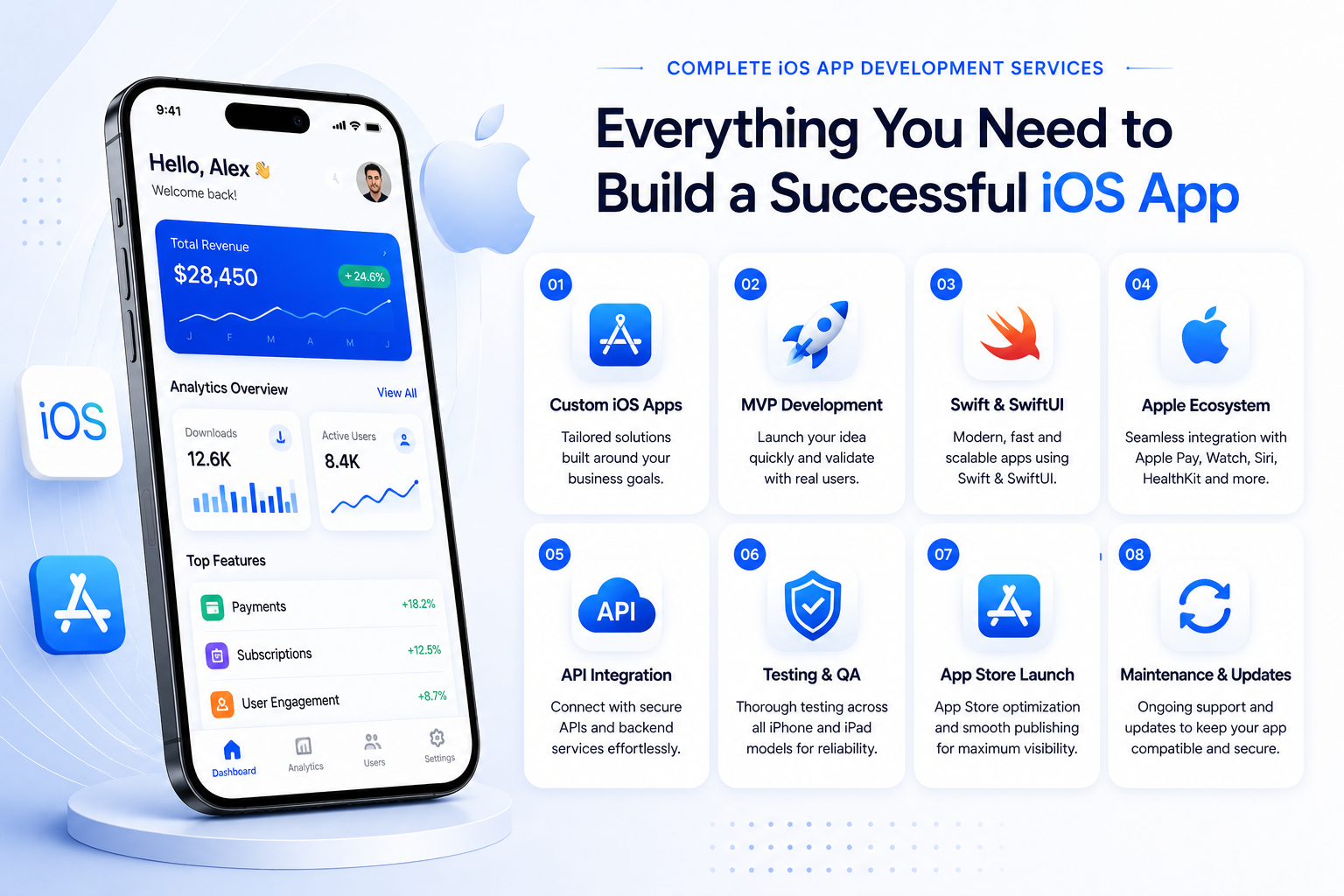
A good iOS partner should be able to handle the whole lifecycle of an app, not just the first build.
Custom iOS app development means building around your actual business logic in Swift and SwiftUI, rather than squeezing a cross-platform codebase into place. iPhone and iPad app development accounts for the different screen sizes and interaction patterns across Apple’s device range, so the app feels right no matter which one someone’s holding. Enterprise iOS apps bring the security, scalability, and internal system integration that bigger organizations actually need.
For startups still testing an idea, MVP development gets a lean, working iOS app in front of real users fast. SwiftUI and UIKit development covers both the modern declarative approach and the older, more established framework, depending on what the project actually calls for. Apple ecosystem integration, Apple Pay, Apple Watch companion apps, Siri Shortcuts, HealthKit, and similar tools connect the app to the parts of the ecosystem that make it genuinely useful to iPhone users, not just present on their phone somewhere.
API and backend integration ties the app to whatever services it needs to run, while App Store optimization helps make sure the app actually gets found once it’s live, not just approved and forgotten. App testing and QA across different iPhone and iPad models catches issues before users do, and app migration moves an older app onto current Swift standards without losing functionality along the way. Maintenance and support keeps the app current with new iOS releases, since keeping pace with Apple’s yearly updates really isn’t optional.
Industries That Benefit From Native iOS Apps
Some industries lean on native iOS development more than others, usually because the stakes around performance, security, or platform integration run higher.
Healthcare apps benefit from HealthKit integration along with the data security Apple’s platform is built to support. Finance and banking apps are better served by native development, which handles tight security and Face ID or Touch ID integration cleanly. E-commerce brands often lean on Apple Pay integration to cut down checkout friction, especially for iPhone shoppers. Education platforms make use of iPad-specific features for interactive learning tools.
Fitness and wellness apps depend heavily on Apple Watch integration and HealthKit data. Real estate firms use AR features through ARKit for virtual property tours. Travel apps benefit from Apple Maps integration and offline capability built the native way. Media and entertainment apps need the smooth video and audio performance that only native development really delivers, and enterprise SaaS companies often build a dedicated iOS companion app for their main product simply because their customer base skews heavily toward iPhone and iPad.
Native iOS vs Cross-Platform Development
You might be wondering whether you actually need a dedicated iOS build or whether a cross-platform app would do just as well. Honestly, it depends on the project.
| Factor | Native iOS | Cross-Platform |
| Cost | Higher separate iOS codebase | Lower one codebase for multiple platforms |
| Development Time | Longer across multiple platforms | Shorter if targeting Android and iOS together |
| Performance | Best possible on Apple hardware | Good, but slightly behind native in edge cases |
| Access to Apple Features | Immediate, full access | Usually delayed until the framework catches up |
| App Store Approval | Generally smoother | Can sometimes face more scrutiny |
| Design Consistency | Matches Apple’s guidelines throughout | Good, but not always pixel-perfect to iOS |
| Long-Term OS Support | Quick to adopt new iOS versions | Depends on the framework’s own update schedule |
| Best For | iOS-first or iOS-only user bases | Businesses needing both platforms, fast and affordably |
If most of your users are on iPhones, or your app leans heavily on Apple ecosystem integration, it’s worth the extra investment to go native. If you need to reach both Android and iOS quickly on a tighter budget, a cross-platform build like Flutter might be the smarter call and a good development partner should be honest enough to tell you which situation you’re actually in, rather than steering you toward whatever they happen to sell.
It also helps to think of this as a spectrum rather than a strict either-or. Some companies launch a cross-platform MVP first just to see if the product has legs, then move to native iOS once it does and the App Store experience starts mattering more for retention and revenue. Others know from day one that their whole user base lives on iPhone, in which case starting native from the beginning saves them a costly rebuild later on.
Why Businesses Choose Creatah for iOS Development
Our iOS work spans healthcare, fintech, and enterprise projects, so the Swift and SwiftUI experience on the team isn’t something being picked up on a client’s timeline. We build custom rather than templated, and we pay close attention to how an app should feel on an iPhone specifically, not just whether it technically works on it.
Pricing stays transparent from the start, agile sprints mean you see real progress instead of waiting around for one big reveal, and a dedicated project manager keeps communication consistent the whole way through. Quality assurance runs through every stage of development rather than getting squeezed in right before submission, and support keeps going well past launch, including the ongoing tweaks that Apple’s yearly iOS updates tend to demand, whether anyone asks for them or not.
iOS App Development Process
It usually starts with discovery, understanding the business, the target users, and why iOS specifically is the right call for this project before moving into business analysis to nail down requirements before any design work begins.
From there, wireframing sketches out the app’s structure, and UI/UX design turns that into interfaces built around Apple’s actual design conventions rather than some generic template. Development happens in Swift and SwiftUI, usually across agile sprints, followed by testing across different iPhone and iPad models to catch device-specific issues before real users do. App Store preparation covers what Apple expects for submission, and App Store publishing handles the actual review and release. Post-launch support keeps the app current with new iOS versions and responsive to whatever feedback comes in from real users.
iOS App Development Trends in 2026
SwiftUI has matured enough now that it’s the default starting point for most new projects, rather than the newer alternative to UIKit it used to be seen as. AI features are showing up across iOS apps too, plenty of them built using Apple’s on-device machine learning tools, which keep user data private while still enabling features that feel genuinely smart.
Even businesses that haven’t built anything for Apple Vision Pro and spatial computing yet are starting to plan around it, since it’s opening up a whole new category of app design. Widgets and Live Activities have stopped being a novelty and turned into a real engagement tool, and privacy-first development keeps getting more central as Apple keeps tightening its App Tracking Transparency rules. Apple Watch and wearable integration keep growing too, and on-device AI processing is increasingly replacing cloud-based approaches for anything touching sensitive user data.
Developer surveys keep showing Swift as one of the most in-demand languages for mobile-specific roles, which says a lot about how much dedicated iOS expertise still matters even as cross-platform tools keep getting more capable.
Why Native iOS Development Is a Good Business Investment
If your user base is genuinely iOS-heavy, native development tends to hold up well. It gives you the best possible performance and experience on Apple hardware, immediate access to new Apple features the moment they ship, and generally smoother App Store approval. It also builds in stronger long-term compatibility with new iOS releases, and it tends to earn better reviews and retention specifically among iPhone users, who can usually tell the difference between an app built for them and one that’s just been adapted to fit.
Finding the right iOS app development company in Chennai really comes down to finding a team that treats native development as a specialty, not a checkbox next to their other services. Precision and speed aren’t actually at odds once a team knows the platform well enough to move fast without cutting corners on the details that make an iOS app feel genuinely native. Chennai has built up real depth in this space, which makes it a solid place to look for a partner who can deliver both.
Want to Build a High-Performing iOS App?
Whether you’re launching a new iPhone app or planning to bring an existing product fully native, Creatah’s iOS developers in Chennai build fast, secure, and polished apps tailored specifically around Apple’s platform and design standards. From Swift and SwiftUI development to Apple ecosystem integration and App Store optimization, we care about apps that feel like they belong on iPhone, not just apps that happen to run on it.
Contact Creatah today to discuss your project and see how our native iOS expertise can bring your app to life the way it deserves to be.
