

There’s usually a moment when a growing business realizes its tools have quietly stopped fitting. We still track orders in a spreadsheet. Three different people edit it at once, and it’s never quite up to date. The CRM you bought does most of what you need. Yet none of the specific twenty percent matters. Or your team’s stitching together four separate apps just to pull one report together every Monday morning. None of this feels like a crisis. It’s just friction, and it piles up quietly until someone finally says, “There has to be a better way.”
That’s usually about when custom software development in Chennai enters the conversation. Custom development avoids bending your business to fit generic software built for nobody in particular. A solution built around how your team actually works, how you sell, and how you fulfill orders. It reflects the way your specific business runs day to day. It costs more upfront than an off-the-shelf tool, and it takes longer to stand up. We build it for you, not for some hypothetical average customer three tiers removed from your actual problem.
The guide clarifies the meaning of custom software. It explains when investment pays off, cost drivers, and how to assess a development partner’s trustworthiness. It guides you on deciding if a partner is reliable for the job.
What Is Custom Software Development?
Custom software is software built for one specific business. It serves that business’s workflows, data, and people, not a generic product for thousands of unrelated companies.
Off-the-shelf tools, like a standard accounting package, are designed to serve many businesses. By design, they stay broad. They manage common cases well, yet overlook specialized needs. That means they have to stay broad by design. They’ll handle the common cases reasonably well. Specific ones are often poorly handled, if at all, which is where custom software earns its keep. It’s shaped around your actual process, so the software adapts to you instead of the other way around.
Imagine a logistics company needing a dispatch system built around its exact fleet, routes, and driver scheduling. Nothing off the shelf handles that out of the box. Or a clinic chain that needs patient records syncing across locations in a very particular sequence. Or a manufacturer whose inventory tracking needs to mirror how their specific production line physically moves. These aren’t rare edge cases you patch onto a template later. They’re basically the whole reason custom software exists.
Why Growing Businesses Consider Custom Software
Growth has a way of exposing the limits of generic tools pretty fast. Tools that worked well at ten employees start creaking at fifty. By a hundred, they rely on uncomfortable workarounds.
Automation typically initiates the discussion. Manual tasks like data entry, approvals, or report pulling waste hours. Custom software can quietly absorb much of that workload in the background. Productivity tends to follow naturally once people stop fighting the tool and just get on with the actual work. Scalability is essential, yet often underestimated early on. Off-the-shelf software limits users, data, or customization. A custom-built solution can align with your growth trajectory.
Data is fragmented across tools. Bring it together in one place to support integration. Custom systems can be built to plug directly into whatever you already use, rather than forcing you to rip everything out and start over. And eventually, all of this shows up somewhere customers actually notice fewer delays, more consistent service, and fewer “let me check and get back to you” moments. Underneath all of it is a fairly simple idea: custom software reflects how your business genuinely operates, not a generic stand-in for a business roughly like yours.
When Does a Business Need Custom Software?
Not every business needs this, and that’s genuinely fine; plenty of companies have run well on off-the-shelf software for years without ever hitting a wall. It tends to become worth considering in a handful of fairly recognizable situations.
You might be there if you’re relying on a patchwork of spreadsheets and disconnected apps just to keep operations moving day to day. Or you’ve outgrown whatever your current software can handle, bumping into user limits, data caps, or features that simply don’t exist on the plan you’re paying for. Sometimes it’s that nothing off the shelf actually fits how you work, and you’ve spent a while bending your process to match the software instead of demanding the reverse. Other times it comes down to wanting real control over data and security, especially in regulated industries where “good enough” security isn’t actually good enough. And every so often it’s simpler than any of that; you just want an edge that a tool used by every competitor in your space genuinely can’t give you.
Custom Software vs. Ready-Made Software
It’s easier to see this side by side than treat it as an abstract debate.
Customization is the most obvious difference. Ready-made software gives you limited configuration within someone else’s design; custom software is built entirely around what you actually need. Scalability tends to favor custom builds too; they’re designed with your growth in mind rather than a generic user base, and off-the-shelf tools have a habit of hitting a wall exactly when you can least afford a painful migration. Cost runs the other direction upfront; ready-made software is cheaper to start with, and custom development asks for a bigger investment on day one, though that gap tends to shrink over time once licensing fees and workaround costs start adding up on the other side.
Integrations usually go smoother with custom software, since it can be built specifically to connect with your existing tools rather than hoping the vendor happens to support what you need. Implementation is where ready-made wins outright on speed; there’s no shortcut around designing something from scratch, while off-the-shelf tools can often be running within days. Maintenance shifts from “the vendor updates it on their schedule” to “you control your own,” which is either a relief or a responsibility depending on your team. And control, generally, sits with you in a custom setup of the code, the data structure, and the road map rather than being decided for you by someone else’s product team.
Neither is universally the right call. It really comes down to how specific your needs are and what that specificity is quietly costing you right now.
Benefits of Custom Software Development in Chennai
Chennai has become a genuinely solid hub for software talent, so growing businesses here have real, credible options for custom software development in Chennai rather than settling for whatever on the shelf.
The most practical benefit is just getting software that actually fits no forcing your process into someone else’s template, and no paying for a stack of features you’ll never touch. Beyond that, there’s usually a real efficiency gain once repetitive manual work gets automated properly, which frees people up for the parts of the job that actually need a human being. Scalability tends to be built in from the design stage rather than bolted on later, so the system can grow alongside the business instead of turning into the next bottleneck. Security is also something that can be handled deliberately from day one, rather than inherited from whatever a vendor decided was “good enough” for their broadest possible customer. And because you’re not tied to someone else’s licensing model or product road map, you get a kind of long-term flexibility that off-the-shelf software rarely offers.
None of this makes custom software the automatic right choice for every business that still depends on your specific situation, budget, and timeline. But for a business that’s already outgrown generic tools, the benefits tend to keep compounding rather than leveling off.
What Types of Custom Software Can Businesses Build?
The range is broad, but a handful of categories come up again and again with growing businesses.
We build CRM systems around how your team actually sells, not a generic pipeline. They align with your real sales steps, gaps, and approvals, making data more accurate for forecasting and coaching. When a CRM reflects your process, on boarding new reps becomes smoother and faster, speeding training and reducing turnover among new hires. This alignment speeds training and reduces turnover among new hires. ERP solutions tie together finance, inventory, and operations to mirror your business. They fit your actual workflows rather than a template built for another industry. That alignment reduces manual work and data errors during month-end and replenishment cycles. Inventory systems that track stock the way your business actually moves it matter more than they sound.
How Does the Custom Software Development Process Work?
Most reputable teams carry out a fairly similar process, although they label the exact steps somewhat differently.
It starts with requirement gathering, figuring out the actual business problem, who’s involved, and what “done” really looks like, before anyone opens a code editor. From there, planning breaks things into phases with timelines and cost estimates that hold up to scrutiny. UI/UX design comes next, mapping out how the software will look and feel so you can push back and adjust things before development locks anything in place. Then comes development itself, ideally with enough visibility that you’re not just guessing what’s happening for six weeks straight. Testing follows checking function, performance, and security properly before real users ever touch it. The team deploys the software by moving it from the test environment to live use, a delicate step that often gets rushed. And maintenance covers everything after: fixes, updates, and adjustments as your business keeps shifting underneath the software.
In practice, these stages overlap more than the neat list suggests, and a good team keeps you in the loop throughout rather than vanishing between steps and reappearing at the end with a surprise.
How Much Does Custom Software Development Cost?
There’s genuinely no honest single number here; it depends entirely on what you’re building. What’s more useful is understanding what actually pushes the cost up or down.
Complexity often drives costs more than anything. A basic internal tool with a few screens costs far less than a multi-user platform with real-time data. Features matter as well; every added capability increases design, development, and testing time. Integrations can raise costs, especially with older legacy systems or third-party APIs that resist cooperation. Platform scope shifts with targets; a single web app differs from web plus native iOS and Android. Design requirements matter, since a polished custom interface takes longer than a simple, functional one. Security needs can push costs up, especially for payments or sensitive personal data. The timeline affects pricing, since rushed projects usually need more people to meet a hard deadline. Maintenance, while billed separately, deserves a spot in your total budget from the start rather than appearing later.
Any custom software development company worth its salt should walk you through these specific factors for your project rather than tossing out a vague ballpark over email and hoping you don’t ask follow-up questions.
How to Choose the Right Custom Software Development Company
This is genuinely where most projects succeed or fail, not in the coding itself, but in who you actually pick to do it.
Technical expertise comes first: does the team have real experience with the kind of software you’re building, or are they generalists hoping to figure it out as they go? A relevant portfolio backs that up not just polished screenshots but projects that genuinely resemble what you’re trying to build. Their development process should be clear and specific, not vague reassurance about being “agile” with nothing tangible behind it. Communication is worth watching from the very first call. Do they respond promptly, explain things in plain language, and seem genuinely curious about your business, or does it feel like a rehearsed script?
Testing and security practices are worth a direct, pointed question, especially if you’re handling customer data or payments. Consider scalability now: can this system grow with you, or will you end up rebuilding it in two years? Ongoing support after launch matters as much as per-launch work. Software requires ongoing commitment, not a one-time delivery; you need someone who stays past the invoice payment. And pricing transparency ties all of it together: a good custom software development company explains what’s actually driving the number, rather than handing you a figure and expecting blind trust.
Questions to Ask a Custom Software Development Company
A short, direct list of questions tends to reveal more in twenty minutes than a week spent browsing agency websites.
- Have you built software similar to what we need before?
- What does your development process look like from start to finish?
- How do you handle communication and progress updates while the project’s running?
- Who exactly will be working on our project, and how experienced are they?
- How do you approach testing and quality assurance?
- What security measures do you build in, especially around sensitive data?
- Can this software actually scale if our user base or data grows a lot?
- What kind of support is available after launch, and what does it cost?
- What factors would most likely push our cost or timeline higher than expected?
- How do you handle changes or new feature requests once the project’s already underway?
Focus less on how confidently the answers come across and more on how specific they are. Vague answers to pointed questions tend to be a preview of what’s coming later.
Why Post-Launch Support Matters
Launch feels like the finish line, but it’s really the start of the software’s actual life. This is exactly where businesses realize they lack proper support in advance.
Maintenance keeps the system functioning as intended by catching small issues before they become larger. Bug fixes are inevitable; no software ships perfectly. How quickly we resolve problems after they surface matters more than whether they exist. Updates help software stay compatible with new operating systems, browsers, and security standards, all of which evolve constantly.
A company that treats post-launch support as an afterthought is usually one you’ll end up replacing eventually anyway, which somewhat defeats the point of going custom in the first place.
How Creatah Can Help
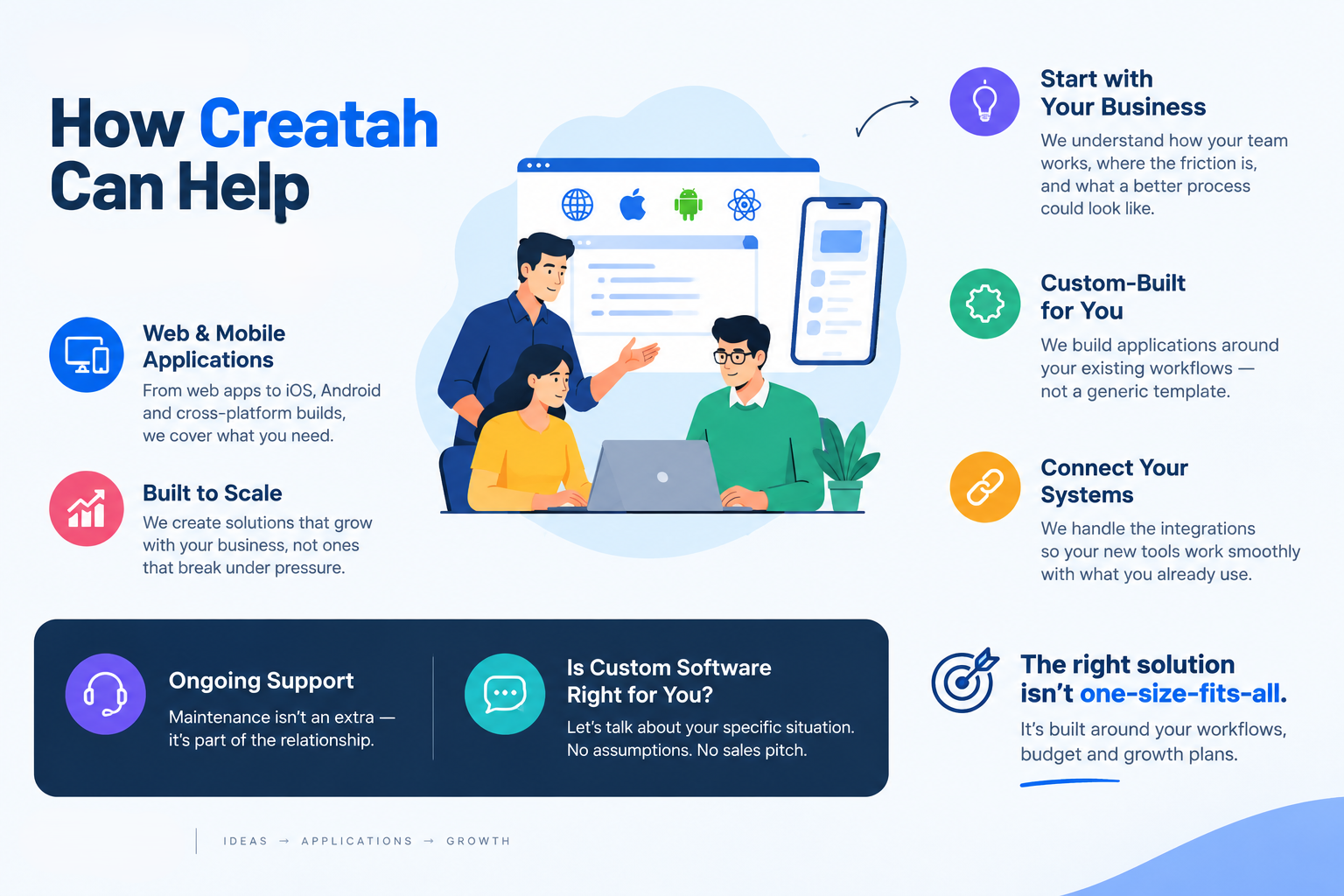
Creatah works with growing businesses on custom software development, including web applications and mobile applications for iOS, Android, and cross-platform builds. The starting point is always understanding the actual business problem first: how a team currently works, where the friction really is, and what a genuinely better version of that process would look like before anyone gets into technical decisions.
In practice, that means building custom applications around a client’s existing workflows rather than trying to force a generic template to fit, alongside the software integration needed to connect new systems with whatever a business already relies on. The goal throughout is scalable business solutions that still hold up as the business grows, not something that looks great on day one and starts straining by year two. We continue to support clients after launch, treating ongoing maintenance as part of the relationship rather than an optional extra tacked on at the end.
If you’re weighing whether custom software fits your business goals, have a direct conversation about your situation instead of assuming.
Custom software isn’t the right choice for every business, but for one that has outgrown generic tools or is losing time to workarounds and disconnected systems, it can solve problems that off-the-shelf software simply can’t handle. The right approach really depends on your specific workflows, budget, and growth plans, which is exactly why the process should start with understanding your business, not with a sales pitch dressed up as a discovery call.
Whether you’re exploring custom software development in Chennai for the first time, the basics remain the same. If you compare a development company with your current solution, the fundamentals stay the same. The fundamentals are clear requirements, an experienced team, honest pricing, and genuine support once the software is live.
Looking for custom software development in Chennai that fits your business rather than the other way around?
Talk to Creatah about the problem. Identify what you are actually trying to solve. Together, explore what a software solution built around your real workflow could look like.
Contact Creatah today to begin.
