

Picture a small chain of clinics that wants patients to book appointments from their phones. Nothing unusual about that. Then the developer asks, “Android, iOS, or both?” and the conversation gets awkward. Both mean two builds and roughly double the cost. One means some patients get left out.
Plenty of app projects get stuck right there, and it’s a big reason React Native has become so common. If you’re searching for a React Native app development company in Chennai, this article covers what the framework does well, where it doesn’t, and what to ask before you sign with anyone.
What Is React Native App Development?
React Native is an open-source framework from Meta, the company behind Facebook and Instagram. Developers write in JavaScript, using React (the same library behind a huge number of websites), and end up with apps for both Android and iOS.
It also uses real native components. A button in your app is an actual platform button, not a lookalike, which is why these apps usually feel at home on whatever phone they run on.
For you as a business owner, the useful part is the shared codebase. Most of the app is written once and works on both platforms, so you don’t pay twice for the same login screen, checkout flow, or booking logic.
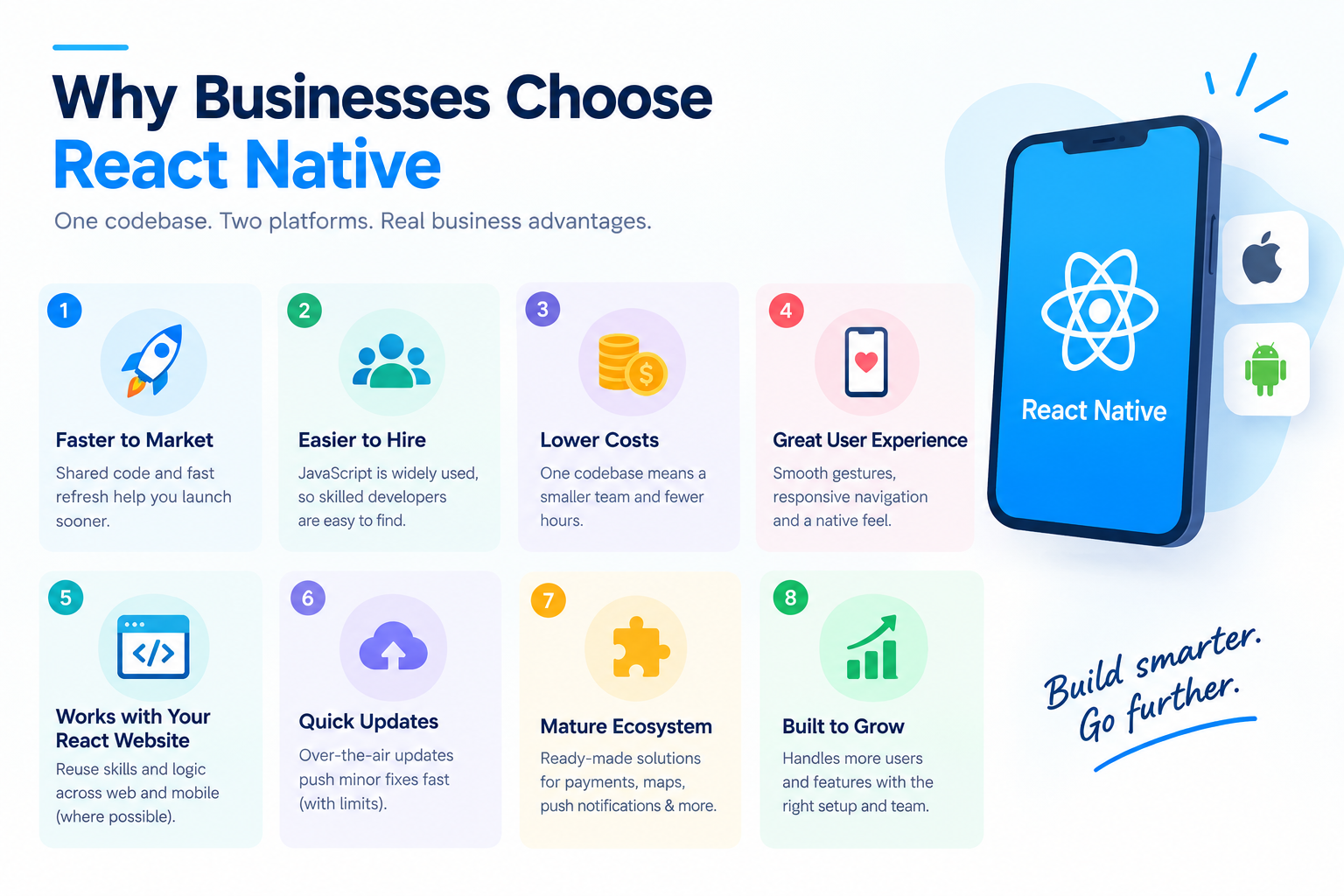
Why Businesses Are Choosing React Native
You reach the market sooner
Shared code means less repeated work. Developers also get “fast refresh,” which shows a change on screen almost immediately. A request like “make this button bigger” takes minutes instead of becoming a two-day detour. If you’re racing a competitor or aiming to be alive before the festive season, those weeks add up.
Developers are easier to find
JavaScript is among the most widely used languages, so there’s a large pool of people who know it. That helps when you need to add someone mid-project or when your original developer moves on. Hiring risk is a real headache for small businesses, and this softens it.
Costs tend to stay lower
One codebase usually means a smaller team and fewer hours. The saving continues after launch too, because each fix or feature is written once. How much you’ll actually save depends on the app. If anyone quotes you a neat percentage before seeing your requirements, treat it as a guess.
It feels right to users
Scrolling, gestures, and navigation behave the way people expect on their own phones. Nobody compliments good UX, but everybody notices bad UX.
Your React website can share some of the load
If your website already runs on React, your team can often reuse skills and some logic on the mobile side. It isn’t copy-and-paste, but it can save real effort.
Small fixes can go out quickly
For changes in the JavaScript layer, over-the-air update tools let teams push a fix without waiting for a full app store review. There are limits, and the stores still have their rules, but it’s handy when something minor breaks.
The ecosystem is mature
React Native has been around for years. Payments, maps, push notifications, and logins all have well-tested solutions, so your team isn’t building everything from scratch.
It can grow with you
It isn’t only for prototypes. A well-structured app with a solid backend can handle more users and features over time. How well it’s structured depends far more on the team than on the framework.
React Native vs. Traditional Native Development
Native development means building a separate app for each platform with its own tools, usually Kotlin or Java for Android and Swift for iOS. It’s a proven route, and sometimes it’s the right one. A quick comparison:
| React Native | Native (Android + iOS) | |
| Development time | Usually shorter, thanks to shared code | Longer, since two apps are built |
| Maintenance | One main codebase | Two codebases |
| Team | One JavaScript-focused team can cover both. | Separate Android and iOS specialists |
| Overall cost | Often lower to build and maintain | Often higher |
| Platform-specific features | Available, sometimes through custom native modules | Direct access, including brand-new OS features |
| Peak performance | Strong for most apps | Best for the most demanding use cases |
Go native if your app leans heavily on advanced hardware or the very latest OS features. The same goes for graphics-heavy products like high-end 3D games and for businesses that already have a mature native app and a team that knows it well.
For most business apps, such as storefronts, service platforms, dashboards, and customer portals, React Native strikes a sensible balance. If your project belongs in the native camp, a good development partner will say so, even if it means a smaller job for them.
When Should a Business Choose React Native?
Think about your situation first and the technology second. React Native tends to work well in these cases:
- You’re a startup watching every rupee and every week. Reaching both platforms without doubling the spend is a big deal.
- You’re building an MVP. The aim is to put something real in front of users, learn from it, and improve. Speed matters more than polish at this stage.
- You run an online store. Catalogues, carts, payments, and order tracking look and work the same on both platforms, so there’s no point building them twice.
- You need bookings or appointments for clinics, salons, travel, or events. The logic is shared, which suits a single codebase.
- You offer on-demand services, like delivery or home repairs. These apps change often, and updating one codebase is easier than updating two.
- You already have a React website. Your team’s skills can carry over.
- You need internal tools for sales, inventory, or field staff. They have to work on whatever phones your people already own.
How a React Native App Development Company Can Help
Choosing the framework is only half the job. The team you hire decides how the project actually goes, so here’s what a capable partner should cover, roughly in order.
It starts with understanding your business. A good team asks about your users, goals, and limits before anyone mentions a price. If the first thing you receive is a quote, be a little cautious.
Next is UI/UX planning. Wireframes and clickable prototypes let you see and approve the experience early, when changes cost almost nothing. Changing a sketch is easy. Changing a finished app is not.
Then comes app architecture, the structure under the hood. Users never see it, but it decides how smoothly the app grows. You usually only notice it when it’s been done badly.
After that comes development, meaning clean, readable code that another developer could pick up later without guesswork. It goes hand in hand with API and backend integration: databases, payment gateways, CRMs, third-party tools. A lot of hidden complexity lives here.
Then there’s testing on real devices and different screen sizes, so your customers aren’t the ones who find the bugs, followed by deployment. Google Play and the App Store each have their own guidelines, and experienced teams know how to avoid preventable rejections.
Last is post-launch support. Operating systems update, libraries age, and users ask for new features. Bring it up before you sign, not after launch.
One practical tip: ask to see past work, and notice how clearly they explain things in the first few conversations. A team that’s easy to understand before you’ve hired them usually stays that way.
Why Choose a React Native App Development Company in Chennai?
You can hire a team anywhere, so why stay local? A few reasons come up again and again.
Communication is simpler. You share a time zone and working hours, and nobody waits overnight for a reply. A quick doubt gets cleared with a phone call instead of a long email thread.
Local context also counts. A Chennai-based team understands how customers here behave and what they expect, from UPI and local payment gateways to regional language support.
Some conversations simply go better in person, like requirement workshops and demos. And after launch, you’ll want people nearby who can respond quickly when something needs attention.
Creatah is a Chennai-based agency that offers mobile app development alongside web development and digital marketing. If you’d like one team to handle both the build and the launch, that can make coordination simpler. Whoever you choose, look for people who listen, are upfront about costs and timelines, and treat your app as something that will keep evolving.
Frequently Asked Questions
What is React Native used for?
It’s used to build mobile apps for Android and iOS from a largely shared codebase. Businesses use it for e-commerce, booking, on-demand services, community apps, and internal tools.
Is React Native good for business apps?
For most of them, yes. It offers a native feel, a mature ecosystem, and room to scale. Still, walk a developer through your key features before deciding, because every project has its quirks.
Is React Native suitable for startups?
Yes, it’s a popular choice. A shared codebase and a big pool of JavaScript developers help you launch sooner and keep early costs under control.
Is React Native cheaper than native app development?
Often, since most of the code is shared and upkeep is simpler. But cost depends on complexity, design, and integrations, so savings vary from project to project.
Can React Native build both Android and iOS apps?
Yes. One codebase can produce both, and developers can add platform-specific code wherever a feature needs it.
How long does React Native app development take?
A simple app might take a few weeks. A larger one with custom design, backend integration, and several user roles can take a few months. Clear requirements and early design approval do more to keep a project on schedule than anything else.
How do I choose a React Native app development company in Chennai?
Check their portfolio and client feedback, then ask how they plan, test, and support apps after launch. Notice how clearly they communicate and whether they’re honest about cost and timelines. A trustworthy team will also tell you if React Native isn’t the right fit.
React Native has earned its reputation by dealing with what businesses worry about most: speed, cost, user experience, and room to grow. One shared codebase shortens timelines, simplifies upkeep, and puts your app in front of Android and iOS users together. It won’t suit every project, but for startups, MVPs, e-commerce, booking, on-demand, and internal apps, it’s a practical and proven choice.
Still, a framework is only as good as the people using it. Working with a React Native app development company in Chennai means easier conversations, a better feel for local needs, and support close at hand. Creatah provides mobile app development solutions for businesses that want a clear, collaborative path from idea to launch.
Looking for a reliable React Native app development company in Chennai?
Contact Creatah to discuss your mobile app development requirements.
