

There’s a conversation that comes up in almost every app planning meeting, sooner or later: “Are we building for iPhone, Android, or both?”
Most businesses want to say “both,” because customers don’t sort themselves neatly by platform. But building two separate apps usually means two codebases, two sets of testing, and two teams to manage or one team stretched thin trying to do both properly. For a startup watching its runway, or a business that just needs this shipped without hiring an entire department, that math rarely adds up.
This is more or less the exact problem Flutter was built to solve. You write the app once, and it runs on both iOS and Android, behaving the way people expect on each. It’s not a shortcut dressed up as a solution. For a lot of businesses, it’s genuinely just the more sensible way to build.
This piece walks through what Flutter app development actually looks like in practice, where it saves money, where it doesn’t quite fit, and what to look for if you’re hiring someone to build it for you.
What Flutter App Development Actually Means
Flutter is Google’s framework for building apps from one codebase that run across multiple platforms. A team writes the app once, and that same code powers both the iOS and Android versions, sharing the same logic and layout underneath.
Compare that to traditional native app development, where the iOS app is written in Swift and the Android app in Kotlin, two separate projects that just happen to serve the same business. Native still has its place (more on that later), but for most standard business apps, maintaining two full codebases side by side is a lot of extra weight for not much extra benefit.
Cross-platform app development, Flutter in particular, exists to take that weight off businesses without asking them to give up much on quality.
Where the Cost Savings Actually Come From
A lot of people hear “Flutter is cheaper” and picture a lower quote, nothing more. The real savings are a bit more specific than that.
One codebase instead of two means you’re not paying two teams to essentially rebuild the same app twice. Testing gets faster too; a bug fixed once applies to both platforms instead of being chased down separately in two different languages. Maintenance follows the same pattern: updates and fixes get built once and pushed everywhere, rather than duplicated. And in practice, a Flutter team can often deliver what would otherwise take two separate native teams to pull off.
None of that makes Flutter a “budget option.” It just removes a lot of duplicated work that businesses used to pay for without getting much extra in return.
Getting to Market Faster
Speed matters more than most founders expect going in, especially for startups trying to validate an idea before the runway runs out or a business trying to beat a competitor to a feature.
Because Flutter app developers build one codebase serving both platforms, there’s no waiting around for a second team to catch up, and no quietly launching on Android three months after iOS because the budget ran thin by then. Both versions usually go live together.
Take a retail business launching a loyalty app before a festive season; there’s no room for a staggered rollout there. Getting iOS and Android out at the same time is often the entire point of the exercise.
Keeping the Experience Consistent Across Devices
People switch phones more than businesses tend to notice. Someone using an iPhone this year might’ve been on Android last year, and they still expect the app to behave the way it always did.
Flutter is built around widgets that render consistently, so checkout, navigation, and core features work the same way regardless of platform. Customers don’t have to relearn your app just because they switched devices, and support teams don’t end up fielding two different sets of “why does it work differently on my phone” complaints.
Built to Grow With the Business, Not Just Launch Day
A question we hear fairly often: can Flutter actually keep up once a business starts scaling? Fair thing to ask. The honest answer is mostly yes as long as the app was architected properly from the start, not rushed out just to hit a launch date.
A well-built Flutter app can absorb a growing user base without needing a rebuild, take on new features layered onto what’s already there, connect cleanly with backend systems and third-party APIs, and hold its performance steady as things get more complex.
Where we’ve seen Flutter apps run into scaling trouble, it’s almost always traced back to a rushed initial build, not any real ceiling in the technology itself.
Simpler Maintenance, in Practice
Maintaining two native apps means every bug fix, every iOS compatibility check, and every small feature gets built and tested twice over. It doesn’t feel like much in any single sprint, but it adds up fast across months and years.
With Flutter app development services, most of that work happens once. A fix goes out to both platforms together, and there’s a single codebase for the team to genuinely understand well, instead of splitting attention across two.
For businesses without a large in-house dev team, this is often the difference that actually decides things.
Where This Shows Up in Engagement and Revenue
None of this matters much if it doesn’t translate into something a business actually feels, so here’s where it tends to show up.
Faster feature rollouts mean customers see improvements more often, which keeps an app from feeling stale. A consistent experience across devices cuts down the friction that causes people to quietly delete an app and never come back. Lower maintenance costs free up budget for marketing or support instead of getting eaten by upkeep. And getting to market sooner means catching customer interest before a competitor does.
A diagnostic center rolling out an appointment-booking app, for instance, benefits from having both iOS and Android versions ready at once; nobody wants Android patients waiting weeks longer than iPhone patients for the same feature.
When Flutter Is the Right Call — and When It Isn’t
Flutter works well for most standard business apps: e-commerce, booking systems, service apps, internal tools, content platforms, and the vast majority of startup MVPs. If your app doesn’t lean heavily on device-specific hardware, Flutter will likely serve you well.
There are cases where native development still makes more sense, though. Apps that need to use brand-new, platform-specific features the moment Apple or Google releases them. Extremely performance-heavy apps, like high-end games with complex 3D rendering. Or apps that need immediate, deep integration with OS-level capabilities before cross-platform tooling has caught up.
Outside of those specific cases, and most businesses aren’t in them, custom Flutter app development offers a practical balance of cost, speed, and quality that’s genuinely hard to match.
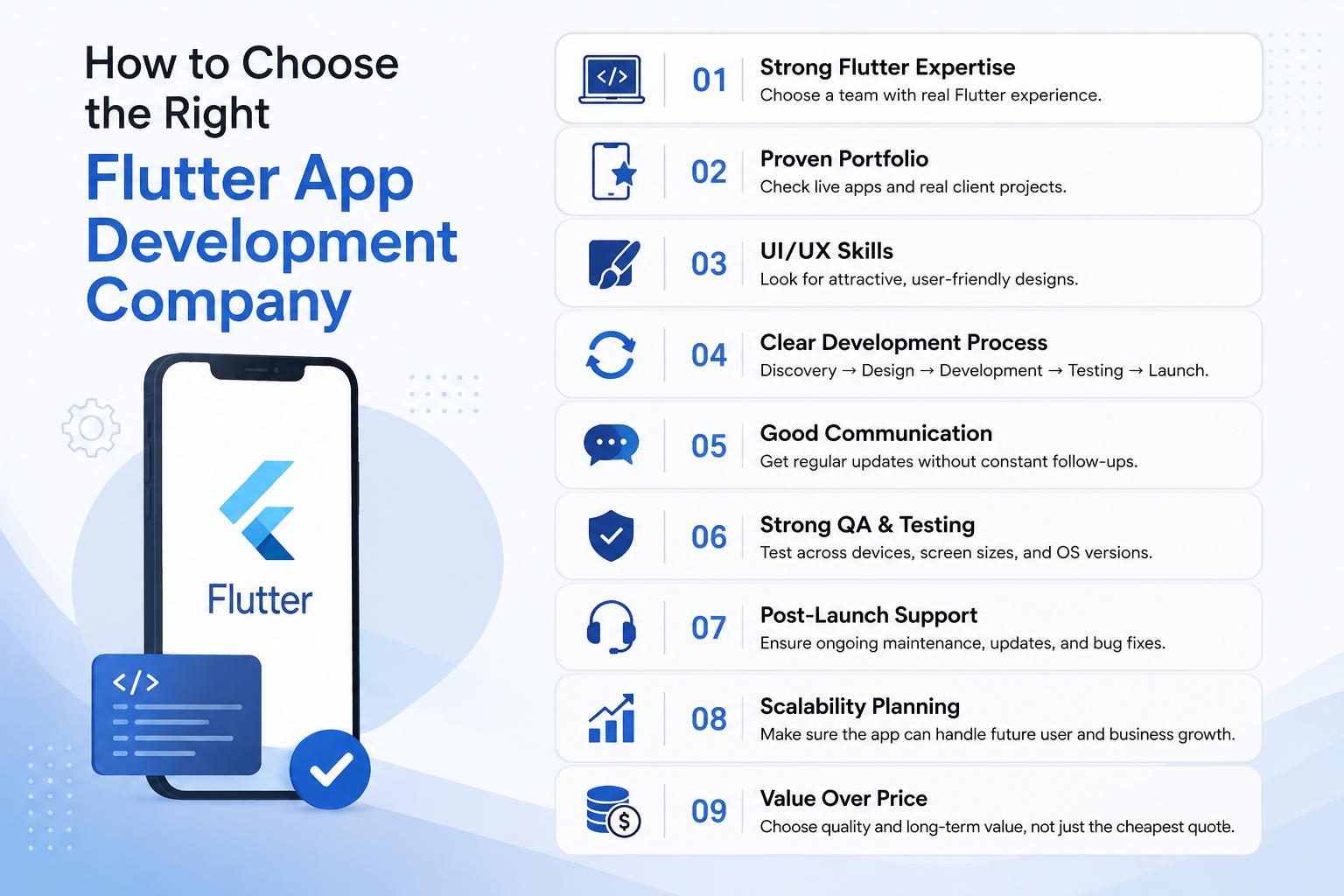
How to Choose the Right Flutter App Development Company
Picking the right partner matters more than picking the right technology. Here’s what’s actually worth checking before you commit.
Technical expertise that goes beyond the basics
Ask how long the team has actually worked with Flutter specifically, not just mobile app development in general. Flutter has its own patterns and its own pitfalls, and that specific experience matters.
A portfolio with real, working apps
Look past the case study slides. Download an app they’ve shipped if you can; it tells you more in five minutes than a pitch deck will in an hour.
Genuine UI/UX capability
Flutter can produce excellent interfaces, but only when the team behind it actually understands design, not just code. Ask to see how they’ve handled platform-specific design details.
A process you can actually follow
A good Flutter app development company should walk you through discovery, design, build, testing, and launch without hiding behind vague answers or jargon.
Communication you don’t have to chase
You should know roughly where your project stands at any point, without sending three follow-up emails to find out.
Real testing and QA practices
Ask specifically how they test across devices and OS versions. This is exactly where quality problems either get caught early or missed until customers find them.
Support that doesn’t stop at launch
An app needs attention after it ships OS updates, bug fixes, and new feature requests. Confirm this is part of the plan from day one, not something you negotiate later under pressure.
Scalability considered from the start
Ask how they’d approach the build differently if your user base grew tenfold. The answer tells you a lot about how far ahead they’re actually thinking.
Building for both iOS and Android used to mean choosing between double the cost or a slower, staggered rollout. Flutter app development has largely changed that equation, without asking businesses to give up much on quality or user experience along the way.
Whether you’re a startup trying to launch before the budget runs thin or an established business trying to modernize without doubling development overhead, it’s worth having an honest conversation about whether Flutter actually fits what you’re trying to do.
If you’ve got a mobile app idea taking shape or already have requirements in mind and want to talk it through with a team that’s built with Flutter before, we’d be glad to hear about it.
Need expert help with Flutter app development?
Reach out to Creatah and let’s build your online success story together.
