
A Chennai-based logistics company came to us last year with a problem we hear more often than you’d think. Their delivery agents were juggling three different apps that didn’t talk to each other, and none of them worked properly on an iPhone. Complaints were piling up, and nobody on the team could say exactly why.
That’s usually the moment business owners stop treating iPhone app development as a “someday” project. Not because it’s fashionable, but because their customers already carry iPhones in their pockets, and a clunky app quietly costs revenue and reputation with every bad review.
It’s also why so many founders and CTOs end up searching for a top iOS app development company in Chennai instead of trying to build this in-house. The city has built up a genuinely strong developer base over the last decade, helped along by a mature IT ecosystem and a steady stream of talent from local engineering colleges. Finding the right team, though, still takes more than a quick Google search.
An iPhone app is not just a smaller version of your website. It needs its own design thinking, its own performance considerations, and a development partner who understands both the technical and business side of the decision. This article walks through what actually separates strong iOS development teams from average ones, what technologies power modern iPhone apps, and how to choose a partner who won’t disappear after launch day.
Whether you’re a startup building your first app or an enterprise modernizing an old one, the goal is the same: build something your customers actually want to open every day.
Why Businesses Still Choose iOS Apps
Android has a bigger user base globally. Yet plenty of businesses still prioritize iOS first, and there are solid reasons behind that decision.
Higher revenue potential. iPhone users consistently spend more on apps, in-app purchases, and subscriptions compared to users on other platforms. For businesses running a paid app or subscription model, this difference shows up directly in monthly revenue.
A premium customer base. iPhone ownership tends to skew toward users with higher disposable income. If your product targets professionals, healthcare consumers, or premium retail buyers, your audience is very likely already on iOS.
Better security by design. Apple’s tighter control over its hardware and software stack means fewer fragmentation issues and stronger baseline security. For finance, healthcare, and enterprise apps, this matters more than most founders initially realize.
A strong App Store ecosystem. Apple’s review process is stricter, but that strictness builds user trust. Customers generally expect apps on the App Store to be safer and better maintained.
Brand credibility. Having a well-built iPhone app still signals a certain level of maturity to customers, investors, and partners. It’s a small detail that quietly builds trust.
None of this means Android should be ignored. It simply explains why iOS app development services remain a priority for businesses that want quality users and dependable revenue from day one.
What Makes a Top iOS App Development Company in Chennai Different?
Anyone can write Swift code. Building an app that businesses can actually rely on for years takes something more, and this is usually where the gap between an average freelancer and a proper team starts to show.
Business-first thinking. The best iOS developers ask about your business model before they ask about your app’s color scheme. They want to understand what problem the app solves and how it fits into your revenue plan.
Genuine UI/UX expertise. iPhone users have high expectations for how an app should feel. A skilled team designs around Apple’s Human Interface Guidelines instead of forcing a generic layout onto iOS.
Deep Swift and SwiftUI knowledge. Swift has matured into a fast, safe, and expressive language. Developers who understand its newer patterns, especially SwiftUI, can build interfaces faster without sacrificing performance.
Clean, scalable architecture. A rushed MVP built without proper architecture becomes a maintenance headache within a year. Experienced teams structure code so new features can be added without rewriting everything.
Strong API integration skills. Most modern apps depend on multiple backend services, payment gateways, and third-party tools. Developers need to integrate these cleanly without creating a fragile system.
Performance optimization. Battery drain, slow load times, and laggy animations are the fastest way to lose users. Top developers test and tune performance as a core part of the process, not an afterthought.
Security-first development. From data encryption to secure authentication, this needs to be built in from the start, especially for apps handling payments or personal information.
App Store submission expertise. Apple’s review guidelines change often. Teams that submit apps regularly know how to avoid common rejection reasons and get through review faster.
Technologies Used for Modern iPhone Apps
The tools behind an iPhone app matter more than most non-technical founders realize, because they directly affect how the app performs and how easily it can grow.
- Swift remains Apple’s primary language for iOS application development, valued for its speed and safety.
- SwiftUI has become the standard for building modern, declarative interfaces with less code and faster iteration.
- Xcode is Apple’s development environment, used for building, testing, and debugging apps before submission.
- UIKit still powers many existing apps and remains relevant for certain complex interface needs.
- Core Data handles local data storage, useful for apps that need offline access.
- Firebase is widely used for real-time databases, authentication, and push notifications.
- REST APIs connect the app to backend servers and third-party services.
- GraphQL is gaining traction for apps that need more efficient, flexible data fetching.
- AI integrations are increasingly built into apps for recommendations, chat support, and personalization.
- Apple Pay simplifies checkout for e-commerce and subscription-based apps.
- CloudKit allows seamless data sync across a user’s Apple devices.
A capable iOS app development company doesn’t just know these tools individually. They know which combination fits your specific product and budget.
Industries Benefiting from iOS Development
Custom iOS app development isn’t limited to consumer apps anymore. Businesses across nearly every sector are investing in iPhone applications.
- Healthcare patient portals, appointment booking, and telemedicine apps
- Finance secure banking, investment tracking, and payment apps
- Logistics delivery tracking, fleet management, and route optimization
- Manufacturing inventory management and equipment monitoring tools
- Retail mobile commerce, loyalty programs, and in-store experiences
- Real Estate property listings, virtual tours, and client management
- Education learning platforms, student portals, and course delivery
- Travel booking apps, itinerary planning, and travel assistance
- Food Delivery ordering, tracking, and restaurant management apps
- SaaS companion apps that extend web platforms to mobile users
Each of these industries has different compliance, security, and performance needs. A team offering enterprise iOS app development should be able to adapt to these differences rather than applying the same template everywhere.
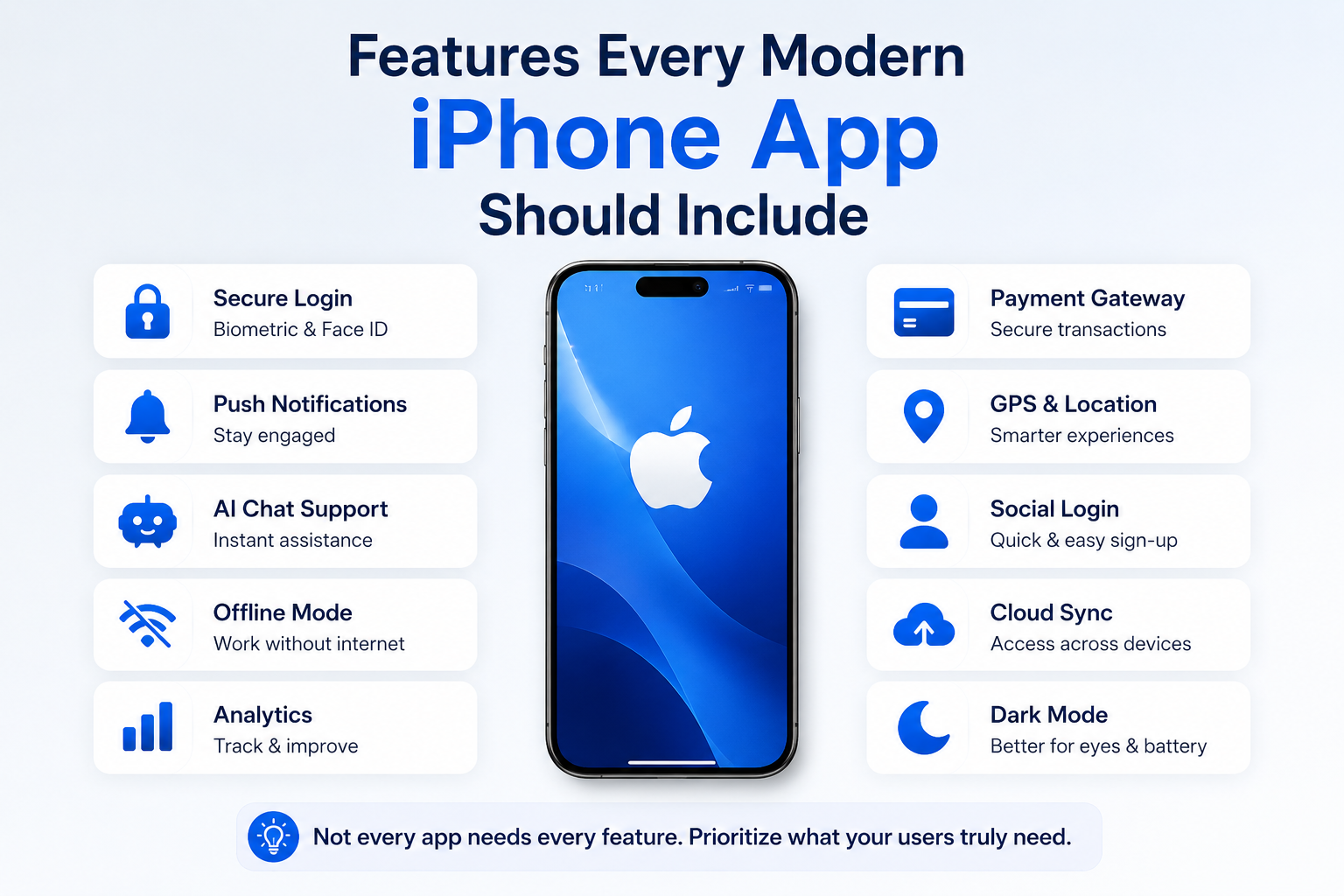
Features Every Modern iPhone App Should Include
Some features have moved from “nice to have” to genuinely expected by users.
- Secure login, including biometric options like Face ID
- Push notifications to keep users engaged without being intrusive
- AI chat support for faster customer service
- Offline mode for uninterrupted use without a stable connection
- Analytics to track usage patterns and guide future updates
- Payment gateway integration for smooth, secure transactions
- GPS and location services for delivery, travel, and retail apps
- Social login to reduce signup friction
- Cloud sync so users can pick up where they left off on any device
- Dark mode for better usability and battery life
Not every app needs every feature on this list. A good development partner will help you prioritize based on what your users actually need first.
Why Chennai Has Become a Hub for iOS Development
Chennai’s rise as a mobile app development hub didn’t happen overnight, but the reasons behind it are fairly clear.
A steady pipeline of skilled developers. Local engineering colleges and IT training centers produce a strong supply of developers familiar with Swift, SwiftUI, and modern app architecture.
Cost-effective development without cutting corners. Businesses can hire experienced iOS developers in Chennai at rates that are noticeably lower than in Western markets, without compromising on code quality.
A growing startup ecosystem. Chennai’s startup scene has pushed local development companies to move faster and think more like product partners than vendors.
Solid IT infrastructure. From co-working spaces to reliable connectivity, the city supports remote collaboration well, which matters for clients working across time zones.
Real experience with global clients. Many Chennai-based teams have already delivered projects for clients in the US, UK, Middle East, and Southeast Asia, so they’re used to different working styles and expectations.
This combination is exactly why “hire iOS developers in Chennai” has become such a common search among founders outside India, not just locally.
Common Mistakes Businesses Make While Hiring Developers
Before choosing a development partner, it helps to know where things usually go wrong.
Choosing based on price alone. The cheapest quote often means shortcuts in testing, architecture, or design, and those shortcuts cost more to fix later.
Ignoring the portfolio. A flashy website doesn’t guarantee real experience. Ask to see actual apps they’ve built, ideally in your industry.
No maintenance plan. Apps need updates for new iOS versions, security patches, and bug fixes. Skipping this conversation upfront leads to problems later.
Weak communication. If a team is hard to reach during the sales process, that pattern usually continues after the contract is signed.
No post-launch support. Launching the app is only the beginning. Businesses need a partner who sticks around for updates, scaling, and troubleshooting.
Poor testing practices. Apps that skip proper QA often ship with bugs that surface only after real users start using them.
How to Choose the Right iOS App Development Company
Signs You’ve Found a Top iOS App Development Company in Chennai
Here’s a practical checklist to run through before signing any contract:
- Review their portfolio for apps similar to your industry or use case.
- Ask about their design process and how much attention they give to UI/UX.
- Check their technical stack: Swift, SwiftUI, and modern architecture should be standard, not an add-on.
- Ask how they handle App Store submission and past rejection rates.
- Confirm post-launch support terms in writing before signing anything.
- Look for transparent pricing with a clear breakdown of costs.
- Read client reviews or ask for references you can actually contact.
- Evaluate their communication style during the first few conversations.
- Talk to their team directly, not just a sales representative, to gauge technical depth.
If a company checks most of these boxes, you’re likely looking at one of the better iOS application development teams in the market, not just a low-cost vendor.
Why Businesses Choose Creatah
We’re not going to claim Creatah is the only decent iOS app development company in Chennai; there are good teams doing solid work across this city. But a few things keep bringing clients back to us for a second or third project.
Our developers actually sit with the business model before touching a line of code. That one conversation, more often than not, saves clients from paying for features nobody was going to use anyway.
We work in short, visible sprints, so clients see real builds early instead of waiting three months for one big unveiling. Updates come regularly, not as vague “we’re on track” messages every other Friday.
Our UI/UX team designs around how people actually use an iPhone, not around whatever template happened to load first. For a few larger clients, we’ve built enterprise iOS app development solutions that had to plug into existing internal systems, which is a very different animal from a standalone consumer app.
We stick around after launch, too. Scalable architecture and proper QA aren’t checkboxes on a proposal for us; they’re the reason a two-year-old app can still run without needing a rebuild.
If you’re weighing a top iOS app development company in Chennai against a few others, we’d rather earn that decision through a real conversation than a polished pitch deck.
Future Trends in iOS App Development (2026)
The pace of change in iOS app development hasn’t slowed down, and a few trends are worth watching closely this year.
AI-powered apps are becoming standard rather than a differentiator, with personalization and predictive features built into core functionality.
Apple Intelligence is opening new possibilities for on-device AI features that respect user privacy while still feeling smart.
Vision Pro compatibility is starting to matter for businesses in retail, real estate, and education looking at spatial computing early.
SwiftUI continues to evolve, making it faster to build polished interfaces with less custom code.
AR and VR features are moving beyond gaming into retail try-ons, real estate walkthroughs, and training tools.
Wearable integration, especially with Apple Watch, is expanding for health, fitness, and productivity apps.
IoT connectivity is growing as more businesses want their apps to control or monitor connected devices.
Privacy-first design isn’t optional anymore. Apple’s App Tracking Transparency rules have pushed developers to rethink data collection from the ground up.
Voice interfaces are quietly becoming a standard input method for hands-free interactions.
Predictive analytics are helping apps anticipate user needs instead of just reacting to them.
Businesses that plan for these trends now will have an easier time keeping their apps relevant over the next few years.
Building an iPhone app in 2026 isn’t really about having a presence on the App Store anymore. It’s about giving customers something reliable and secure on the one device they probably check fifty times a day.
Chennai has genuinely earned its spot as a serious location for iOS app development: skilled developers, reasonable costs, and real experience working across industries and time zones. But the city alone won’t get you results. The partner you pick will.
Whether you’re a startup testing your first idea or an enterprise dragging a legacy system into 2026, the fundamentals don’t really change: think business-first, build on solid architecture, communicate honestly, and stay around after launch instead of disappearing once the invoice is paid.
If you’re currently comparing a top iOS app development company in Chennai for your next project, it’s worth having one direct conversation before you decide anything.
Creatah has worked with businesses across healthcare, logistics, retail, and SaaS to build iPhone apps that hold up once real users get their hands on them.
If you’ve got an app idea or an old app that needs fixing, reach out to Creatah.
No pressure, just a straightforward conversation about what your business actually needs.
