

Most app projects don’t fail because the vision was bad. Honestly, they usually fail because the discipline to protect that vision, what to build first, what to leave out, and what genuinely needs custom engineering sitting behind it gets lost somewhere between the pitch meeting and the launch date. A good mobile app development company in Chennai earns its keep in exactly that gap: turning a founder’s outcome into something sequenced and build able, rather than a wish list that ships eighteen months late and half-finished.
A Vision Is a Starting Point, Not a Spec Sheet
Founders tend to describe their app idea as an outcome: “I want customers to trust the product before they buy,” or “I need my team to stop double-booking appointments,” and then hand that straight to a developer, expecting a full feature list to come back. Wrong order, if you ask me. The outcome should decide which three or four features get built first and which ones get deliberately parked for later.
Whatever single feature actually delivers on your outcome, that’s the one worth obsessing over. Everything else—loyalty programs, chat, financing, referral systems—taking your pick is usually just a distraction from finding out whether the core idea even works in the first place. A sharper development partner says so early. They don’t quietly agree to build everything at once and let the timeline quietly absorb the fallout later.
Let the Vision Pick the Technology, Not the Other Way Round
Once you actually know which feature matters, the technology conversation gets a lot simpler. Apps leaning heavily on camera work, AR, or tight hardware integration tend to perform better with built-in iOS app development in Chennai and Android app development in Chennai, tuned separately for each platform rather than squeezed through one shared code base.
For most other business apps, though booking systems, service platforms, and internal tools, that level of platform-specific performance was never really the bottleneck. Flutter app development in Chennai or React Native app development in Chennai covers both app stores from a single code base for a fraction of the time and cost. Most businesses don’t pick the “wrong” technology in some grand, obvious sense. They just never stop to ask which feature actually needs which technology before someone decides for them, usually by default.
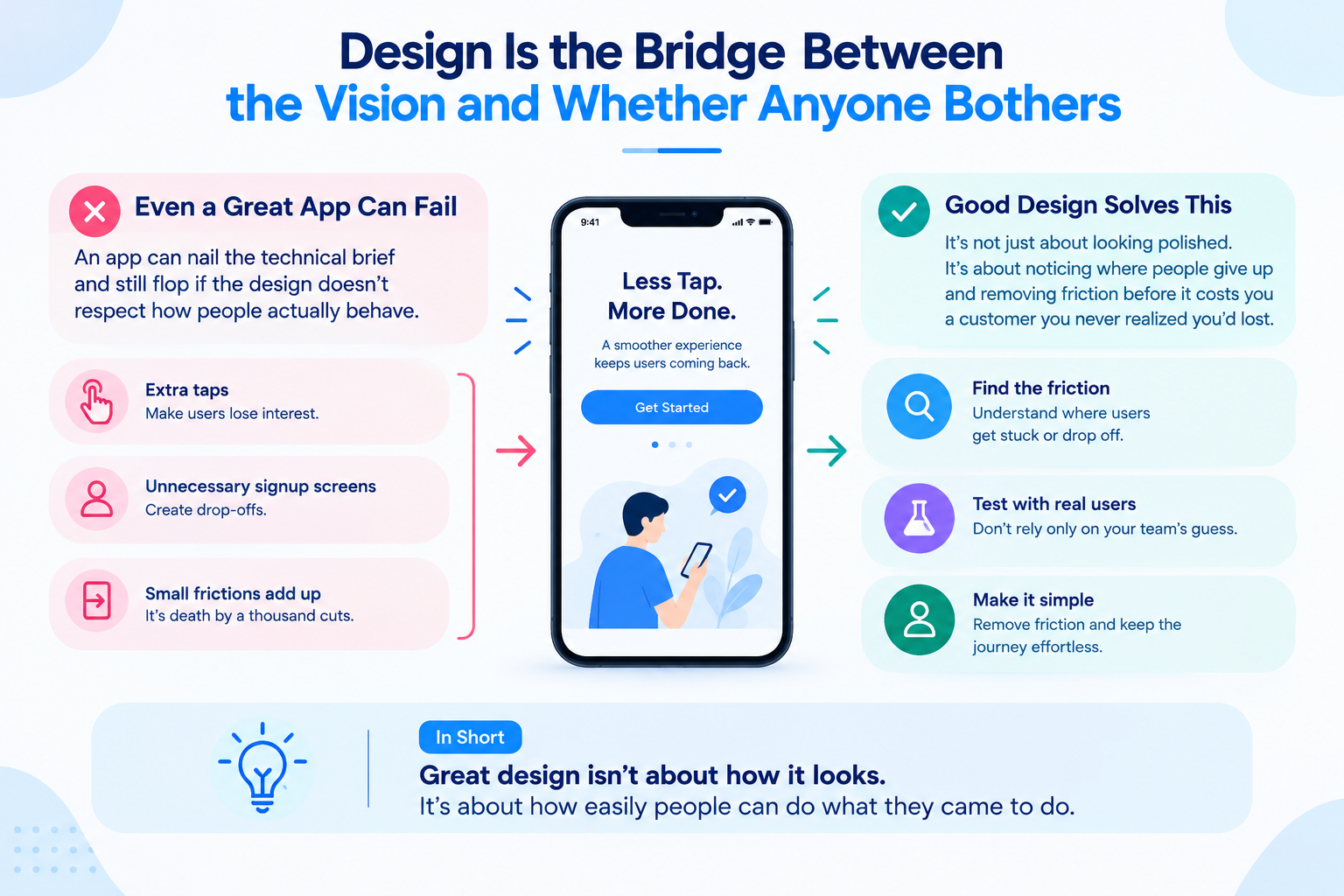
Design Is the Bridge Between the Vision and Whether Anyone Bothers
An app can nail the technical brief and still flop if the design doesn’t respect how people actually behave. Every extra tap, every unnecessary sign up screen sitting between a user and the thing they came to do, chips away at how many people actually bother finishing what they started. Death by a thousand small frictions, basically.
Good design isn’t really about looking polished. It’s about noticing exactly where people quietly give up and removing that friction before it costs you a customer you never even realized you’d lost. That takes real testing with real users before launch, not just a design team’s best guess at what feels intuitive from behind their own desk.
What’s Actually Sitting Behind the App
The part users see is maybe a third of the real engineering, if that. Behind it you need a backend that survives real traffic spikes rather than just the polite load of a demo, APIs that don’t buckle under concurrent use, and an admin panel often overlooked entirely that lets non-technical staff manage data without filing a support ticket every time something needs updating.
This is usually where things grow from “app developer” into a genuine custom software development company in Chennai territory, because the app and the systems propping it up really need to be designed together, not bolted on afterward as an afterthought. Businesses that only invest in the customer-facing app and treat the backend as a later problem tend to hit a wall fast right around the point where usage actually starts to matter.
Security Belongs in the Vision, Not Tacked On at the End
The moment an app touches payment details or anything personal, security stops being optional. Encrypted storage, properly secured APIs, and routine patching of dependencies—none of it makes for an exciting line on a pitch deck, but skipping it is exactly how a good idea turns into a bad headline down the line. Build it into the architecture from day one. Retrofitting it afterward is slower, pricier, and almost always only happens once something’s already gone wrong.
Testing Against How People Actually Use the Thing
Every app looks flawless, tested on a brand-new phone, on strong wifi, and by someone who already knows exactly what to tap next. Real users are messier older devices, patchy networks, and a fair bit of impatience. Testing across a real spread of devices and conditions is tedious; there’s no getting around that part, but it’s the entire difference between a feature that works beautifully in a boardroom demo and one that actually works for the person holding the phone on a bad connection.
Deciding Whether the Impact Was Even Real
“Impact” needs a number attached to it before launch, not after the fact, when you’re scrambling to justify the spend retroactively. Whatever your app is meant to change—conversion, engagement, or operational efficiency—pick the one metric that would actually prove it, and track it from week one. Downloads and star ratings tell you almost nothing about whether the thing worked. A repeat-usage rate or a conversion lift tells you everything that actually matters.
Finding a Partner Who Protects the Vision Instead of Watering It Down
The businesses that end up genuinely happy with their app tend to have picked a partner willing to say “not yet” to half the feature list, rather than one who agreed to everything upfront and let the budget and timeline quietly absorb the damage. Look for a company that asks what success actually looks like before it even quotes you a price. And one that’s still around, still involved, months after the app is live, not just during the sales call.
Frequently Asked Questions
How do I stop my app idea from growing out of control before launch?
Pin down the one outcome the app absolutely has to deliver, then cut anything that doesn’t serve it directly for version one. Everything else goes on a real list for later, not a vague “phase two” that quietly never gets funded.
Is native or cross-platform better for my app?
If the feature leans on camera, AR, or device-specific rendering, native usually performs better. For most other business use cases, Flutter or React Native get you to market faster without much of a real quality trade-off.
How do we know if our app is actually having an impact?
Pick one measurable behavior tied to the core outcome,—a conversion rate, a repeat-usage number, or a task completion time, and track it from day one. Downloads and star ratings won’t tell you much on their own, honestly.
What’s usually behind app projects running over budget and past deadline?
Scope creep, almost every single time piling on features before the core one’s even been validated with real users. Sequencing discipline saves more money than nearly any technical decision you’ll ever make.
Do we need custom software beyond just the app?
Very likely, once real usage kicks in. This is exactly where working with a custom software development company in Chennai pays off backend systems, admin tools, and integrations end up mattering just as much as the app people see, especially once you’re past the first few hundred users.
How involved should the development partner stay after launch?
Quite involved, honestly. Bug fixes, performance monitoring, OS updates, and adjusting based on real usage data—all of it is part of what turns a launched app into one that’s still making an impact a year later, instead of quietly fading.
The Vision Only Matters Once It’s Actually Working
A vision by itself doesn’t count for much. What makes it real is the sequencing of knowing what to build first, which technology genuinely serves that core feature, and what to measure to find out if any of it actually worked. That’s the discipline Creatah brings to the businesses we build for, working as both a mobile app development company in Chennai and a custom software development company in Chennai covering iOS, Android, Flutter, React Native, and whatever backend systems end up sitting quietly behind the app customers actually see.
Ready to turn your business idea into a powerful mobile app?
Contact us today and take the first step towards digital success with Creatah.
