

Most successful apps don’t start with a groundbreaking idea nobody has thought of before. They start with a business that knows its customers well and finds a simple way to make their day easier, on a screen they’re already checking fifty times a day. If you run a company that has outgrown spreadsheets and phone calls, this is where a good mobile app development company in Chennai earns its fee.
Why Growing Businesses Eventually Need an App
Every business hits a point where the old way of doing things starts to feel heavy. Customer engagement flattens. Your team spends more time coordinating than actually working. Competitors who went mobile early start winning customers, just because they’re easier to reach.
Customer Engagement That Actually Sticks
Email open rates have been sliding for years. Push notifications still get read, as long as you don’t send six a day. When someone installs your app, they’re telling you they want to hear from you, and that’s a different relationship from a stranger scrolling past your Instagram post. Appointment reminders, restock alerts, and personalized offers let you have a real conversation with customers, something a website can’t do.
Operations You Can Run From Your Pocket
If you manage more than one location, you know how much time goes into asking “how are things going there?” A well-built app, or the internal tools behind it, turns that call to the manager into a five-second look at your phone. People often overlook this side of app development, but it’s usually where the biggest return shows up.
Accessibility for Customers Who Live on Their Phones
Smartphone use in Chennai, like the rest of urban India, has reached the point where going mobile-first isn’t a choice anymore. Customers want to book, order, track, and pay without opening a laptop. Make them work harder than that, and they’ll quietly move to someone who doesn’t.
Before You Build Anything: Validating the Idea
A surprising number of businesses start development without checking whether anyone actually wants the app. Validation doesn’t have to be complicated:
- Talk to around twenty people who could be your users.
- Put up a simple landing page explaining what the app will do, and see how many people sign up for updates.
- Run the service manually first, even over WhatsApp or a spreadsheet, before you invest in automating it.
These conversations often change the first version of an app completely. What founders assume users want and what users actually need are rarely the same. Learning that early saves you months of building the wrong thing, however well you build it.
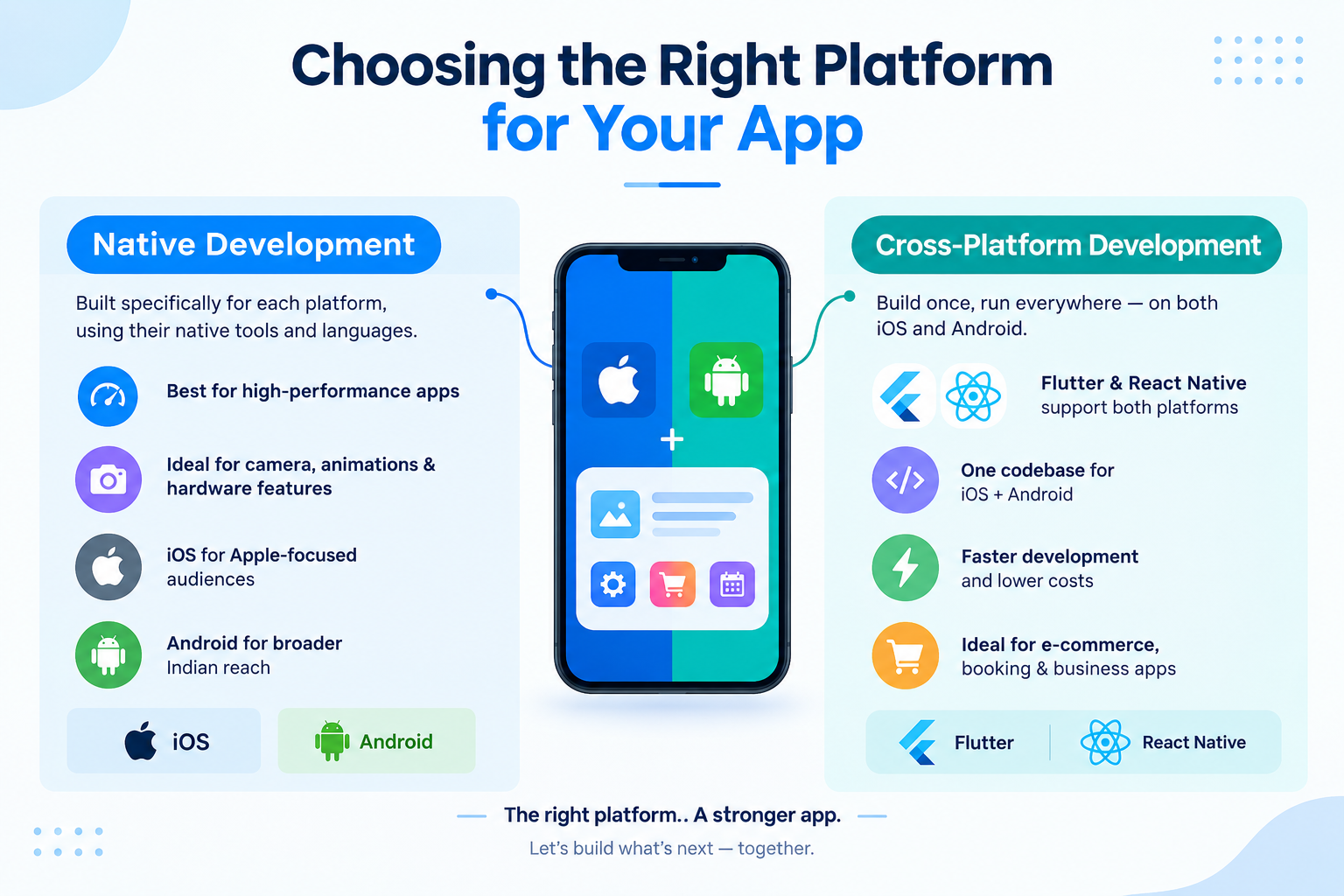
Choosing the Right Platform for Your App
This is usually the first big decision, and a good development partner should question your assumptions instead of nodding along to whatever you bring to the table.
Native iOS and Android Development
If your app relies heavily on device-specific features like camera scanning, complex animations, or deep hardware integration, native development usually performs best. iOS app development in Chennai makes sense when your audience leans towards iPhone users, which is more common in premium retail, hospitality, and B2B than most people expect. Android app development in Chennai is often the default choice, since Android holds the largest share of the Indian smartphone market.
Cross-Platform with Flutter and React Native
For most business apps, such as booking systems, e-commerce, service marketplaces, and internal tools, the performance gap between native and cross-platform is now small enough that paying double rarely makes sense. Flutter app development in Chennai and React Native app development in Chennai let you keep one code base that runs on both app stores. That helps a lot when you want to launch quickly on a limited budget.
How the Right Partner Helps You Decide
A company that recommends the same technology to every client is thinking about its own convenience, not your results. The right choice depends on your users, your timeline, your budget, and how you expect the app to grow over the next two years. It shouldn’t depend on whatever the agency’s developers happen to know best.
UI/UX Design: Where Users Decide If They Stay
An app can work flawlessly and still fail if people can’t figure it out in the first thirty seconds. Bad UX doesn’t throw up an error message. It shows up as high uninstall rates and users who open the app once and never come back.
Good design starts with what the user is trying to do, then removes every tap that stands in the way. The actions people use most should be easy to find, not hidden three menus deep. The best teams test their designs with real people before writing production code. Even five people spending fifteen minutes each with a prototype will show you things you’d never spot on your own.
The Technology Behind a Reliable App
What happens behind the screen matters as much as what users see. A strong foundation means a back end that can handle your real traffic, not just a smooth investor demo. It means APIs that are secure and well documented and a database that won’t need a painful rebuild when you add a second product line.
This is also where the conversation often goes beyond the app. A custom software development company in Chennai worth working with will tell you when your business needs more than an app. That could be inventory management connected to your point of sale or an admin dashboard that lets non-technical staff update content without raising a support ticket every time.
App Security: Not Optional, Especially Now
Many teams treat security as a box to tick, and that mistake gets costlier the longer it’s ignored. It matters even more when your app handles payments, health information, or personal data. A sound approach includes encrypted storage for sensitive fields, secure API authentication, regular updates to patch known vulnerabilities, and never storing passwords or payment details in plain text.
The level of responsibility also depends on your industry. An app handling health records or financial transactions carries far more risk than a purely informational one. Your development partner should bring this up early, not scramble to fix security after a close call.
Testing: Catching Problems Before Your Users Do
When deadlines get tight, testing is often the first thing to be squeezed. That’s the wrong way round. Proper testing means:
- Running the app on a range of devices and OS versions. Android fragmentation alone means two or three phones won’t cut it.
- Checking how it behaves on weak networks, since not everyone has a strong 4G signal.
- Walking through real user scenarios, not only the “happy path” a developer naturally follows while building.
Teams that skip this tend to hear about their bugs from one-star reviews instead of their QA team. That’s a far more expensive way to find out.
Maintenance and Growth After Launch
Launch day isn’t the finish line. It’s closer to the starting gun. Operating systems update, devices change, and user expectations move on. An app that isn’t looked after slowly gets worse: more crashes, slower performance, and eventually trouble on newer phones.
Ongoing maintenance covers bug fixes, OS compatibility updates, performance monitoring, and new features guided by what real usage data tells you. This is what separates a one-time vendor from a true technology partner, so ask about it before you sign anything, not six months after launch when something starts misbehaving.
Choosing the Right Mobile App Development Company in Chennai
By now you can probably see the pattern: the technical build is only part of what you’re paying for. The rest is judgment. It’s knowing when Flutter is a better fit than native, when an idea needs more validation before development starts, and when to tell a client, politely, that a request might not work as well as they think.
Ask to see apps the company has actually published on the App Store and Google Play, not just design mockups. Ask how they handle support after launch and what it costs. Ask how they’d approach your specific idea. A company that asks sharp questions before pitching a solution is usually more trustworthy than one that promises everything on the first call.
Frequently Asked Questions
How long does it take to build a mobile app?
A straightforward MVP with core features usually takes eight to twelve weeks. More complex apps with custom back-end systems, multiple integrations, or advanced features can take four to six months. Much of the timeline depends on how clearly your requirements are defined before development begins.
Should I choose native or cross-platform development?
It depends on your users, your budget, and how feature-heavy the app needs to be. Cross-platform frameworks like Flutter and React Native suit most business apps and cost less to build and maintain. Native development is worth the extra investment when performance or deep hardware access is central to what the app does.
How much does mobile app development cost in Chennai?
Costs vary widely depending on complexity, platform choice, and design scope. A simple MVP costs far less than a feature-rich app with custom backend infrastructure. A reliable partner will give you a realistic estimate once they understand your requirements, not a generic number upfront.
Do I need custom software in addition to a mobile app?
Often, yes. Many businesses need internal systems for inventory, staff management, and reporting that the customer-facing app doesn’t cover. Working with a company that also does custom software development helps here, because the app and the back end are built to work together from the start.
How is app security handled during development?
Through secure authentication, encrypted data storage, secure API design, and regular security audits and dependency updates. Security should be part of the architecture from day one, not something added just before launch.
What happens after the app is launched?
A good partner keeps monitoring performance, fixing bugs, updating the app for new OS versions, and helping you plan new features based on how people actually use it. Think of it as an ongoing relationship, not a one-off transaction.
Bringing the Idea Home
A business idea is only a starting point. What turns it into something customers rely on is the work behind it: the right platform choices, design that respects how people actually behave, security that protects their trust, and the discipline to test and maintain the product long after launch.
That’s the role Creatah plays for the businesses we work with. We don’t just write code. We act as a technology partner that understands where your business is headed and builds with that in mind, across iOS, Android, Flutter, React Native, and the custom software that often needs to sit behind the app.
Ready to turn your business idea into a powerful mobile app?
Contact us today and take the first step towards digital success with Creatah.
