

If you’ve ever looked at your own app’s numbers and noticed that a smaller slice of users is quietly driving most of the revenue, you already know something about iPhone customers that most businesses take years to figure out. They tend to be fewer in number but much more valuable; they spend more per order, stay longer, and rarely make a decision based on price alone.
That pattern repeats over and over across industries, and it’s exactly why working with the right iOS app development company in Chennai has become a deliberate business decision rather than a nice-to-have. In most categories, iPhone users aren’t just any slice of your audience; they’re the slice that spends the most and stays the longest. Building a genuinely good iOS experience for them isn’t a technical afterthought. It’s a growth lever, and it’s why so many businesses now look for iOS app development services in Chennai rather than settle for a generic cross-platform build.
In this article, we’ll discuss why that’s the case, how to tell a serious iOS development partner from a generic app shop, and what you should really look for before you put your budget on the line with one.
Why Should a Business Invest in iOS Apps?
The logic goes far deeper than “Apple users have money,” though that’s part of it.
Begin with the premium customer base. In most markets, owning an iPhone is associated with higher disposable income and a greater willingness to pay for quality. We talked to a food delivery platform that found their iOS users ordered premium menu items nearly twice as often as Android users, same restaurants, same features, totally different spending behavior. That naturally leads to revenue potential: in-app purchases, subscriptions, and premium features tend to convert better on iOS, often enough that product teams plan around it when scoping Apple app development work.
Security is a real thing, not just a marketing gimmick. Apple’s tightly controlled ecosystem and strict App Store review process offer a level of trust for businesses and customers alike that’s genuinely harder to replicate elsewhere, something that matters a great deal for anything handling payments or sensitive personal data. This tends to translate into more customer loyalty too. iPhone users are less likely to switch to a slightly cheaper alternative, so the lifetime value of an iOS customer often exceeds what the same feature set delivers elsewhere.
User experience is where Apple’s ecosystem really lives up to its reputation. The Human Interface Guidelines enforce a design discipline that makes apps feel instantly familiar, even if the user can’t say why. Performance benefits too, since Apple controls a narrow range of hardware optimizing for a handful of chipsets rather than thousands of Android configurations, giving developers room to fine-tune animations and load times in ways that show up immediately to the end user.
And global market reach is worth mentioning on its own. iPhones dominate in the US, the UK, Japan, and much of Western Europe, so any business with international aspirations sooner or later needs a credible iOS presence.
Why Chennai Has Emerged as a Hub for iOS App Development
Chennai didn’t become a serious iOS destination because someone thought it would be a good idea to market it that way. It happened because the fundamentals were already right.
Genuinely experienced iOS developers are here, not just in theory. Years of enterprise software delivery for global clients have produced iPhone app developers in Chennai who’ve shipped Swift and Objective-C codebases at real scale, backed by an IT ecosystem with decades of delivery experience and client-handling maturity that’s hard to shortcut.
The startup culture has matured alongside it too, moving past chasing trends into building for healthcare, fintech, and logistics industries where a wobbly iOS build has real-world consequences, not just an annoying bug report.
Affordability remains a genuine plus, and it isn’t about cutting corners. Costs here run substantially lower than in the US or UK, so startups can afford a proper native app rather than a rushed compromise once the budget runs thin. Many businesses compare a mobile app development company in Chennai’s iOS pricing against a wider cross-platform build before deciding which route makes sense. Sometimes an Android app development company in Chennai or a Flutter app development company in Chennai is the better starting point for an early MVP, where reaching both platforms quickly matters more than native polish.
Global delivery capability is rounded out by the time zone overlap with Europe and the Americas, which lets Chennai-based teams operate as genuine extensions of an international product team rather than an outsourced vendor working in isolation. And there’s a real innovation streak running through the better companies here, teams experimenting with ARKit, Core ML, and Apple’s newer frameworks well before clients specifically ask for them.
What Makes a Good iOS App Development Company in Chennai?
Plenty of teams can technically build an iPhone app. Very few create one that actually works the way Apple’s ecosystem expects it to.
Business understanding has to come first. A team that asks about your revenue model before talking about Swift versions is a team that will actually do the right thing. Technical chops matter too, especially in Swift and SwiftUI, Apple’s current and future-facing frameworks. If a team is still relying heavily on older Objective-C patterns for new projects, that’s a red flag, not a stylistic choice.
Real experience with Apple’s Human Interface Guidelines is what makes the difference between apps that feel native and apps that feel like an Android build wearing an iPhone costume. Users notice this even if they can’t explain why. On iOS, UI/UX isn’t optional the way it might be elsewhere Apple’s own review process and its users demand a level of polish a rushed template won’t deliver.
Agile development keeps the project honest, with sprints you can actually see instead of a single reveal three months in, when misalignment is costly to fix. Transparent communication tells you what working together will really feel like if a team is vague about timelines or costs during the sales conversation, that vagueness doesn’t improve once you’ve signed.
A security-first approach is non-negotiable for iOS, with Apple’s own privacy requirements getting more stringent every year. Ask specifically how a team handles data encryption, authentication, and app tracking transparency. App Store compliance deserves its own line item too, since Apple’s review process rejects a meaningful share of first-time submissions over guideline violations an experienced team would have caught beforehand.
And long-term maintenance completes the picture. iOS updates roll out annually and can break existing functionality overnight. A partner without a maintenance plan is setting you up for a scramble down the line.
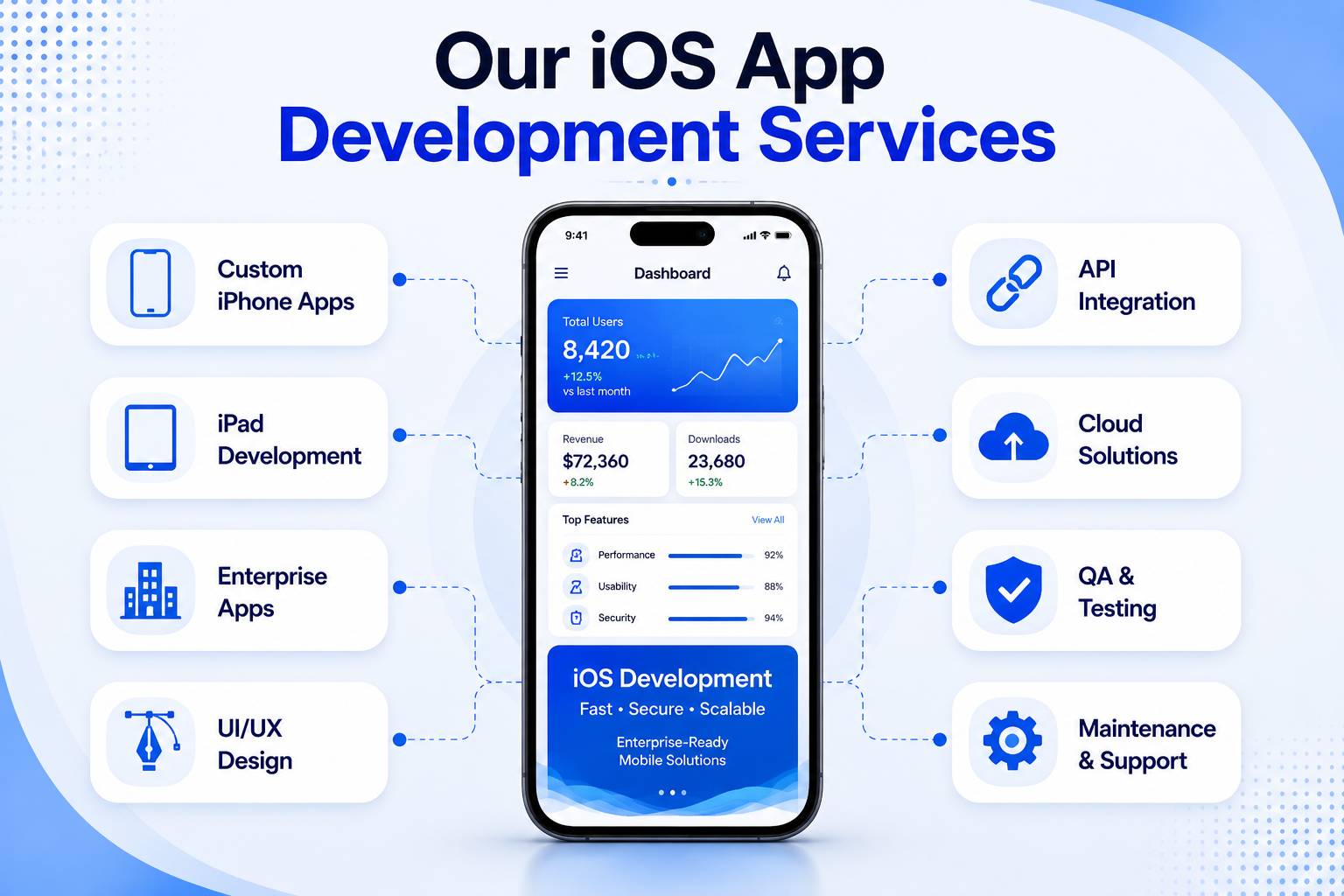
Our iOS App Development Services
A capable iOS App Development Company in Chennai, backed by skilled iPhone App Developers in Chennai, should offer the full range of services Apple’s ecosystem demands from a single iPhone build to full enterprise iOS app development for larger organizations:
- Custom iPhone App Development built around your specific business logic, not a generic template.
- iPad App Development layouts optimised for the larger screen, not just a stretched phone interface.
- Enterprise iOS App Development internal tools that don’t need to be app-store perfect, just stable and integrated with existing systems.
- Apple Watch Apps companion experiences for notifications, health tracking, or quick actions that extend your primary app.
- Apple TV Apps a smaller but growing category, especially relevant for media, fitness, and entertainment brands.
- UI/UX Design wireframes and prototypes designed around Apple’s style, tested before development starts.
- API Integration connecting your app to payment processors, CRMs, and third-party services your business already relies on.
- Cloud Integration architecture built on Firebase, AWS, or Azure depending on your scale and existing infrastructure.
- App Migration moving an app to another platform without losing user data or functionality.
- Legacy App Modernisation rebuilding old Objective-C apps in Swift before they break under new iOS requirements.
- App Testing QA across multiple device generations and iOS versions, not just the latest iPhone in a controlled office environment.
- Maintenance & Support ongoing updates, bug fixes, and compatibility work as Apple releases new OS versions.
Technologies Used in iOS Application Development
Behind good iOS application development are technology choices, and they’re not random; each one solves a particular problem.
Swift is Apple’s modern language and the backbone of nearly every serious Swift app development project today, valued for its speed and safety over older alternatives. SwiftUI, Apple’s declarative framework, is becoming the go-to way to build interfaces faster, while Objective-C still shows up in legacy codebases that a competent team needs to read even while building new work in Swift. Xcode is non-negotiable, since it’s the only officially supported way to build and submit iOS apps, and UIKit still has its place in complex enterprise builds that need more control than SwiftUI can offer. Core Data handles local persistence for apps that need to work reliably offline.
Firebase provides authentication and push notifications out of the box with little setup; Node.js and Laravel are popular choices for custom APIs, and AWS or Azure handle hosting for larger deployments depending on what systems a business already runs. REST APIs remain the standard for most apps talking to their backend, with GraphQL gaining traction for complex, nested data needs. AI and machine learning are showing up more in recommendation engines, Core ML runs trained models on-device for speed and privacy, ARKit delivers genuinely useful augmented reality features in retail and real estate, and CloudKit ties into Apple’s own cloud infrastructure for tight iCloud sync.
Industries Benefiting from iOS Apps
Use cases vary meaningfully by sector, and that’s where iOS mobile app solutions actually earn their value.
Healthcare apps handle secure patient records and teleconsultation, with HealthKit adding real value for tracking vitals. FinTech apps depend on iOS’s reputation for security in payments and lending; it’s often the first platform users trust with sensitive financial data. Retail and e-commerce apps take advantage of AR try-on features and Apple Pay checkout flows that measurably reduce cart abandonment, while logistics apps lean on real-time tracking, with iOS’s reliable background processing keeping location data accurate without draining battery life.
Education apps take advantage of iPad-specific layouts for the classroom, while manufacturing apps get deployed on the shop floor for inventory checks, prized for hardware reliability in demanding environments. Hospitality and travel apps often use Apple Wallet for digital room keys and boarding passes, and real estate apps rely on ARKit for property visualization that genuinely helps close deals. Food delivery apps depend on fast, seamless order tracking, and fitness apps use HealthKit and Apple Watch integration for a genuinely connected experience.
Why Custom iOS Apps Are Better Than Off-the-Shelf Products
| Factor | Custom iOS App | Generic/Template Solution |
| Performance | Tailored to your use case | Generic, often slower |
| Security | Designed for your data and compliance | Shared, one-size-fits-all |
| User Experience | Built for your users | Built from a template |
| Branding | Fully matches your brand identity | Limited customization options |
| Scalability | Built to grow with your business | Hits structural limits quickly |
| Long-term ROI | Strong is a real business asset | Weak ongoing vendor dependency |
| Maintenance | Dedicated support from your development partner | Dependent on third-party update cycles |
| Integration | Integrates seamlessly with your existing systems | Often limited or awkward integrations |
| Flexibility | Can change as your business changes | Limited by the template’s constraints |
A generic solution can get an idea off the ground quickly, but for a business planning to grow on iOS, custom iOS app development wins on everything that matters well past the initial launch date.
The iOS Application Development Process
While the specifics differ by project, a serious build follows a fairly consistent pattern.
Discovery comes first: understanding your business goals and what success actually looks like before any design work starts. Market research follows, looking at competitor apps and App Store trends. Wireframing turns ideas into a loose structural layout, and UI/UX design builds on that with Apple’s Human Interface Guidelines in mind, creating prototypes you can test before development begins.
Development is where Swift and SwiftUI code gets written against the approved designs and quality assurance tests across device models and network conditions, catching issues before Apple’s reviewers do. App Store submission, a critical part of any app store development project, means preparing metadata and privacy disclosures correctly the first time, since a rejected submission can cost days.
Launch is the visible milestone, but it’s really the beginning of the next phase. Ongoing maintenance keeps the app compatible with new iOS versions, and feature enhancements follow based on real usage data, keeping the app relevant well past its initial release.
Essential Features for Every Successful iOS App
Fast loading is a must. iOS users have little patience for lag, and slow apps get deleted quickly. Face ID or Touch ID enables a secure, frictionless login while keeping accounts safe, and push notifications, used judiciously rather than aggressively, help keep users engaged without making them want to turn off notifications entirely.
Offline mode matters more than most businesses think. Built-in analytics let you actually understand user behavior instead of guessing, and cloud sync keeps data consistent across a user’s devices without any manual effort. A well-integrated payment gateway that supports Apple Pay reduces friction at checkout, multi-language support broadens your addressable market, and accessibility features genuinely expand who can comfortably use your app. It’s the subtle, not showy, high-end UI animations that make an app feel premium rather than just functional.
Common Mistakes Businesses Make
The biggest mistake is often choosing the cheapest developer available, which usually comes back to bite you later in the form of rushed testing or weak security. Ignoring App Store guidelines results in rejected submissions and weeks lost. An experienced team spots these issues before Apple does. Poor UI design is a quick way to lose iOS users specifically, since they notice polish, or the lack of it, immediately.
Skipping proper testing means bugs surface in production instead of QA, often right after launch when first impressions matter most. Weak security is a risk you can’t afford, especially with payment apps, since one breach can undo years of built-up trust. And a lack of scalability planning or a maintenance plan leaves an app vulnerable the moment it gets real traction or the moment Apple releases its next major update.
Points to Consider Before Hiring an iOS App Development Company in Chennai
- Check their portfolio for apps of similar complexity to what you’re building
- Ask for real client references, not just testimonials on their website
- Validate their knowledge of Swift and SwiftUI specifically, not just general mobile experience
- Understand their App Store submission experience and historical rejection rate
- Request a written breakdown of costs, including what’s not covered
- Ask directly about their security practices and how they handle data
- Understand their terms for post-launch maintenance and support
- Confirm their communication style suits you: regular calls, shared boards, or both
- Ask how they handle scope changes during a project
- Make sure they have experience with the specific Apple frameworks your app will use
Upcoming Trends in iOS App Development
As Apple builds more on-device AI directly into iOS, Apple Intelligence integration is becoming a genuine consideration, and AI-powered iPhone apps are moving well beyond simple chatbots into truly adaptive experiences. AR/VR experiences are seeing real-world applications beyond gaming in retail and real estate, and while still early, Vision Pro compatibility is already catching the eye of forward-thinking teams exploring spatial computing.
Fitness apps are deepening wearables integration with Apple Watch syncing, and IoT connectivity is driving iOS apps into smart home and industrial use cases. Voice interfaces are becoming standard for hands-free interactions, predictive analytics is helping apps anticipate needs before they’re even stated, privacy-first design keeps growing in importance as Apple tightens its requirements, and cloud-native apps are becoming the norm as businesses expect their iOS builds to scale without infrastructure headaches.
Why Selecting the Right iOS Development Partner Matters
Selecting the right partner for this kind of work affects far more than your launch timeline. It decides whether customers actually stay, whether the app scales gracefully as your business grows, and whether your long-term return is worth what you spent building it in the first place.
The right partner brings real Swift and SwiftUI expertise and a maintenance plan that keeps your app functioning long after launch day is history. The wrong one leaves you with an app that looks great in a demo but falls apart the moment real users show up.
For many businesses, an iOS app isn’t just another item on a development checklist; it’s the primary way their most valuable customers experience the brand. The companies seeing real results from their iOS apps aren’t the ones who took the cheapest quote. They worked with a team that understood their business and Apple’s ecosystem well enough to deliver something that actually holds up.
If you’re evaluating an iOS app development company in Chennai, look beyond the initial cost. Look at their experience with Swift, their design discipline, their App Store track record, and what they do post-launch. That combination, more than anything else, decides whether your iOS app becomes a real growth asset or just another app sitting unopened on someone’s home screen.
Ready to Build an Amazing iOS Experience?
Creatah builds secure, scalable, and genuinely well-designed iOS applications for startups, growing businesses, and enterprises across Chennai and beyond. From the first wireframe to launch on the App Store and everything in between, our team is focused on building something your users will actually want to keep on their home screen.
Whether you’re building your first iPhone app, expanding to iPad or Apple Watch, or modernizing a legacy application that’s fallen behind, we’re ready to help you build it right.
Get in touch with Creatah to talk about your project and learn what a development partner who takes Apple’s ecosystem as seriously as you take your business can do for your growth.
