

How Mobile Apps Drive Modern Business Growth
It’s tempting to think of “we need an app” as a tick-box exercise. Businesses that are actually growing through their apps look at it very differently; they’re using apps for specific, measurable reasons, not because it feels like the next step.
Take customer engagement, for instance. A website just waits for someone to type in a URL or click a search result. An app sits on the home screen and can reach out first with a push notification that a lab report is ready, a reminder that a prescription refill is due, or a flash sale alert timed for lunch hour. One diagnostics client we worked with saw a sharp jump in report downloads once patients could pull up results in the app instead of waiting on a call from the front desk.
There’s brand visibility too, and it compounds in a way ads never do. Every time someone opens your app, they see your name, not a competitor’s ad sitting next to your listing on Google. That repeated exposure, without paying for it each time, is worth far more than most people realise.
This is where it gets real revenue. An e-commerce brand selling through Instagram and a marketplace app is always paying a toll: ad spend on one side, commission cuts on the other, and an algorithm that changes without asking. An owned app removes that middleman for repeat buyers. Once the app is on their phone, getting them to order again costs almost nothing.
Then there’s automation, which sounds boring until you see what it saves. One logistics company we spoke with used to confirm delivery slots over phone calls, branch by branch, every single day. Building a driver-and-dispatch app cut close to two hours of daily coordination work per branch time that now goes into actually running the business.
And competitive advantage, at least for now, is still real. In several service categories across Chennai, a well-built app is still a differentiator rather than the default. That window is closing, but it hasn’t closed yet.
Why Chennai Is the Preferred Location for Mobile App Development
Chennai’s software reputation wasn’t an accident, and it’s worth exploring why the city keeps coming up whenever people talk about mobile app development services in Chennai.
The IT ecosystem here is mature in a way that’s hard to fake. Between the OMR corridor and decades of global tech companies operating out of the city, there’s institutional knowledge in how software gets delivered, not just how it gets written.
Developer talent here runs deep, not just wide. Chennai’s core-engineering colleges have produced strong technical graduates for years, and on top of that, there’s a layer of specialists who’ve spent years building enterprise-grade Android and iOS products, not just prototypes.
Cost is a real factor, and it should be. Development here costs meaningfully less than in the US, the UK, or even Bangalore in some cases without the quality drop you’d expect at a lower rate. For a startup watching its runway, that difference can decide whether the product ships at all.
The startup culture has also matured. It isn’t all fintech and edtech experiments anymore; there’s genuine experience now building for healthcare, manufacturing, and logistics, sectors that punish sloppy engineering far more than a consumer app ever would.
Global delivery works out well too, mostly thanks to time zones. The overlap with European mornings and American evenings makes Chennai teams a natural fit for international clients, not just a fallback chosen on price alone.
And newer technology AI integration, IoT-connected builds, and cloud-native architecture aren’t a specialty niche here anymore. It’s simply part of what an established team is expected to know.
How to Select a Good Mobile App Development Company in Chennai
Plenty of teams can write working code. Fewer deserve to be trusted with a product your business relies on, and that’s the real difference between the two.
A good team leads with your business, not their stack. If the first real conversation is about frameworks and not about your customers or your revenue model, take that as a signal.
Industry expertise matters more than people expect. A healthcare app carries compliance and data-sensitivity requirements a retail app never comes close to. A team that’s built in your sector before will quietly save you from mistakes you don’t even know exist yet.
Design isn’t ornamentation; it’s retention. People don’t judge apps by how many features they pack in but by how easy they are to use. A team without an actual design process, working from templates instead, will ship something that technically works and still loses users within a week.
Agile matters because it keeps both sides honest. You should see progress every week or two, not wait three months for one big reveal where the misalignment finally surfaces, usually too late and too expensive to fix.
Security has to be built in, not bolted on. Before you sign anything, learn exactly how a vendor handles authentication, encryption, and API security. Vague answers here are a red flag, not a minor gap.
Communication tells you what to expect later. If getting a straight answer during the sales pitch already feels difficult, it won’t get easier once you’ve paid the advance.
Testing should reflect real conditions: different devices, older OS versions, and patchy networks, not just the latest iPhone over office Wi-Fi.
And maintenance isn’t optional. Launch day is the start of the relationship, not the end. The app needs attention long after that, as OS updates and user expectations keep shifting.
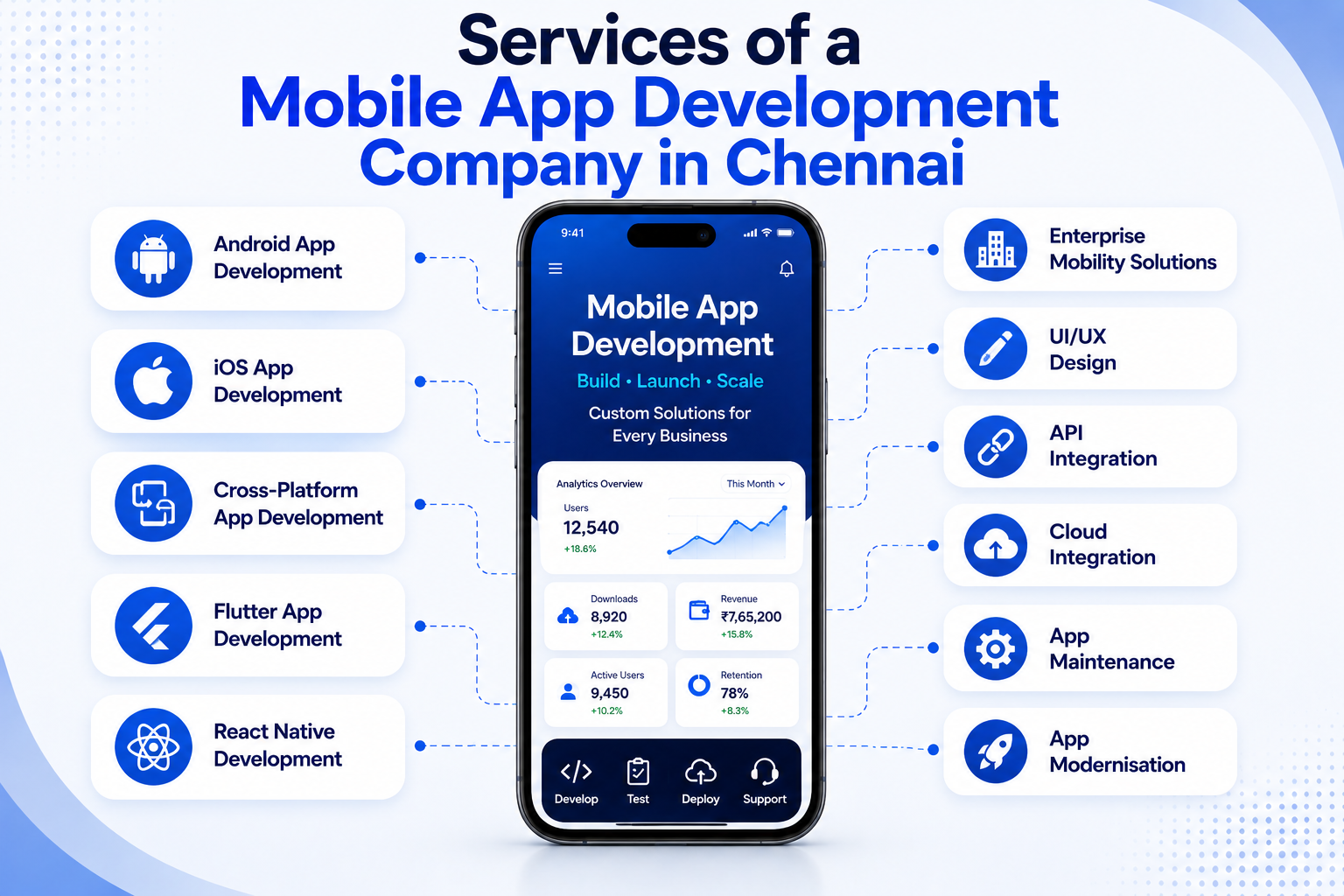
Services of a Mobile App Development Company in Chennai
A full-service team of mobile app developers in Chennai should cover the whole lifecycle, not just one slice of it:
- Android App Development built for the largest device base in India and tuned for performance across budget and mid-range phones, not just flagships.
- iOS App Development built around Apple’s stricter design and privacy standards, usually the focus for premium or B2B products.
- Cross-Platform App Development a single codebase for both platforms, useful when speed to market and budget matter more than platform-specific polish.
- Flutter App Development Google’s toolkit for near-native performance from shared code is increasingly the default for startups weighing cost against quality.
- React Native Development a mature alternative to Flutter, especially handy when a team already has strong JavaScript skills in-house.
- Enterprise Mobility Solutions internal tools for field teams, inventory, or HR, built for operational reliability rather than app-store polish.
- UI/UX Design wireframes, prototypes, and usability testing before a single line of production code is written.
- API Integration connecting your app with the payment gateways, CRMs, and ERPs your business already runs on.
- Cloud Integration hosting and data architecture on AWS, Azure, or Firebase, chosen based on your actual load and budget.
- App Maintenance bug fixes, OS compatibility updates, and ongoing performance monitoring.
- App Modernisation rebuilding an aging app before it collapses under new OS requirements or user needs it was never designed for.
Off-the-Shelf Mobile Apps vs. Custom Development
This is a decision that defines the next five years, not just a launch date.
| Factor | Custom App Development | Ready-Made App |
| Cost | More expensive upfront | Less expensive upfront |
| Scalability | Scales with your business | Reaches limits quickly |
| Security | Custom architecture | Shared, generic model |
| Customization | Fully adapted to your workflows | Limited to template options |
| Performance | Optimized for your specific use case | General-purpose, often bloated |
| Long-term ROI | Strong a real business asset | Weak, you’re renting, not owning |
| Maintenance | Direct support from your dev partner | At the mercy of a third-party vendor’s roadmap |
Ready-made platforms make sense for a quick proof of concept, nothing more. If the app is meant to be a real part of your business, Custom Mobile App Development Chennai wins on total cost of ownership almost every time, even with the higher sticker price on day one.
Industries Benefiting from Mobile App Development
What matters is the use case, not the industry label, so here’s what this actually looks like across sectors.
Healthcare apps handle appointment booking, e-prescriptions, teleconsultation, and lab report delivery, which eases the front desk and gives patients quicker access to their own results. This is especially useful for a hospital chain with many branches; one app can schedule appointments across every location instead of managing each branch separately.
Education apps include attendance, assignment submission, and parent-teacher communication features that have gone from nice-to-have to near-essential since 2020, especially for institutions managing multiple campuses.
Retail uses apps for loyalty programs, personalized offers, and inventory visibility, letting a store compete with e-commerce on convenience instead of trying to win on price alone.
E-commerce depends on cart-abandonment alerts and one-tap reordering, both of which improve conversion rates in ways a mobile website can’t.
Logistics runs on real-time tracking, route optimization, and driver-dispatch coordination—the sort of thing that reduces fuel cost and delivery errors at the same time.
Manufacturing benefits from shop-floor apps handling inventory checks, quality control logs, and maintenance scheduling, cutting down paperwork and the human error that comes with it.
Finance needs secure transaction processing, expense management, and loan applications, all while balancing tight compliance requirements. This is a real specialty, not something a generalist team should be learning on your project.
Real estate makes use of virtual property tours, EMI calculators, and lead-capture tools to shorten a usually long, expensive sales cycle.
Hospitality relies on room booking, digital concierge features, and loyalty apps to improve the guest experience without adding more staff.
Food delivery is basically built on order tracking, kitchen-display integration, and delivery partner apps—the operational backbone of the whole business, not an add-on to it.
Travel apps help manage itineraries, bookings, and real-time trip updates, keeping a traveler engaged with a brand long after the initial booking.
Technologies Used by Top Mobile App Development Companies
The stack should be driven by the business need, not the other way around. A modern team typically works with:
Flutter and Kotlin for Android and Swift for iOS are the core native and near-native languages, depending on the depth of platform integration required. React Native remains a solid cross-platform, JavaScript-based option with a large, battle-tested ecosystem behind it.
On the backend, most API and admin-panel work runs on Node.js and Laravel, with Python coming in for anything involving data processing or AI-driven features.
Firebase covers authentication, real-time databases, and push notifications for smaller and mid-sized builds, while AWS and Azure handle hosting and scaling for anything enterprise-grade. The choice between them usually comes down to what a company’s existing systems already run on.
Beyond that, there’s AI for chatbots and recommendation engines, IoT for apps that connect to physical devices like healthcare monitors or manufacturing equipment, blockchain for the narrower set of use cases that need verifiable transaction records, and cloud computing underpinning all of it, letting apps scale without anyone needing to manage physical servers.
How the Right Development Partner Drives Business Growth
Speed matters more than most founders admit. A team that’s already solved your type of problem saves you real weeks on a build simply because they aren’t learning on your dime.
User experience isn’t the icing on the cake; it’s the cake, and it determines whether people stick with the app or delete it after the first use, which directly drives churn and app-store ratings.
The basics done right improve retention: push notifications sent at the right time, some actual personalization, and lag-free performance. None of it is exotic. It just has to actually be done.
Costs come down because automated scheduling, reporting, and inventory replace manual work that was quietly eating up staff hours before the app existed.
A well-architected app simply doesn’t care about scale. It can handle ten times the users, no rebuild required. A poorly constructed one falls apart the moment it gets real momentum, often when the business needs it most.
Security built in from day one is much cheaper than patching it in after something has already gone wrong.
And innovation continues because a long-term development relationship means the app keeps evolving, rather than freezing on launch day.
Mistakes Companies Must Avoid When Hiring an App Development Company
The most common mistake is going for the cheapest option, and it’s usually cheap because they cut corners on testing, security, or support that only becomes apparent after launch.
Ignoring the portfolio is another one. A portfolio demonstrates what a team can actually build, as opposed to what they say in a pitch deck. Ask for apps of similar complexity to yours, rather than a general showcase.
Skipping reviews is a mistake too. Testimonials and third-party reviews show patterns recurring praise or recurring complaints that a sales conversation is never going to reveal on its own.
Poor communication during the proposal phase is a preview of what’s to come, not an exception to it. If getting a straight answer already feels like effort, it’s not going to get easier once you sign the contract.
The biggest cause of budget overruns is usually an undefined scope. Demand a thorough scope document before development begins, not sometime in the middle of it.
And a lack of post-launch support means you’ve got a ticking clock. Eventually, an OS update will break an unmaintained app; it’s a matter of when, not if.
Mobile App Development Company Hiring Checklist
- Check portfolio apps of similar complexity and in a similar industry to yours, not just the prettiest project out there
- Ask for real client references, not just testimonials from their own website
- Validate their cadence visible, regular milestones through agile sprints
- Identify who owns the source code and design files once the project is finished
- Get a written breakdown of costs, specifying what’s not covered
- Ask directly about their security and data-protection practices
- Understand their maintenance and support terms after launch
- Get clear on how often you’ll actually communicate: weekly calls, a shared board, or both
- Ask how they handle scope changes once development has started
- Confirm their experience with the specific platforms and technologies your app needs
Upcoming Trends in Mobile App Development
AI-powered apps have moved past basic chatbots into real personalization apps that adjust content and offers based on how someone actually uses them, not a rigid segment they were assigned at signup.
Voice interfaces are becoming standard in food delivery and smart home control, mostly because people would rather speak a command than type it while doing something else.
Wearables have grown far beyond fitness tracking into healthcare monitoring and fieldwork applications for enterprise teams.
Super apps, one app for payments, bookings, messaging, and shopping, are gaining ground in India, following a pattern already seen in other Asian markets.
Predictive analytics within apps are beginning to anticipate needs before anyone asks for restocking suggestions, churn warnings, and demand forecasts that arrive before a human even raises the alarm.
AR/VR has found genuinely practical, non-gimmicky applications in retail try-before-you-buy features and real estate virtual tours.
Low-code development is speeding up internal tools and MVPs but runs into a wall quickly when real customization is needed.
Hyper-personalization, tailoring the whole app experience for each individual user, not just each segment, is becoming the norm rather than something that impresses anyone.
And 5G is finally opening up richer media and real-time features that just weren’t possible to build on older networks.
Why It’s Essential to Pick the Right Mobile App Development Company
It all comes down to one decision: Who do you trust to build something your business will rely on for years to come? The right partner brings real enterprise mobile app development experience when scale matters, honest technical guidance when you’re not sure what you actually need, and enough transparency that you’re never left guessing where the budget went.
The wrong partner leaves you with an app that looks great in a demo but falls apart when used for real, one that costs more to fix later than it would have cost to build right the first time, while quietly eroding the trust you’ve built with your customers over the years.
A mobile app isn’t a one-and-done purchase. It’s a continuous relationship between your business and the people who use it. The businesses actually seeing growth from their apps aren’t necessarily the ones that spent the most; they’re the ones that chose a partner who understood their business before their technology.
If you’re seeking a mobile app development company in Chennai today, don’t make the decision solely on cost. Look at technical depth, industry experience, how they communicate, and what happens once the app is live. That combination, not the lowest quote on the table, is what actually determines whether your app turns into a growth engine or just another forgotten download.
We help startups, growing businesses, and enterprises in Chennai and beyond build secure, scalable, truly usable mobile applications: an Android app, an iOS app, a Flutter-based cross-platform build, or a complete enterprise mobility solution.
We don’t start with a tech stack. We begin with the business problem and work backward from there.
Speak with us at Creatah about your project and see what a development partner focused on long-term outcomes, not just delivery deadlines, can actually do for your growth.
Contact Creatah today for expert mobile app, software, and digital marketing services tailored to your business goals.
