
Why You Should Work With a Custom Software Development Company
Eventually, most businesses hit the same wall. The off-the-shelf software that felt great at first turns into a straitjacket somewhere along the way. Teams find ways around it. There’s a spreadsheet being maintained that was never supposed to exist. And you’re paying for half the features you don’t use because they don’t match how your business actually works; they were built for someone else’s business, really.
That’s usually when a company starts thinking seriously about custom software development. Generic tools are made for the broadest possible audience, which really just means they’re not made for you specifically. A custom software development company takes a different path. It starts with your workflows and your goals and builds around those, instead of asking your team to adapt to someone else’s idea of how things should work.
This article gets into why more companies are going that route, what to actually look for in a development partner, and whether custom software makes sense for your business right now or whether it doesn’t, which happens too.
What Is Custom Software Development?
Custom software development is the process of designing and building software specifically for one organization’s needs, rather than offering a one-size-fits-all product to the general market.
Instead of buying a license and adapting your processes to fit the tool, you get an application built around your existing workflows, the needs of your industry, and maybe most importantly, the people who’ll actually be using it day in and day out. Sometimes that means a fully custom platform, built from scratch. Sometimes it’s just better integration between systems you already own and don’t want to throw out. Either way, the software gets designed around you. Not the other way round.
Top Reasons to Partner With a Custom Software Development Company
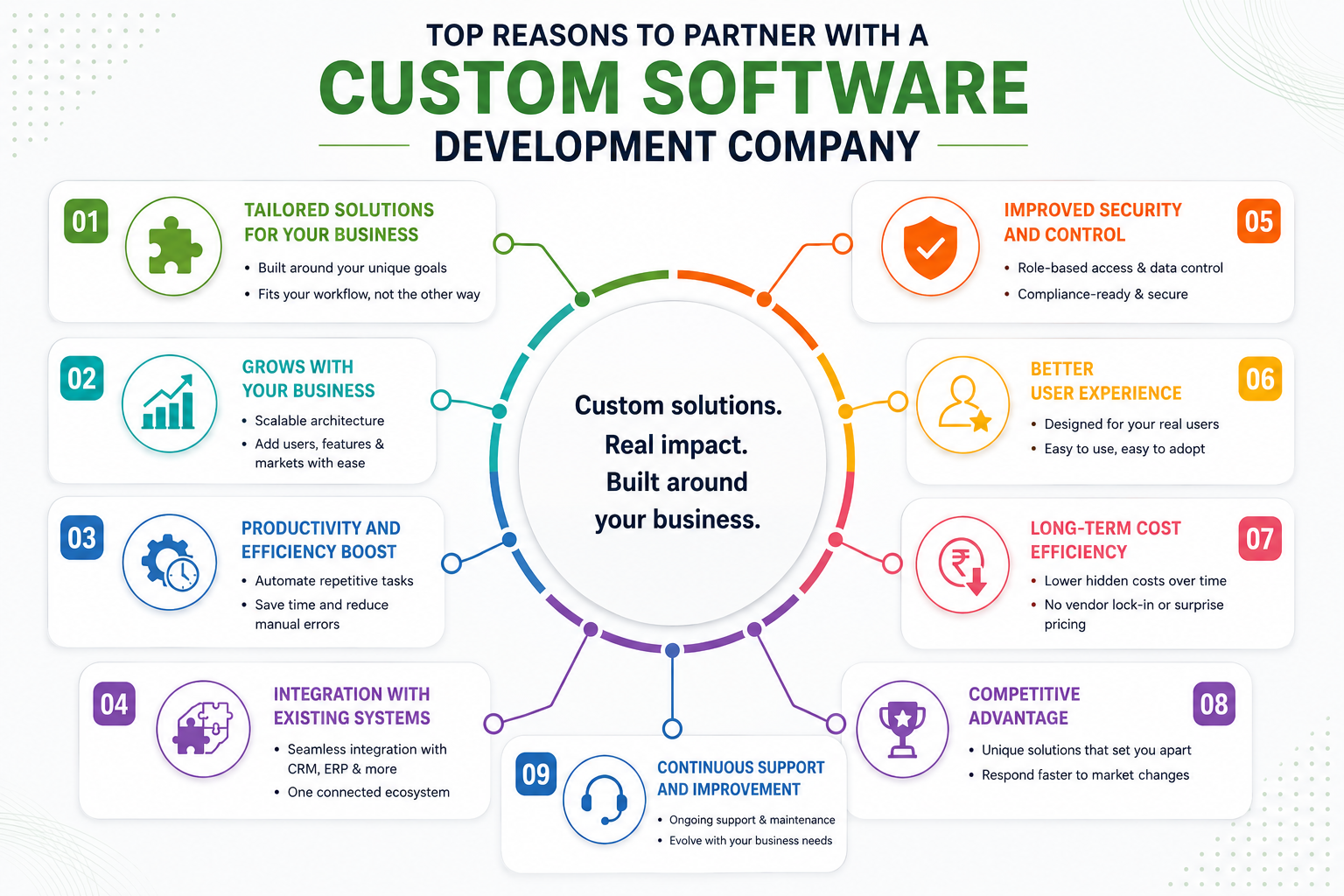
1. Tailored Solutions for Your Business
Off-the-shelf tools force compromise. You get maybe 70% of what you need, and your team spends the rest of its time on workarounds, extra spreadsheets, manual approvals, and copy-pasting between systems that were never built to talk to each other in the first place.
Custom software turns that around. A logistics company can get a dispatch system that reflects how their fleet actually operates instead of bending to whatever a generic tracking tool assumes. A retailer can get an inventory system that understands their supplier cycles, not a template built for a completely different kind of retail. The software fits the business. Not the other way round.
2. Grows With Your Business
Generic software often comes with ceilings, user limits, pricing tiers that jump without warning, and feature restrictions you didn’t even know existed until you bumped straight into one. Custom software solutions get built to scale from the beginning, so adding users or expanding into new markets doesn’t turn into a full migration to another platform somewhere down the line.
3. Productivity and Efficiency Boost
The inefficiency in a typical workday isn’t dramatic. It’s death by a thousand small frictions entering the same data into three systems, waiting on someone to run a report that should’ve been automated years ago. Custom software can take on exactly these business-specific tasks, because it’s built around what your team actually does all day, not some generic use case that only half applies.
4. Integration With Existing Systems
Most businesses already have some systems in place — a CRM, an ERP, a payment gateway, maybe a few internal tools cobbled together over the years without much of a plan. Off-the-shelf software often integrates with these poorly, or not at all, which is exactly how data ends up scattered across disconnected platforms nobody quite trusts. A development partner, instead, can build proper integrations, APIs, payment processors, and internal tools that actually share data rather than quietly duplicating it.
5. Improved Security and Control
Commercial software locks you into whatever security model the vendor happened to build their permissions, their authentication, their update schedule, and their timeline on. Custom development gives you control over how your data is handled and who has access to what, which matters a lot more once you’re in an industry like healthcare or finance with genuinely specific regulatory requirements.
6. Better User Experience
Software designed around real users actually gets adopted, unlike software built for a broad average of “typical” users who don’t exist anywhere in particular. Custom development lets you shape workflows around how your specific employees or customers actually think and work, instead of an interface trying to serve everyone reasonably well and, in practice, nobody particularly well.
7. Long-Term Cost Efficiency
Worth being upfront here: custom software isn’t always cheaper upfront, and anyone telling you it definitely will be isn’t being straight with you. Over time, though, it can quietly trim costs that creep up unnoticed, like duplicate subscriptions, hours of manual workarounds, and eventually the cost of migrating off a platform you’ve simply outgrown.
8. Competitive Advantage
When your operations run on the same platform as every competitor in your space, there’s not much differentiation left on the process side. Custom software lets a business build something tailored to how it actually works, which can translate into faster turnaround times or the ability to respond to market shifts before competitors stuck on generic tools even notice something’s changed.
9. Continuous Support and Improvement
Software isn’t a one-time purchase, no matter how much it feels that way at launch. Requirements change. User numbers grow. Security needs shift in ways nobody fully anticipated at the start. This is really where the choice of development partner ends up mattering most, not just who builds version one, but who’s still around for updates and improvements a year or two later, once the initial excitement has worn off and the maintenance actually kicks in.
Picking the Right Software Development Partner
Choosing the right partner comes down to relevant technical experience, a proven track record of similar projects, straightforward communication, and a genuine willingness to understand your business before writing any code.
A few things worth actually checking before signing on with anyone:
- Industry and technical experience — have they built for businesses with needs anything like yours?
- Portfolio and past projects — ask for real examples, not just a list of technologies they claim to know.
- Development methodology — does their process actually match how you want to work, in practice?
- Communication and transparency — regular updates, or radio silence between milestones until something’s “done”?
- Security practices — how specifically is data protected and access controlled?
- Post-launch support — is there a maintenance plan, or are you on your own the moment it ships?
- Scalability planning — will the architecture actually scale, or is that a problem for later?
- Understanding of your business — do they ask about your workflows, or just run through your feature list?
- Budget and timeline clarity — are the estimates realistic, with scope creep addressed upfront rather than discovered halfway through?
Creatah tends to get evaluated on more or less these exact points by the businesses that come to us — which is usually a decent sign these are the right questions to be asking any potential partner, not just us.
Do You Need Custom Software Development for Your Business?
Not every business needs a custom build, and it would be a little dishonest to say otherwise. If your needs are pretty standard basic accounting, generic project tracking, and common CRM functionality, a well-established off-the-shelf tool might serve you just fine, and building something custom would mean solving a problem you don’t actually have.
It starts to make sense once your processes create real friction with off-the-shelf tools, once you’re scaling in ways standard platforms simply can’t support, once compliance needs stop being negotiable, or once you’re trying to build a real operational advantage rather than parity with everyone else in your space.
Generic software solves generic problems. That’s fine, right up until it isn’t. Once your business has particular compliance requirements, specific workflows, or growth plans that don’t fit neatly into a template, the calculus starts shifting toward custom development.
A good development partner doesn’t just write code. They take the time to actually understand how your business operates, then build something that fits it and keeps working as things change around it. Whether that’s a full custom software platform, a mobile app, or a set of integrations tying existing tools together, the right partner makes a real, measurable difference to how the business runs day to day.
If mobile is part of the picture, it’s worth looking into mobile app development, Android app development, iOS app development, or Flutter app development. And if software is only half the picture, digital marketing services and SEO services are usually the next conversation worth having.
If your business is outgrowing the capabilities of generic software, or you’ve got something in mind that off-the-shelf tools simply can’t handle, it’s worth talking through before settling on any one direction.
Contact Creatah to talk about what you actually need and figure out together what makes sense for where your business is headed next.
At Creatah, we help businesses turn their software ideas into real, scalable digital solutions.
