

Talk to a handful of founders in Chennai these days and you’ll notice a pattern. A healthcare startup wants a patient booking app. A logistics company needs a way for drivers to track deliveries in real time. A retail brand wants a loyalty app before the festive season rush. Different problems, but almost the same answer keeps coming up: build it in Flutter. If you’ve been searching for a Flutter app development company in Chennai, you’ve probably run into this same conversation already.
It’s not hype for the sake of hype either. Flutter solves a problem business owners have complained about for years: building separately for Android and iOS used to mean two codebases, two teams, and roughly double the budget. Flutter collapsed that into one, and Chennai’s tech scene picked up on it fast.
This piece walks through why Flutter has become such a common choice for businesses, why Chennai in particular has turned into a place people come to for this kind of work, and what actually separates a solid development partner from one that just lists Flutter on their website.
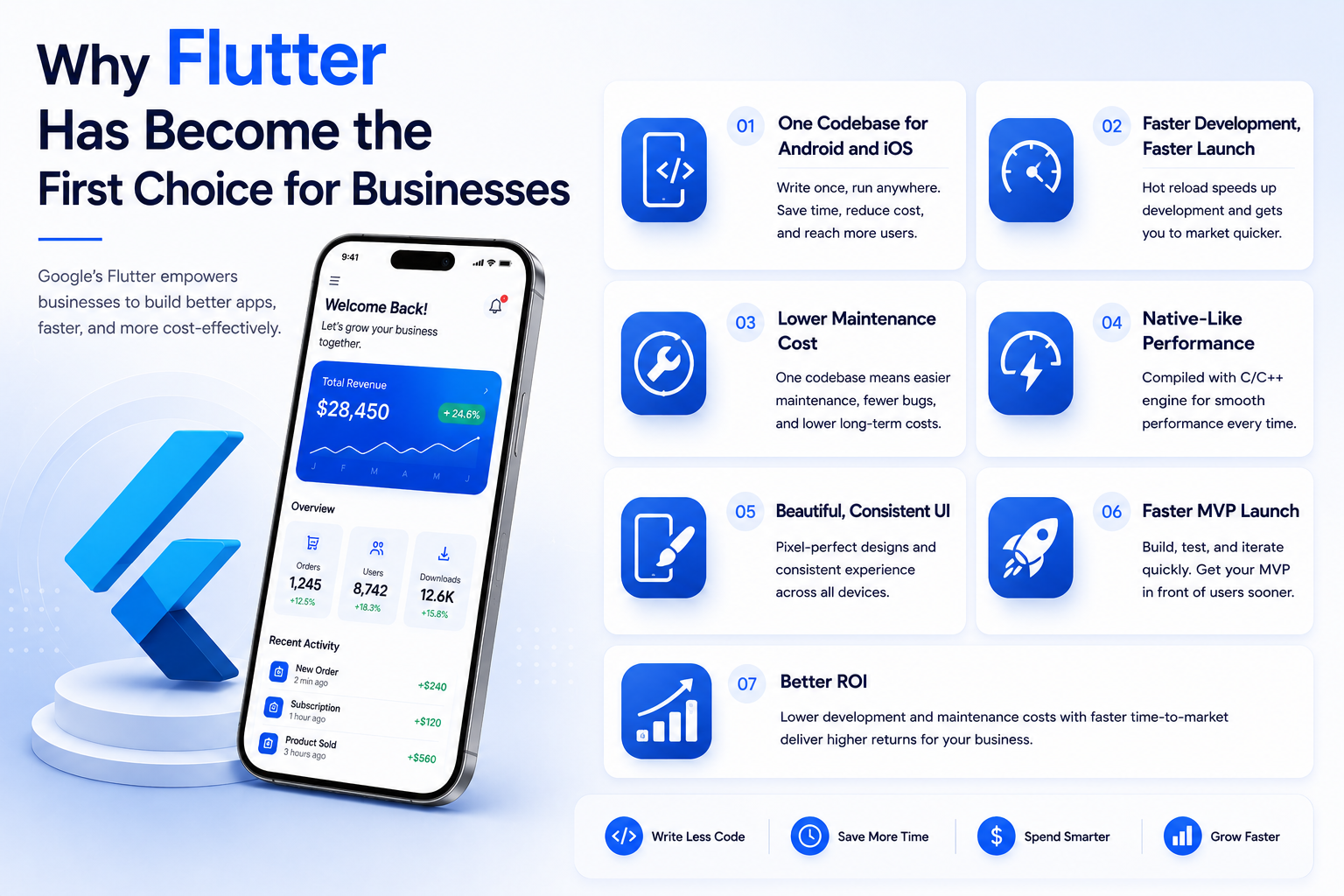
Why Flutter Has Become the First Choice for Businesses
Flutter isn’t some brand-new experiment anymore. Google had it out for years, but the real shift has happened more recently, as businesses realized it lets them move fast without cutting corners on quality.
One Codebase for Android and iOS
This is usually the first thing that gets a founder’s attention. Write the app once, and it runs natively on both platforms. No separate Swift and Kotlin teams to coordinate, no keeping two codebases in sync every time a feature changes. If you’re watching your runway closely, this alone can make a real dent in your development budget.
Faster Development, Faster Launch
Flutter’s hot reload lets developers see the effect of a code change almost instantly, without rebuilding the whole app from scratch. It sounds like a small technical detail until you’re the one waiting on a feature update, and it turns into a difference of days instead of weeks.
Lower Maintenance Cost
Fewer codebases means fewer places for bugs to hide and fewer places to patch when something needs fixing. Over a year or two of running an app, that difference adds up more than most people expect going in.
Native-Like Performance
Flutter apps compile down to native ARM code rather than running inside some browser-based wrapper. In practice, that means the scrolling feels smooth, transitions feel snappy, and touch response doesn’t lag the things users actually notice, even if they can’t name why.
Beautiful, Consistent UI
Because Flutter draws every pixel itself rather than relying on native platform widgets, designers get much finer control over how things look. For a brand that cares about looking the same on an iPhone and a Samsung, that consistency matters more than people give it credit for.
Faster MVP Launch
For a startup, getting something real in front of users usually matters more than getting everything perfect. Flutter’s speed means a working MVP can go from idea to app store in weeks rather than months, without the app feeling half-baked.
Better ROI
Add it up: it’s cheaper to build, cheaper to maintain, faster to launch, and the return tends to beat traditional native development, especially for small- and mid-sized businesses that don’t have deep engineering budgets to burn.
Take a small clinic chain wanting an appointment booking app. Built natively, that’s a Swift team, a Kotlin team, and roughly double the QA hours. Built in Flutter, one team handles both platforms, tests once, and ships to both app stores in a fraction of the time. That’s the kind of math that keeps pulling more businesses toward Flutter every year.
Why Chennai Is Emerging as a Flutter Development Hub
Chennai isn’t just riding along on the Flutter trend; it’s actually become one of the places producing a lot of this work.
Part of it comes down to the startup scene here, which has grown well past its old fintech-and-edtech reputation. These younger companies need lean, affordable ways to build apps, and Flutter fits that need almost perfectly. Part of it is talent; the city’s engineering colleges keep producing developers, and its long-running IT sector means plenty of them have picked up Flutter and other cross-platform frameworks along the way.
Cost plays a role too. Compared with many other Indian metros, and certainly compared with international markets, Chennai offers strong technical work without the premium price tag attached to it elsewhere. Add in solid IT infrastructure, established tech parks, reliable connectivity, and decades of outsourcing experience, and you get a city that’s genuinely set up to support this kind of software work, not just claim to be.
There’s also a practical scheduling advantage that doesn’t get mentioned often enough. Chennai’s time zone overlaps comfortably with Southeast Asia and the Middle East, and the gap with the US and Europe is manageable enough for async workflows and the occasional evening call. Combine that with English-speaking teams and a culture built around client communication, and it’s easy to see why Chennai keeps showing up on shortlists not just from Indian businesses but from clients abroad too.
What Makes a Great Flutter App Development Company in Chennai
Not every company that lists Flutter on their services page actually delivers well on it. A few things tend to separate the ones worth hiring from the ones that just talk a good game.
The best ones start with your business, not the technology. They ask about your revenue model and your users before touching a line of code, because the tech should serve the goal, not the other way around. Good UI/UX sense matters just as much as coding skill. Flutter can produce excellent interfaces, but only in the hands of a team that actually understands usability, not just visual polish.
Working in agile sprints tends to be a good sign too. It means you see progress in regular chunks instead of waiting three months for a single big reveal that may or may not match what you had in mind. Communication ties into this; regular updates and honest timelines prevent the kind of surprises that quietly derail projects. A team that stays with your project from start to finish, rather than rotating in new freelancers every few weeks, tends to understand the product far better, and it shows in the final result.
Quality assurance shouldn’t be an afterthought squeezed in right before launch, and support shouldn’t disappear the moment the app goes live. Apps need updates after release, whether that’s OS changes, bug reports, or new feature requests, and a serious partner sticks around for that. Security deserves the same attention from day one, not as a patch applied once something goes wrong.
It’s worth asking a prospective partner how they handle things when they don’t go smoothly, not just when they do. Every project hits a snag somewhere: a delayed API from a third-party vendor, a mid-sprint design change, or an app store review that drags on longer than expected. The companies worth trusting are upfront about these moments instead of burying them until the deadline is already blown.
Flutter App Development Services Offered
A capable Flutter partner should be able to cover the full range of what a business might actually need, not just a couple of isolated pieces.
Custom Flutter app development means building around your specific workflow instead of bending your business to fit someone else’s template. Android & iOS app development delivers native-quality apps on both platforms from a single codebase, cutting time and cost without cutting quality. For larger organizations, enterprise applications need to be scalable and secure enough to handle bigger user bases and more complex internal logic.
For startups still testing the waters, MVP development offers a lean, functional build that can validate the market before a full-scale commitment. UI/UX design should be shaped around how people actually behave, not just how a mockup looks in a slide deck. API integration connects the app to whatever backend services or internal systems it needs, while Firebase integration brings in authentication, real-time databases, push notifications, and analytics almost out of the box.
Payment gateway integration handles secure, smooth checkout experiences tailored to your market, and third-party integrations—CRMs, maps, chat tools, and analytics platforms—keep the app talking to whatever else your business already relies on. None of this matters if the app hasn’t been properly tested, which is where thorough app testing across devices and use cases comes in. For businesses migrating an existing native app, app migration should preserve data and functionality without losing anything in the move. And once the app is live, maintenance and support keep it running well long after launch day, rather than treating release as the finish line.
Industries That Benefit from Flutter Apps
Flutter’s flexibility means it works across a genuinely wide range of industries, each with its own particular needs.
In healthcare, that means patient portals, appointment booking, and telemedicine apps that need to run reliably across all kinds of devices.
Finance apps need to be fast and secure at the same time, since trust is really the whole product.
Education platforms need to reach a wide and varied user base without breaking on older phones.
E-commerce brands lean on Flutter for smooth shopping experiences and checkout flows that don’t lose customers halfway through.
Logistics companies use it for real-time tracking and delivery coordination that has to hold up in the field, not just in a demo.
Manufacturing businesses build internal tools for inventory and reporting.
Real estate firms use it for property listings and virtual tours with rich visuals.
Food delivery apps need speed above almost everything else, while travel apps need to work even on shaky hotel or airport Wi-Fi.
SaaS companies often build a Flutter companion app to sit alongside their web product, and retail brands use it for loyalty programs and in-store tools that staff actually want to use.
Why Businesses Choose Creatah
We won’t pretend every project looks the same, but a few things tend to hold steady across the ones we’ve worked on. Our developers have built across healthcare, e-commerce, and enterprise projects, so we’re not learning Flutter on your dime. We build custom solutions rather than adapting a template with architecture designed to scale as your user base grows and design decisions driven by usability rather than decoration.
We work in agile sprints so you see real progress along the way, with pricing kept transparent so there are no surprises halfway through. A dedicated project manager keeps timelines and communication on track; quality assurance runs through every stage of development rather than getting squeezed in at the end; and support continues well after launch, not just up to the handover.
Flutter App Development Process
A structured process is usually what separates a predictable project from a chaotic one.
It starts with discovery, understanding your business, your users, and the actual problem the app needs to solve, followed by business analysis to map requirements and priorities before any design begins. From there comes wireframing, a rough sketch of the app’s structure and flow, followed by UI/UX design, where those wireframes turn into polished, tested interfaces.
Development happens in Flutter, usually across agile sprints, followed by testing across functionality, performance, and device compatibility. Once that’s solid, deployment prepares the build for release, and app store publishing handles submission and approval on both Google Play and the Apple App Store. After launch, ongoing support keeps the app monitored, updated, and fixed as issues come up.
Latest Flutter Trends in 2026
Flutter keeps stretching well past its original mobile-only scope. AI-powered features, recommendations, chat assistants, and predictive tools are showing up directly inside Flutter apps now, and the framework has extended into desktop builds for Windows, macOS, and Linux, along with proper web apps that reach browser users without a separate build.
There’s also growing interest in IoT applications and wearable apps for smartwatches, super apps that bundle multiple services into one platform (something already popular across several Asian markets), and progressive web apps that blend the reach of the browser with app-like behavior. Offline-first design keeps gaining ground too, especially for apps that need to work smoothly even when connectivity isn’t great, alongside ongoing Firebase enhancements and deeper AI integrations across analytics and personalization.
Developer surveys tracking cross-platform framework usage have consistently placed Flutter among the most widely adopted options in recent years, a fair signal of just how mainstream it’s become for business app development, not just a framework favored by hobbyists.
Why Investing in Flutter Today Makes Business Sense
For a business weighing where its development budget should go, a handful of practical points tend to stand out. Flutter speeds up digital transformation without dragging development into a long, drawn-out cycle, and one codebase keeps operational costs lower over time. Consistent, smooth interfaces across devices keep users engaged rather than frustrated, and with Google actively expanding Flutter into web, desktop, and embedded use cases, it’s not a framework businesses are likely to outgrow anytime soon. A well-architected Flutter app can also scale with the business without demanding a costly rebuild down the line, and between the lower costs and the faster time to market, the return over the app’s lifecycle tends to hold up well.
Choosing the right Flutter app development company in Chennai isn’t really about finding someone who knows the framework; plenty of people can write Flutter code. It’s about finding a partner who understands your business, designs with your actual users in mind, and stays involved after the app goes live. Chennai has quietly built the talent, infrastructure, and hands-on experience to support exactly that kind of partnership, which makes it a smart place to look if you’re serious about building something fast, scalable, and built to last.
Ready to Build a High-Performance Flutter App?
Whether you’re a startup validating an idea or an established business planning digital transformation, Creatah can help you build fast, scalable, and visually engaging Flutter applications tailored to your goals. Our experienced Flutter developers in Chennai focus on creating secure, high-performing apps that deliver exceptional user experiences across Android and iOS from a single codebase.
Contact Creatah today to discuss your project and discover how our Flutter app development expertise can turn your vision into a successful mobile application.
