
You probably didn’t notice the last time an app got something right for you. The food app put your usual order at the top. The bank texted you about an odd charge before you spotted it yourself. The shopping app showed the exact thing you were about to search for.
That’s AI, working quietly behind the screen. And it’s not just for the big global brands anymore. Clinic owners, retailers, logistics firms, and first-time founders across the city are walking into meetings with a mobile app development company in Chennai and asking the same thing: “Can our app do that too?”
The short answer is yes, but with some caveats. Let’s talk about what AI actually changes, where it earns its keep, and what to think through before you spend a rupee.
How AI Is Changing Mobile App Development
For a long time, an app was basically a digital container. It showed information and took inputs, and that was that. AI changes the relationship. The app starts to learn how people use it, guess what they’ll want next, and take care of small tasks without being asked.
Two things shift because of this:
- What users experience. Apps feel more personal and quicker and easier to use.
- How apps get built. Developers use AI to write and review code, run more tests, and catch bugs earlier.
Business owners mostly care about the first one, and fair enough. It’s what shows up in repeat usage, reviews, and sales.
Where AI Makes Mobile Apps Smarter
Personalization That Feels Helpful, Not Creepy
This is the one users notice most. An app learns what someone browses, buys, or skips and adjusts what it shows them.
In a retail app, that could be product suggestions that actually make sense. In a healthcare app, it might be a gentle reminder about a follow-up visit, sent when it’s useful. The trick is restraint. Good personalization saves people effort. Bad personalization makes them feel watched. Be upfront about what you collect and why.
AI Chat bots and Virtual Assistants
We’ve all had that chat with a bot that says “Sorry, I didn’t get that” three times and then gives up. Today’s assistants are much better at understanding normal, messy human language. They can answer product questions, track an order, book an appointment, and hand the chat to a real person with the whole conversation attached, so nobody has to repeat themselves.
For you, that means customers get quick answers at 11 p.m., and your support team can spend its energy on the cases that really need a human.
Voice and Language Features
Plenty of Indian users switch between languages in the same sentence, and many would rather talk to their phone than type. Voice search and multilingual support, with Tamil and Hindi sitting alongside English, can open your app up to a much wider audience. Speech and language technology has come far enough that this is now realistic for many business apps, not just a nice extra.
Image Recognition and Smart Scanning
The camera has become an input tool. Apps can scan a document and pull out the details, recognize a product from a photo, read a prescription, or verify an ID. Less typing means fewer mistakes, which matters a lot in banking, insurance, healthcare, and field-service work.
Predictive Analytics and Smarter Decisions
AI can study usage patterns and business data to forecast what’s coming. For example:
- Which customers are drifting away from the app
- When demand for a product or service will peak
- Which leads are most likely to convert
- Which deliveries are at risk of running late
When these predictions land in a simple dashboard or a notification, managers can act early instead of cleaning up afterwards.
Smarter Security and Fraud Detection
Any app handling payments or personal details is a target. AI can learn what normal behavior looks like for each user and flag the odd stuff, like a login from an unfamiliar device or a strange spending pattern. It doesn’t replace solid security basics, but it adds a useful extra layer.
Faster, Better-Tested Development
AI also helps the people building the app. It can speed up repetitive coding, suggest fixes, generate test cases and spot bugs before release. People still make the design and architecture calls, but the routine work moves faster, which can mean shorter timelines and fewer nasty surprises after launch.
Industry Examples: AI in Mobile Apps
AI works best when it’s shaped around what a particular sector really needs:
- Healthcare: appointment booking, medication reminders, symptom-based guidance, and secure record access
- Retail and e-commerce: personalized recommendations, visual search and smart stock alerts
- Logistics: live tracking, route suggestions and delay prediction
- Finance: document scanning, fraud alerts and spending insights
- Education: adaptive learning paths and automatic progress tracking
- Real estate and services: lead scoring, virtual assistants and automated follow-ups
Challenges of Building AI-Powered Mobile Apps
AI is powerful, but it’s not a switch you flip. Here are the bumps businesses most often hit.
Not enough good data. AI features need decent data to learn from. If yours is scattered or incomplete, expect some cleanup work before launch.
Privacy and compliance. Apps collect sensitive information, so you need clear consent, secure storage and sensible access controls.
Speed and battery life. Heavy AI processing can make an app sluggish and drain batteries. A good team decides what runs on the phone and what runs in the cloud.
Fuzzy goals. “Add AI” isn’t a requirement. Start with a specific problem, like cutting support calls or making on boarding easier, and build around that.
Upkeep. User behavior changes, so AI features need monitoring and updates. Plan for life after launch, not just launch day.
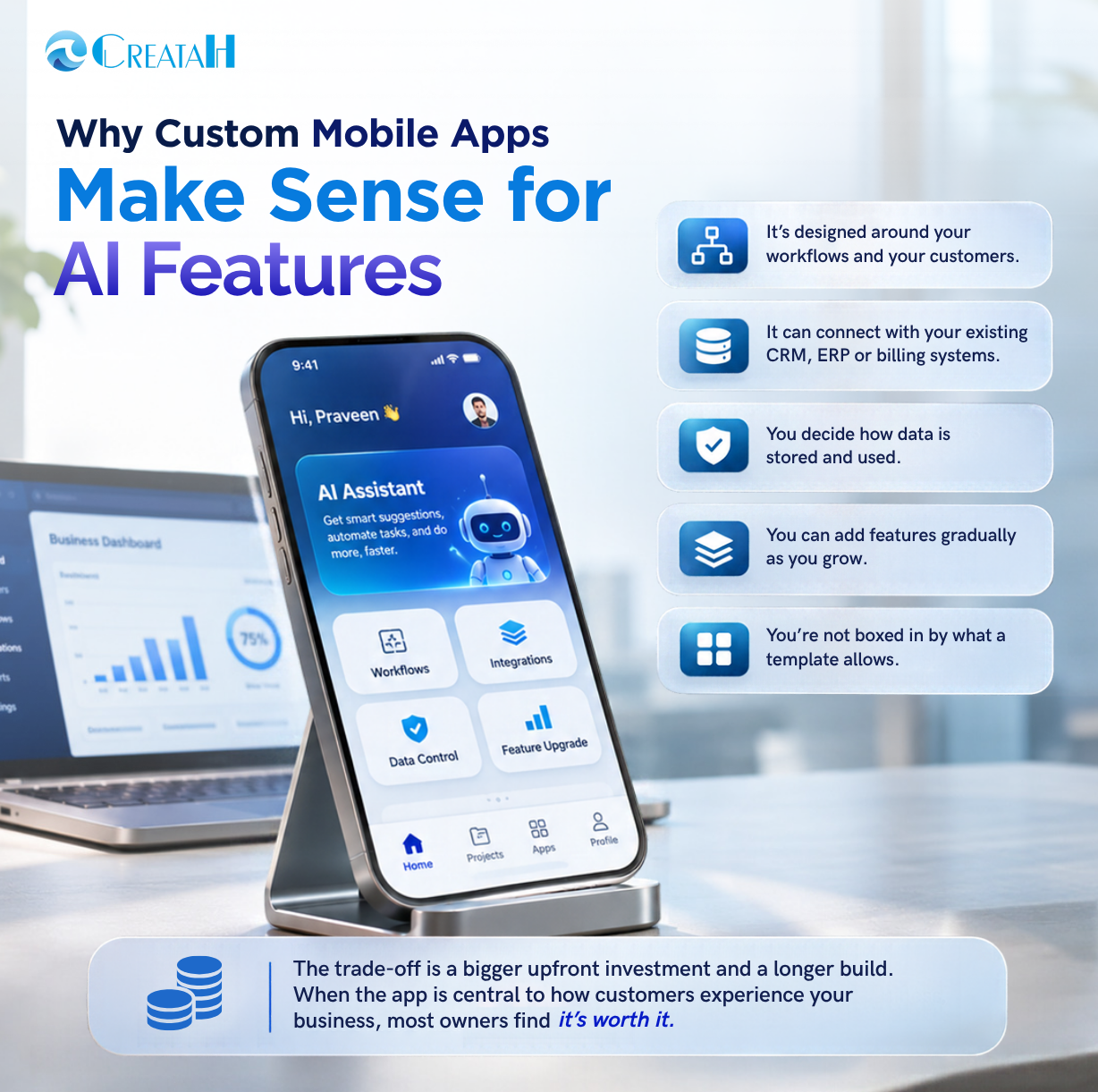
Why Custom Mobile Apps Make Sense for AI Features
App builders and templates are fine for simple needs. But if you want AI to give you a real edge, a custom app usually fits better:
- It’s designed around your workflows and your customers.
- It can connect with your existing CRM, ERP, or billing systems.
- You decide how data is stored and used.
- You can add features gradually as you grow.
- You’re not boxed in by what a template allows.
The trade-off is a bigger upfront investment and a longer build. When the app is central to how customers experience your business, most owners find it’s worth it.
How to Choose a Mobile App Development Company in Chennai
The team you choose has a lot to do with whether your app is used daily or deleted within a week. When you’re comparing a mobile app development company in Chennai, here’s what to look at:
- Work they’ve actually done. Ask to see apps they’ve built and how they solved real business problems.
- Questions before quotes. A good team asks about your users and goals before they start talking about technology.
- Platform experience. Check their background with iOS, Android, and cross-platform frameworks, and with integrating AI services.
- Design sense. An app can be technically brilliant and still be frustrating to use. Good UX matters.
- Security habits. Ask how they handle data protection, testing and code reviews.
- A clear process. Look for defined stages: discovery, design, development, testing and launch.
- Support after launch. Updates, bug fixes and improvements should be part of the conversation from the start.
- Honest pricing. Be wary of vague estimates. You should understand what’s driving the cost.
Frequently Asked Questions
How is AI used in mobile app development?
AI is used both inside the app and while building it. Inside the app, it powers things like personalized recommendations, chat bots, voice search, image recognition, and fraud detection. During development, it helps with coding assistance, testing, and bug detection.
What are the benefits of AI-powered mobile apps for businesses?
They can improve engagement, offer faster customer support, automate routine tasks, support better decisions through predictions, and strengthen security. The actual results depend on how well the AI features match your business goals.
How much does AI mobile app development cost in Chennai?
There’s no fixed price. Cost depends on how complex the app is, which AI features you need, the platforms you’re targeting, how ready your data is, what it needs to integrate with, and your security requirements. Many businesses start with a smaller first version, such as an app with one or two AI features, and expand after seeing how users respond. A reliable development partner will give you a detailed estimate once they understand what you need.
Do all mobile apps need AI?
No. If your app is simple, AI may add cost without adding much value. It makes the most sense when it solves a specific problem, like reducing manual work, personalizing the experience, or making predictions from your data.
Why choose a mobile app development company in Chennai?
Chennai has a strong technology talent pool, and working with a local team makes meetings, feedback, and support easier. It often offers a good balance of technical skill and value, along with a solid understanding of the Indian market and its users.
AI is turning mobile apps from simple tools into smarter, more responsive products that learn from the people using them. The apps that succeed aren’t the ones crammed with the most features. They’re the ones that solve a real problem clearly, protect user data, and feel easy to use.
If you’re planning to build or upgrade an app, a dependable mobile app development company in Chennai can help you work out where AI genuinely adds value and where it doesn’t, then build it in manageable stages. Creatah is a Chennai-based digital marketing and software development agency that offers mobile app and web development alongside digital marketing services. If you’re weighing up an AI-powered app, a conversation about your goals, users, and existing systems is a sensible first step.
Contact Us: Have an app idea, or an app you’d like to make smarter? Get in touch with Creatah at https://www.creatah.com/ and let’s talk about your project.
