
We’ve seen this play out before: a boutique retail brand in Chennai, loyal customers, decent foot traffic, a product line people actually wanted. On paper, everything looked fine. But their online ordering ran through a clunky third-party platform that crashed every time there was a sale, and frustrated customers eventually just… stopped bothering. Quietly, a little at a time, they drifted to competitors with apps that actually worked.
The business wasn’t failing. It was capped, held back by a mobile experience that didn’t match the quality of everything else they’d built.
That story comes up more often than people expect. And the fix usually isn’t “build an app” in some vague, generic sense. It’s finding the top iOS app development company in Chennai, one that actually understands the Apple ecosystem specifically, not mobile development in general.
Demand for iOS apps hasn’t slowed down. iPhone users spend more, engage more, and expect a level of polish that the average mobile audience simply doesn’t. The Apple ecosystem – iPhone, iPad, Apple Watch, and now spatial computing – are real business opportunities, not just technical boxes to check.
But not every development shop can deliver on that. Picking the right partner is often the difference between an app that sits quietly unused on people’s home screens and one that becomes a genuine growth engine.
Why iOS Apps Continue to Drive Business Success
A Premium, High-Intent Audience
On average, iOS users skew toward higher household incomes and spend more per transaction than Android users in most markets. If you’re selling anything premium, that audience matters more than raw download numbers.
Higher Engagement, Consistently
Apple users update their devices and apps more reliably than most, and engagement metrics, session length, return visits, and in-app purchases tend to run higher on iOS across e-commerce, fintech, and subscription categories.
Conversion Rates That Actually Show It
Industry reports have shown iOS apps converting noticeably better than Android equivalents, particularly around paid subscriptions and one-off purchases.
A Baseline of Trust
Apple’s tightly controlled hardware-software pairing, sandboxing, and App Store review process give both businesses and their customers a certain level of built-in trust that’s harder to replicate elsewhere.
Fewer Fragmentation Headaches
Because Apple controls a narrow range of hardware, apps can be tuned precisely for it, which usually means smoother performance and fewer of the device-fragmentation issues Android development runs into.
It signals something.
A well-built iOS app quietly communicates professionalism. For B2B brands and premium B2C companies, especially, it’s often an unspoken trust marker nobody mentions out loud but everyone notices.
What Makes the Top iOS App Development Company in Chennai Different?
Not every team is equal, and the gap usually becomes obvious about three weeks into a project.
Technical Depth, Not Just Familiarity
The strongest teams don’t just “know Swift”. They understand memory management, performance profiling, and the platform-specific patterns that separate a functional app from a genuinely good one.
Developers Who’ve Actually Shipped Apps
Apple certifications help, but a track record of real, shipped App Store products tells you more than any credential can.
UI/UX That Feels Native, Not Bolted On
iOS users notice when an app doesn’t follow Apple’s design language, smooth animations, intuitive navigation, and interfaces that feel like they belong on the platform.
Real Comfort With Swift and SwiftUI
Modern development leans heavily on SwiftUI for faster, more maintainable interfaces, with UIKit still handling more complex or legacy-compatible needs.
Agile, Actually
Structured sprints, regular demos, and feedback loops that mean something, not just a buzzword on a proposal, are essential.
Architecture Built for 10x, Not Just Today
A well-planned app can handle serious growth in users without a rebuild. That kind of planning separates experienced teams from the rest.
Communication You Don’t Have to Chase
Regular updates, honest timelines, and documentation that actually explains things are especially important when you’re managing a project remotely.
Security Baked In From the Start
Encryption, secure API handling, and proper data protection shouldn’t be an afterthought added in week eleven.
Testing That Catches Things Before Launch
Real QA across device types, OS versions, and edge cases is not a quick once-over the night before submission.
Deployment That Doesn’t Drag On
Navigating App Store guidelines efficiently avoids the delays that can quietly wreck a planned launch date.
Support That Doesn’t Vanish After Launch
The best companies stick around for updates, monitoring, and help when something inevitably needs adjusting.
Signs Your Business Needs an iOS App
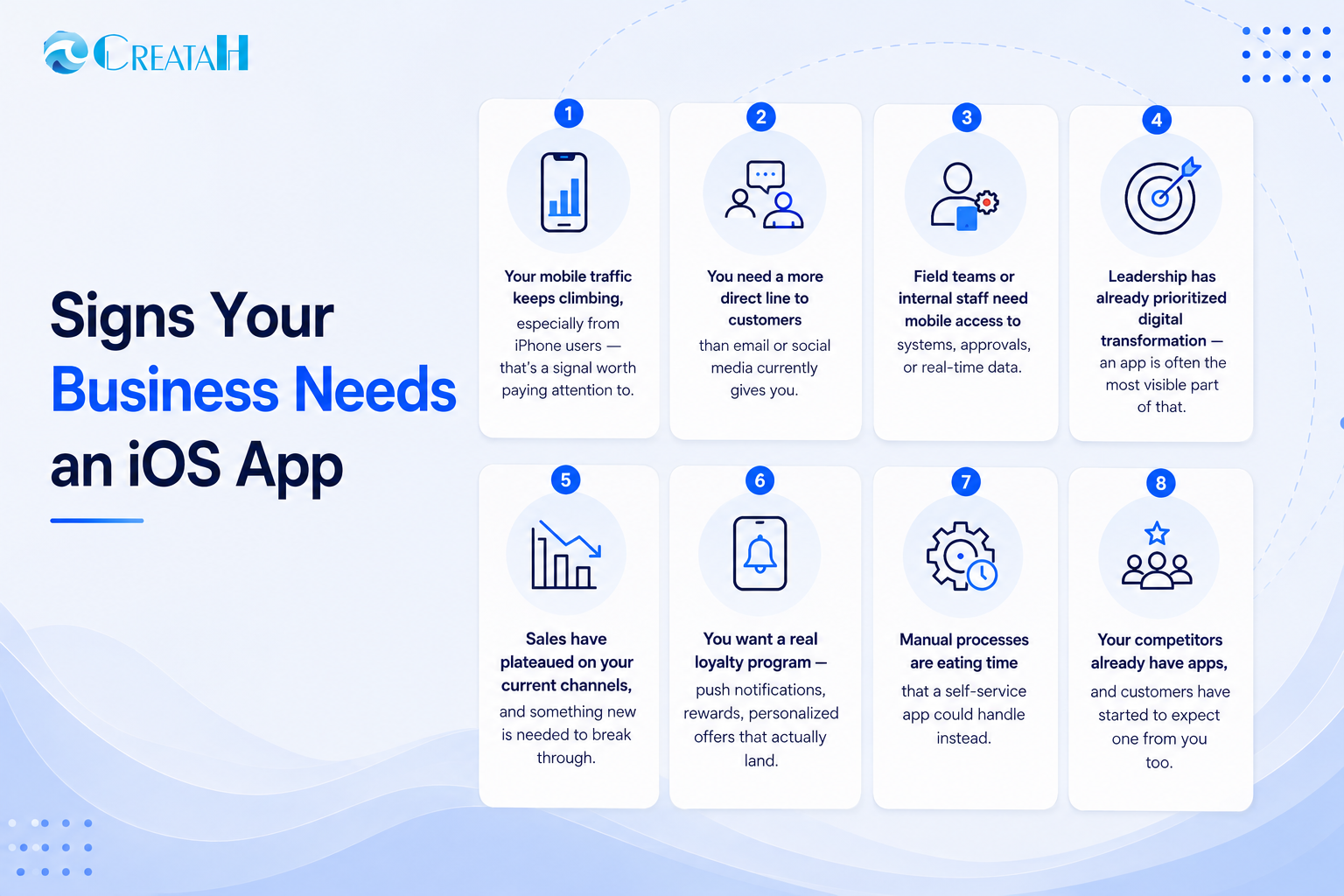
- Your mobile traffic keeps climbing, especially from iPhone users; that’s a signal worth paying attention to.
- You need a more direct line to customers than email or social media currently gives you.
- Field teams or internal staff need mobile access to systems, approvals, or real-time data.
- Leadership has already prioritised digital transformation, and an app is often the most visible part of that.
- Sales have plateaued on your current channels, and something new is needed to break through.
- You want a real loyalty programme push with notifications, rewards, and personalised offers that actually land.
- Manual processes are eating time that a self-service app could handle instead.
- Your competitors already have apps, and customers have started to expect one from you too.
Key Services Offered
A team worth hiring in this space should cover the full range:
- Custom iOS App Development — built around your actual business logic
- Enterprise iOS Apps — secure, scalable tools for internal operations
- iPad App Development — layouts designed for larger screens and productivity use cases
- Apple Watch App Development — companion apps for fitness, notifications, quick access
- AI-Powered Apps — recommendations, chat assistants, predictive features
- IoT-Connected Apps — interfacing with connected devices and sensors
- API Integration — connecting payment gateways, CRMs, and third-party tools
- App Modernization — upgrading architecture, design, and performance without a full rebuild
- UI/UX Design — built around real user behavior, not just how it looks in a mockup
- QA and Testing — thorough, across devices and edge cases
- Ongoing Maintenance — bug fixes, OS compatibility, feature updates
- App Store Deployment — submission, compliance, and approval optimization
Native iOS vs. Cross-Platform
One of the most common decisions businesses wrestle with: build natively for iOS or go cross-platform with something like Flutter or React Native?
| Factor | Native iOS (Swift) | Cross-Platform |
| Performance | Highest — fully optimized for Apple hardware | Good, but slightly less optimised. |
| Cost | Higher upfront if targeting multiple platforms | Lower if targeting iOS and Android together |
| User Experience | Feels fully native, follows Apple design language closely | Can feel slightly less “native” in edge cases |
| Security | Deep access to Apple’s security frameworks | Generally strong, but with an extra abstraction layer |
| Maintenance | Simpler for iOS-only updates | A single codebase can simplify multi-platform maintenance |
| Scalability | Excellent for complex, high-performance apps | Excellent for simpler apps needing wide platform reach |
| Best Use Case | Apps prioritizing performance, premium UX, or deep Apple integration | Apps needing fast, budget-conscious multi-platform launch |
Go native if your audience is mostly iPhone users, you need serious performance (gaming, AR, heavy animation), or you’re building for enterprise-grade security requirements.
Go cross-platform if you need iOS and Android out the door at the same time, on a tighter budget, and the app itself isn’t doing anything especially demanding.
Industries Benefiting from iOS Apps
Healthcare — Patient portals, telemedicine, and appointment scheduling with the privacy safeguards that actually matter.
Banking & Finance — Secure mobile banking and investment platforms leaning on Apple’s security architecture.
Education — learning apps, virtual classrooms, and student engagement tools.
Retail — Branded shopping apps with personalization and loyalty baked in.
Manufacturing — Field service apps, inventory tracking, equipment monitoring.
Logistics — Real-time delivery tracking and route optimisation for drivers and dispatchers.
Travel — Booking platforms, itinerary tools, and personalised recommendations.
Hospitality — Guest service apps, digital check-in, and concierge-style features.
SaaS — Companion apps that extend a web platform onto iOS.
Real Estate — Property browsing with virtual tours and lead capture.
E-commerce — Seamless mobile shopping with Apple Pay baked in.
Startups — MVPs built to test product-market fit fast, without burning the whole runway.
How an iOS App Accelerates Business Growth
Retention improves. Push notifications and personalised touches keep people coming back more consistently than a website alone ever could.
Revenue tends to follow. Higher iOS conversion rates usually translate to stronger revenue per user.
You actually see what’s happening. Native apps generate richer behavioural data than a website, which means smarter decisions down the line.
Operations get smoother. Internal apps cut down on the manual back-and-forth that eats up a workday.
Field teams get faster. Mobile access to key systems matters most for people who aren’t sitting at a desk.
Loyalty compounds. A good app becomes part of someone’s daily routine; that’s not nothing.
It signals transformation. For customers, an iOS app is often the most visible proof that a business is modernising.
It opens doors elsewhere. Apple’s global reach makes an iOS app a natural stepping stone into new markets.
Why Chennai Is Becoming India’s iOS Development Hub
This didn’t happen overnight, but it’s happened.
Real depth in Swift talent. Strong engineering programmes and years of shipped projects have built up a genuinely capable developer base here.
Pricing that still makes sense. Costs remain considerably lower than Western markets without a meaningful drop in quality.
A mature IT ecosystem. Established IT parks and a long-running outsourcing industry support consistent, professional delivery.
Experience with global clients. Plenty of local companies already understand what international quality expectations actually look like.
A culture that keeps up. Proximity to India’s broader tech scene keeps teams current on new frameworks and Apple’s latest moves.
Agile is a standard practice, not an aspiration mentioned in a pitch deck.
A growing startup scene that keeps local teams sharp at building fast, lean MVPs alongside heavier enterprise work.
Mistakes Businesses Make When Hiring an iOS Development Company
Choosing based on price alone. The cheapest quote usually means something got cut – testing, security, or support, most likely.
Skipping the portfolio. Past work tells you more in five minutes than a sales call tells you in an hour.
Ignoring early red flags in communication. If a company is slow or vague before you’ve signed anything, it won’t get better after.
Assuming support continues after launch. It often doesn’t, unless it’s spelt out clearly upfront.
Underestimating security. Skipping proper encryption or secure API handling creates risk that shows up later, usually at the worst time.
Not planning for scale. Apps built without growth in mind tend to need expensive rebuilds within a year or two.
Skipping references. Reviews often reveal patterns of missed deadlines and weak support that a polished portfolio won’t show.
Not asking about hidden costs upfront. Vague pricing has a way of turning into surprise invoices mid-project.
Questions Every Business Should Ask Before Hiring
- Have you built apps in my industry before? Familiarity here shortens onboarding and avoids costly wrong assumptions.
- Can I see live App Store examples? Shipped apps tell you more than mockups ever will.
- Who’s actually on my project team? You want names, not just a sales pitch.
- Swift and SwiftUI, or older frameworks? Modern usually means easier long-term maintenance.
- What’s the realistic timeline? You need this to plan launches and marketing sensibly.
- Who owns the source code after delivery? It should always be you — get that in writing.
- How do you handle App Store rejections? Experienced teams know how to avoid the common ones.
- What security measures are actually built in? Ask specifically, not generally.
- What does your QA process actually look like? Get details, not just reassurance.
- What’s included in post-launch support, and what costs extra?
- How do you handle scope changes mid-project?
- Can I talk to a past client directly?
- How is pricing structured? Fixed, milestone-based, and hourly each carry different risks.
- How do you approach performance load times, battery use, and crash monitoring?
- What happens when I need to scale this later?
Emerging Trends in iOS Development (2026)
Apple Intelligence is turning on-device AI into a baseline expectation, not a novelty.
AI integration and smart recommendations and conversational interfaces are becoming central to how apps are designed, not an add-on.
SwiftUI keeps maturing into the default choice for modern, maintainable interfaces.
Vision Pro is opening up genuinely new categories of immersive business applications.
ARKit is moving past gaming into retail, real estate, and training use cases.
On-device machine learning through Core ML means faster, more private AI features without leaning entirely on the cloud.
Wearables are becoming more central to health, fitness, and quick-interaction use cases through the Apple Watch.
Voice interfaces are gaining ground, especially for accessibility and hands-free scenarios.
Cloud-native architecture now underpins most apps expecting real-time sync and cross-device continuity.
Privacy-first development keeps shaping how apps collect and disclose data, thanks to Apple’s continued push in that direction.
Why Businesses Choose Creatah
Choosing an iOS partner really comes down to trust that your idea will be understood properly, built well, and supported after launch instead of abandoned.
Our developers work daily in Swift and SwiftUI, with real experience across enterprise-grade iOS architecture in healthcare, retail, and service industries. We start with the business, not the code, understanding what you’re actually trying to achieve before anyone opens Xcode.
We work in Agile sprints, so you’re involved throughout regular updates, working demos, and not long silent stretches followed by a surprise. Communication stays honest the whole way through.
Security and scalability get built into the architecture from day one, not treated as something to figure out later. And once the app ships, we don’t disappear; ongoing support is part of how we work with clients for the long haul.
We’ve helped clients scale projects with real confidence, and we’re glad to talk through what that might look like for your business specifically.
An iOS app isn’t just a technical checkbox for a lot of businesses; it’s a genuine growth lever. Higher engagement, stronger conversion rates, a premium audience that actually spends. But none of that matters if the execution doesn’t match the ambition.
Working with the top iOS app development company in Chennai means partnering with a team that understands more than Swift syntax, one that builds something your business can actually grow with, securely and with support that doesn’t evaporate the day it ships.
If you’ve been circling the idea of building an iOS app for a while now, this is probably a good moment to take it seriously.
Curious what an iOS app could actually do for your business?
Get in touch with Creatah for a free consultation, and let’s figure out the right approach together.
