
With the continued growth of mobile use, fast, reliable, and scalable applications have become a critical part of today’s digital company. Today, users expect that their apps will be faster, and provide a better experience, at the same time, that
companies build with an eye on price and value. As the demands continue to escalate, the companies are searching for the fastest way to develop a mobile application and maintain a good user experience, which is why
so many large companies are adopting React Native as one of their mobile application development tools around the world. With React Native, you will build your mobile application with JavaScript, on one codebase, across all devices, and maintain the same user experience. There is no longer a need to build two different applications for the different platforms. You can create one application that feels like a native application across all platforms. For any company looking to scale very quickly, spend less time building applications, and maintain a consistent user experience on both platforms, the ability to do so with React Native is a significant advantage.
Creatah has experienced the positive effect that React Native has on product develop speed and performance. However, while Creatah’s experiences should be taken into consideration, there are many other factors to be reviewed when determining whether or not React Native is the best solution for your business, and there are many other reasons why many of the world’s largest brands continue to choose
React Native to drive success.
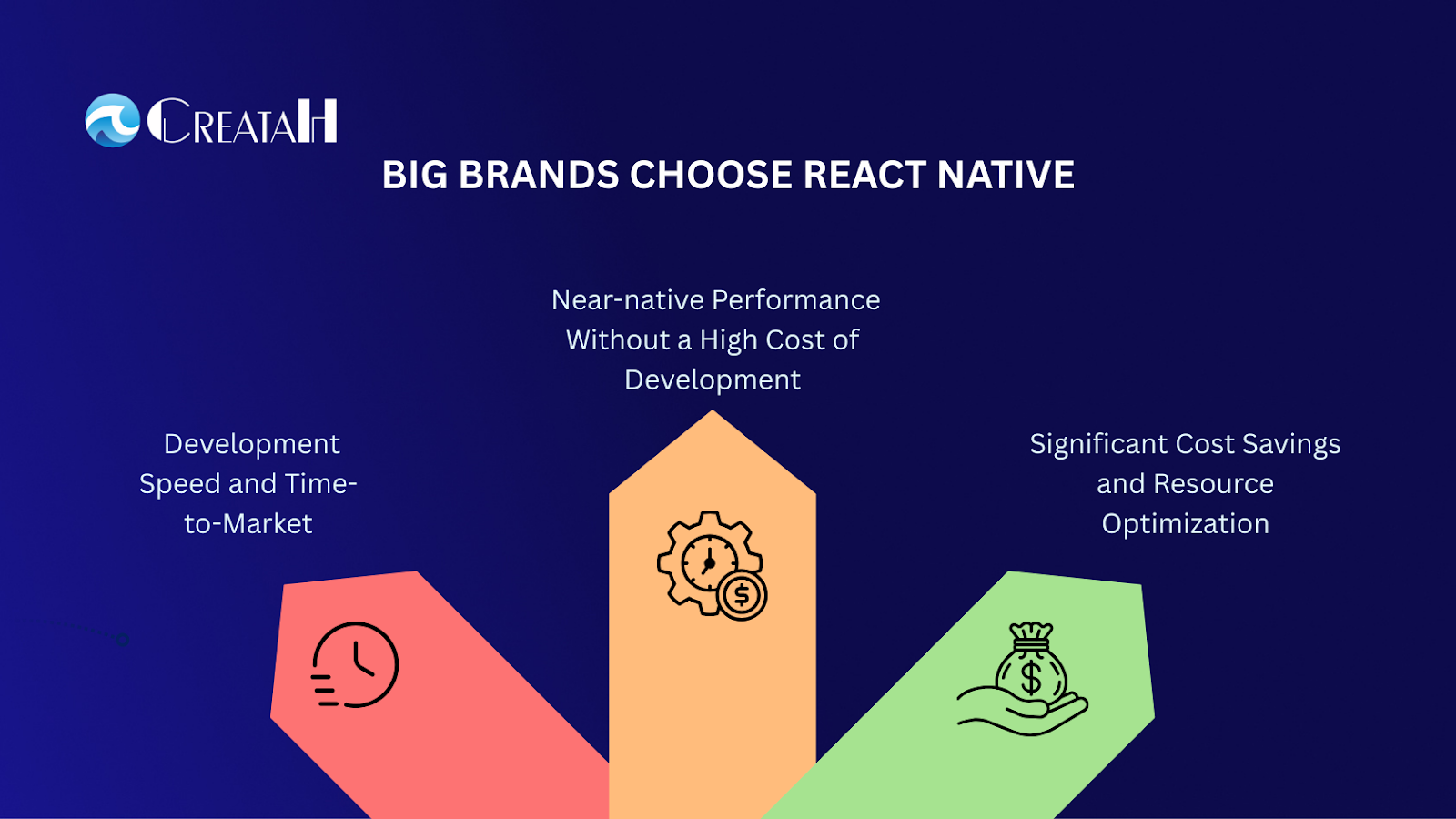
- Development Speed and Time-to-Market
In the fast-paced digital economy, time is a major competitive advantage. Companies need to react quickly to user feedback in order to stay competitive.
It is clear from the speed of react Native application development that the company that launches an application first will have the largest share of the marketplace. Because React Native allows developers to reuse 70-90% of the same code for both Android and iOS platforms, it creates the fastest way for developers to build mobile applications and ultimately provides the minimum amount of time to develop a mobile application, and therefore provides the maximum opportunity to grow the business and the total user base.
Real World Example: Instagram
Instagram has implemented React Native on both iOS and Android platforms to accelerate their ability to develop and introduce new features. By adding React Native to their existing application platforms, they were able to build shared React Native modules that connect both platforms and allow them to develop new features while allowing them to push out updates at a faster pace without sacrificing quality. This hybrid model also demonstrated that React Native is ideal for enhancing already existing large enterprise systems as well as developing new apps.
- Near-native Performance Without a High Cost of Development.
It is often thought that cross-platform applications tend to be sluggish or heavy, but in fact, React Native’s use of optimized rendering capabilities and native components provides an exceptionally similar performance level to that of any application developed with either Swift or Kotlin.
Case Study: Tesla
The official mobile application for Tesla, which has been adopted by millions of people across the globe to control a multitude of automotive functions and services including charging, climate control, security, and driving commands, was built using React Native.
This is a mission-critical application where performance and reliability are of utmost importance, and the decision to adopt React Native was based upon its strength at delivering a native-like app experience while simultaneously lowering the cost of developing that native-like experience. The outcome is an application that is user-friendly, responsive, and secure while delivering a seamless experience for users without issues related to sluggishness.
2 Significant Cost Savings and Resource Optimization.
In hiring two separate teams for iOS and Android, you have doubled your development and maintenance costs. By utilizing React Native, companies have only one team, code base and development process to manage.
Case Study: Walmart
The retailer Walmart made the decision to use React Native to redevelop portions of their mobile app for the sole purpose of reducing cost while improving performance.Walmart experienced 95% code reuse between Android and iOS after implementing a unified codebase with React Native, which resulted in faster rollout of features, better optimisation for low-end devices etc. There was also substantial savings reported by Walmart’s engineering team, making React Native a long-term strategic development methodology.
Minimal maintenance and future-proof scalability were primary objectives in converting from a native platform to React Native. While platform-specific updates are required whenever UI changes on these platforms, React Native makes these processes instantaneous through the use of shared UI logic and the use of scalable architecture.
Pinterest is an example of how a company used React Native to improve productivity with developers; after running an internal study on the use of React Native, Pinterest found that the average time spent creating a screen had decreased by 50%. Due to this success, the company has grown to implement React Native in all mobile engineering teams.
Numerous advantages to using React Native, such as improved maintainability, speedier collaboration, and decreased technical debt, will aid Pinterest in achieving its long-term mobile goals.
The open-source ecosystem surrounding React Native is rapidly growing, with thousands of plugins, libraries, components, UI kits, and other tools available from the React Native community. These community resources enable developers to build applications much faster than if they were to build everything from scratch.
For example, Uber Eats used React Native in their Restaurant Dashboard Application to manage real-time order flows. By using community-created packages and developing custom native modules, Uber Eats was able to create an application that was much faster and improved real-time communication and an easier multi-restaurant interface. The Uber Eats Dashboard Application is currently in use by restaurant owners worldwide, demonstrating the scalability and performance capabilities of React Native.
At Creatah, we support companies of all types to transition to developing using React Native by enabling them with increased speed of launch and lower app development costs of 40-60%. Additionally, React Native is perfect for fitness applications, wellness platforms, logistics management, eCommerce products and SaaS offerings. Finally, React Native has been developed by Meta and is used by many companies with over one billion users!
React Native is an essential part of developing mobile applications quickly and efficiently, and we at Creatah help our clients with their app development in order to make sure that they can continue to innovate as businesses.
The future of mobile application development is in cross-platform solutions, and React Native is the leader in this area. Major brands such as Instagram, Tesla, Walmart, Pinterest and Uber chose to develop using React Native due to its performance, scalability, and long-term cost-effectiveness.
As companies continue to innovate at an ever-increasing rate, it is vital that large corporations develop their mobile applications using React Native to ensure that they are able to keep up. If you are currently thinking about your next app or looking to modernise your current app, React Native is more than just an option – it is an essential competitive advantage!
