

React Native for E-commerce, Healthcare, Fintech & EdTech – Real Use Cases
If you are wondering why React Native is so popular among businesses that are building scalable mobile applications across many domains of work, you are in the right place! Regardless of whether you are in the E-commerce, Healthcare, Fintech, or EdTech sector, React Native is changing how we build, deploy, and scale these applications. In this post, we will look at React Native real use cases in these four hot sectors to see how and – more importantly – why it continues to be a choice for startups and enterprises alike.
Why React Native is Different
Before we delve into true use cases, let’s identify the reasons for the growth in interest in using React Native.
- Cross-platform development – develop ios and Android applications in a single codebase.
- Rapid deployment – Less time to make use of hot reloading and pre-built UI features.
- High Performance – Near native performance by using React Native bridges.
- Strong ecosystem – backing from Facebook and a massive open source community.
Lower cost – reduced dev time, dev maintenance time and long-term costs.
Let’s now dig into some unbelievable real-world use cases of React Native across these industries.
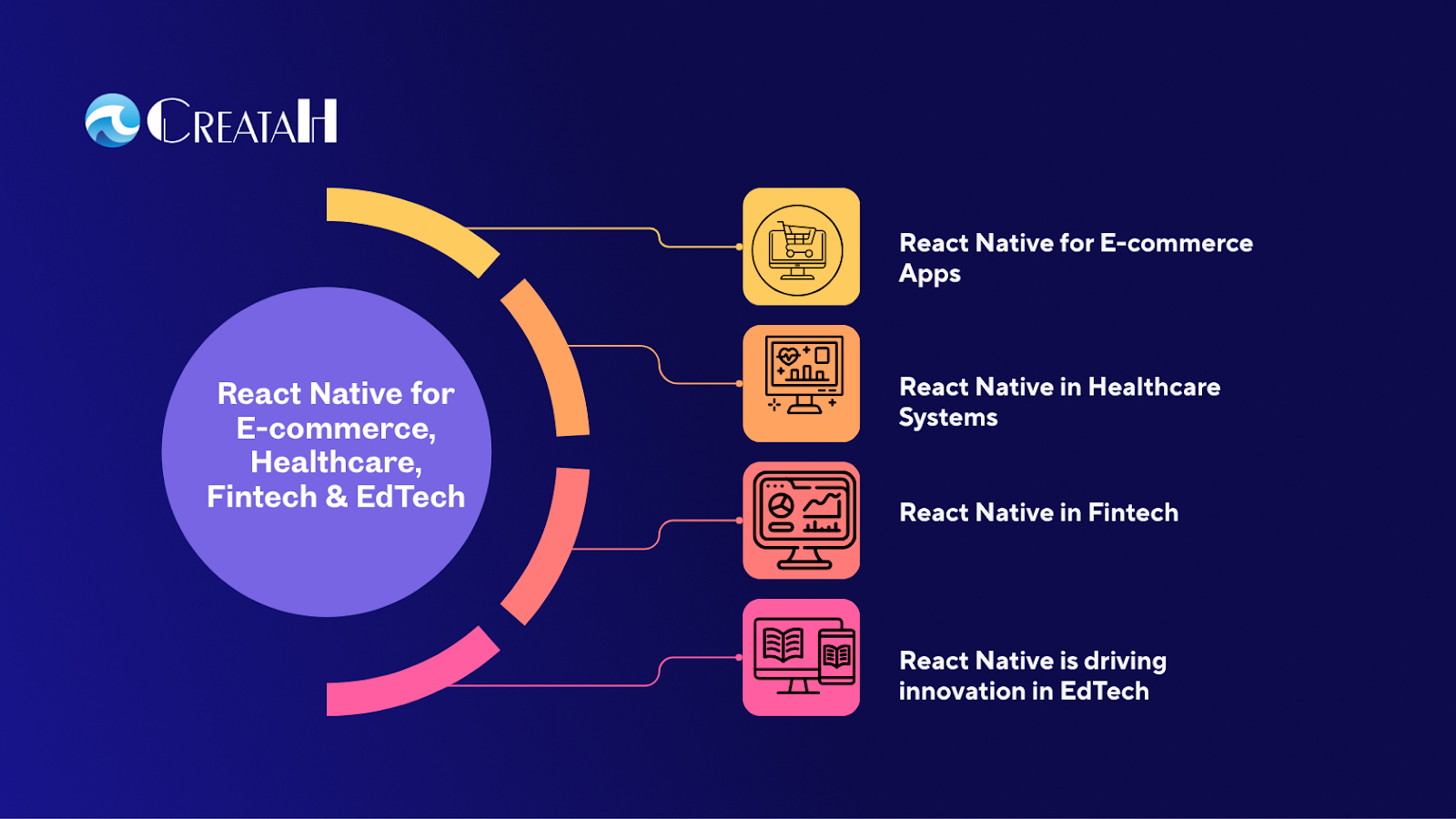
1.React Native for E-commerce Apps
E-commerce applications need to be particularly rapid, and engaging, and highly scalable. Consistent competition means that you need an app that not only handles high traffic, smooth transitions and content personalization while maintaining, not violating, a budget.
Real Use Case: Building a Marketplace App
Let’s sayReact Native allows you to:
- Effortlessly incorporate real-time inventory, filters, and product categories
- Integrate animations and gestures for delightful UX
- Allow secure checkout using Stripe or Paypal plugins
- Easily track users with analytics tools
For example, apps like Flipkart and Shopify Mobile leverage React Native to deliver anefficient and engaging shopping experience to customers, across both platforms, in a fraction of the time of a native app.
Key Benefit: Quick prototyping and scalability, with one code base and continuous updates.
2 .React Native in Healthcare Systems
With patients expecting quality care from their apps right from their smartphones, it is important for the healthcare sector to optimize apps they’ll be secure, reliable, and the overall usability of them can be used without confusion. React Native can achieve this, as it has a blend of performance and adaptability and dynamic possibilities.
Real Use Case: General Patient Care & Doctor Consultation App
What is a hospital or clinic going to build? An app that will include:
- Patient registration & onboarding
- Video consultation/Telemedicine
- Prescription Management
Scheduling appointments
Communicating with the doctor/patient
That is incorporated into the UX/UI development with React Native, allowing for HIPAA compliant workflows, and having optimal smooth micro-interaction flows in-app is essential in the very sensitive environments which healthcare typically can be. Some of the digital healthcare platform apps that utilize React Native for in-app usage is Practo and Zocdoc.
Key Benefit: It is easier to build and integrate multiple modules like EMR, video calls, notifications within the same app for seamless usability with reusable components.
3.React Native in Fintech
Handling money will always need to be efficient and secure.Fintech apps typically utilize complex transaction logic, P2P transfers and third-party integrations, such as banking APIs. React Native is helping disrupt the finance world with the speed capability and functionality it provide in real time.
4.Real use case Digital banking app
When building a banking or investment app, React Native provides:
- Real-time transaction updates
- Graphical analytics for spending/investing
- Secure biometrics and OTP login Without delay
- Cross-device consistency
Fintech apps such as Coinbase, Robinhood, and Revolut also harness the benefits of React Native for a portion of their UI to give users a fast and fluid experience, particularly for their mobile-first users.
Key advantage: Speed of innovation and deployment cycle even if securely engineered or overly reliant on high-tech engendering teams.
5.React Native is driving innovation in EdTech
Online learning is no longer simply zooms of recorded lessons. Today’s EdTech apps need quizzes, discussions, lesson tracking, live video classes, student-centered design, and personalized learning pathways built in. React Native is uniquely suited to enabling such interactive and user-centered learning experiences via apps built to do so.
Real use case Mobile learning platforms allowing for live interactive video/lessons
Here’s how EdTech platforms are using React Native:
- Integration of live-streaming application module & live chat module
- Gamified learning & evaluation
- Offline-enabled content for easy learning
- Personalized course suggestions based on use
- Multi-language support for global or sub-regional learning experiences
Common EdTech platforms like Duolingo and Udemy are utilizing React Native to provide easy management of updates, a more engaging UI, and consistent user performance across devices.
Key advantage: Less dev-time creates more room for experimentation with features designed to facilitate user engagement.
Why React Native works across these industries:
Across all these industries, ecommerce, healthcare, fintech and EdTech, React native is proving it can be consistently relied upon because:
- Reusability… React Native’s components can be reused, not just across screens but across apps/projects.
- Community… There is ongoing support via plugins & libraries that can broaden an app’s functionality via the community.
- Native modules… Work seamlessly utilizing native modules to easily integrate location services, file uploads, a camera, payment gateways, and Bluetooth connection.
- Future proofing… Meta & the open-source community are continually improving the technology.
- It allows for rapid deployment cycles, minimizes dependencies on separate iOS/Android development teams and ensures whoever the end user is will get a clean, intuitive experience.
Final thoughts: Is React Native a good choice for your next big app?
Whether you’re building a shopping app, a remote patient app, digital wallet, or an AI-powered ed system often proceeds to prove the chance it takes. On the whole, its consistency in performance, scalability, and cost continues to strongly position it as a top choice for businesses across the above industries.
At Creatah, we’ve built solutions in all four domains, essentially helping businesses solidify their unique digital journey with smart, scaleable, and engaging solutions/apps. Built from teams of experienced engineers with hands-on react native development experience focusing on blending the business objective with an exceptional UX, who then build apps that work where it means an app is entrusted with the user’s task or solves a pain point.
From healthcare booking apps to cashier-less e-commerce solutions – if you’re ready to turn your idea into a real solution React Native won’t just be a solution, but your advantage.
If you would like, I can also put this into a downloadable pdf, as either a LinkedIn post, carousel, or email sequence.
