
How a Flutter App Can Transform Logistics Tracking and Real-Time Delivery Operations
The Significant Impact of a Flutter App on Logistics Tracking and Real-Time Delivery Operations
1. The Need for Real-Time Delivery Tracking for Logistics Has Never Been Greater
Currently in logistics, real-time tracking is much more of a “must-have” rather than a “nice-to-have.” Customers want to know instantly when their delivery will arrive, and businesses want the ability to see real-time visibility into their fleet and movement of shipments. The logistics industry has come a long way from shipment notifications, and now you can leverage “intelligent tracking,” which allows you to see the live location of an order, timeline of delivery, and whether there is a delay.
For companies that depend on outdated visibility options, they are left figuring out the most efficient way to overcome lost time that arose from delays ultimately effecting the cost of delivery all while not knowing for certainty whether or not their deliveries will be on time for their customers. Mobile technology can give those companies the opportunity to use Google’s Flutter to provide delivery tracking based on real-time data. A real-time delivery tracking app will ensure accurate communication between driver, dispatcher, and customer respectively, which will develop confidence and transparency for all parties involved in the supply chain.
2.Why Flutter is a “Game Changer” for Logistics App Development
Building high performance logistics apps is inherently in the sweet spot and wheelhouse with developing in Flutter. Flutter allows developers to provide cross platform experiences with a single code base significantly reducing costs and time to develop.
Flutter has evolved beyond a traditional or dated native app which means you can either develop two separate builds to run the apps for each device (Android and iOS) or make a cohesive app in Flutter that runs flawlessly. That time can then be used to develop and build better cohesive design, and potentially improve performance.
The end result for logistics companies is a simple and faster time to market of the products, as well as an easier way to market test and deliver new features to the delivery tracking app in a timely manner. Flutter has a reactive UI framework (and native-like performance) that allows speed that is of the essence in the fast world and pace of logistics, and requiring real-time data syncing operation.Essential Delivery Tracking App Features for Logistics Companies
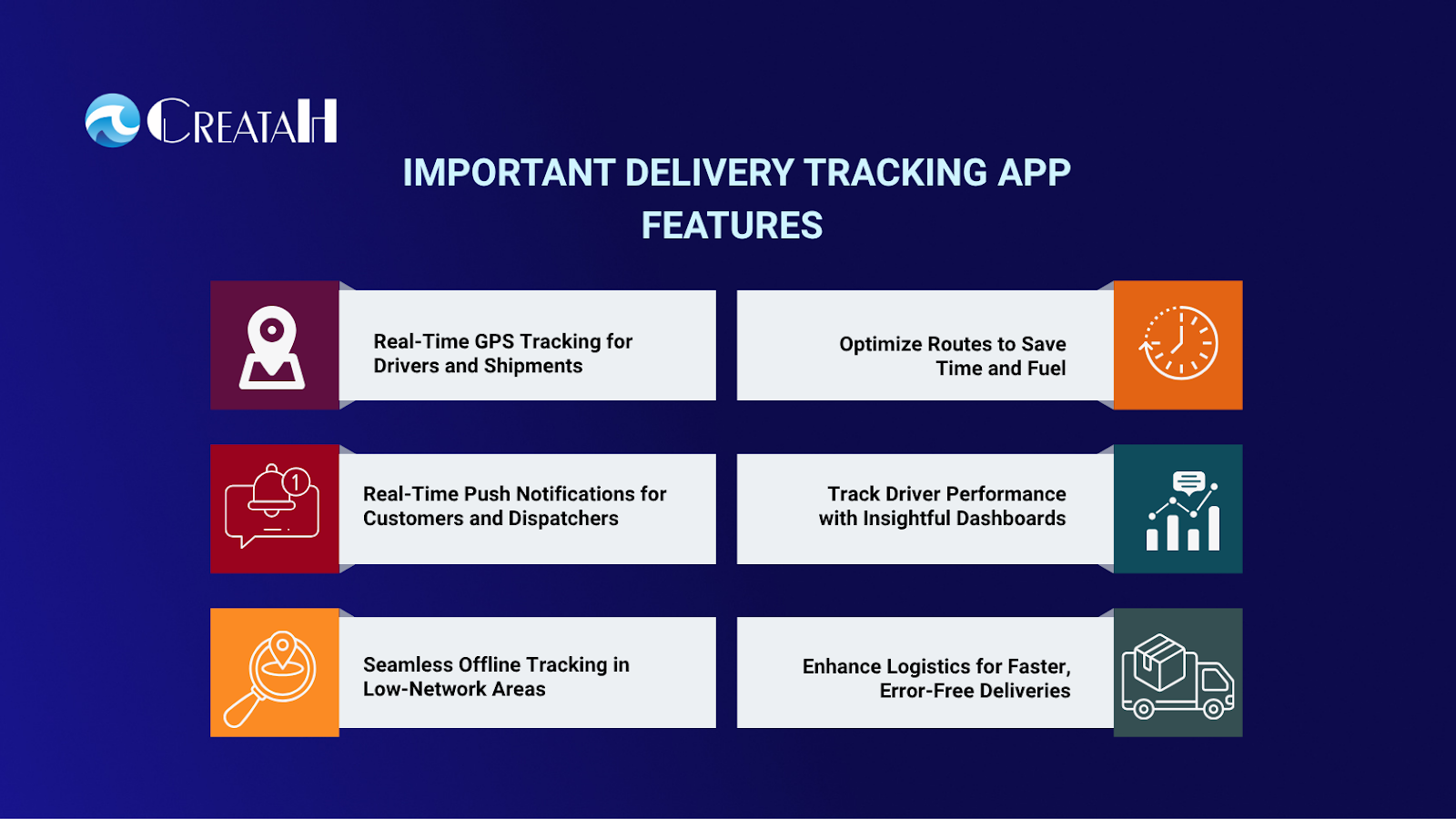
Developing a logistics app isn’t simply about displaying pins on a map—it’s about allowing comprehensive operational control. Some of the most important delivery tracking app features to include are:
- Real-time GPS tracking to help monitor the driver location, as well as the shipment location.
- Route optimization to reduce delays and fuel expenses.
- Push-notifications and updates to keep customers and dispatchers informed in real-time.
- Dashboards to track driver performance metrics such as delivery times and routes taken.
- Analytics and reporting capabilities that provide insights into performance and fleet efficiencies.
- Offline functionality that allows tracking to continue in low-network areas.
- Do incorporate these features thoughtfully, you can significantly improve logistics workflows, resulting in faster deliveries, reduced errors, and more satisfied clients.
3.How Flutter Makes Real-Time Tracking Functionalities for Delivery Apps Easy
Real-time tracking means there is communication and data exchange occurring between devices, servers, and the cloud, constantly. Flutter makes this solution seamless with its reactive architecture and API integration to the cloud.
Because of Flutter, developers can easily incorporate geolocation APIs, Firebase real-time databases, and Google Maps SDKs to provide live tracking functions and updates. Using Flutter’s widget-based UI, every time a location is updated, delivery changes, or routes adjust it will occur swiftly displaying accurate information on the app interface – with no lags or reloads.
This makes Flutter not only efficient and fast but a scalable option for larger logistics companies – as they may manage hundreds of deliveries each day.
4.Improving Fleet Effectiveness with Flutter-Enabled Route Optimization Tools
Route optimization is quintessentially one of the most valuable delivery tracking app features offered to the logistics industry. Flutter-based apps can optimize routes using AI and mapping APIs to provide the fastest routes, as well as the most fuel-efficient routes live and in real time.Drivers are informed about the traffic conditions, alternative routes for any issues, and if the weather is a delaying factor for any deliveries. All of this allows drivers to make better decisions regarding their routing. Dispatchers can also see where vehicles are located, and quickly reroute drivers all in one view.When logistics routes are optimized, this leads to more efficient travel times, less fuel spent, and greater on-time deliveries—all factors that directly relate to profitability.
5.Seamless Integration: Tie Flutter Apps to Your ERP and Warehouse Systems
The true power of a logistics app comes by integrating into existing systems. Flutter ties right into an existing ERP platform, CRM tools, and warehouse management systems (WMS).
This gives visibility to the warehouse with up-to-date information about inventory levels, order status, and order delivery updates. For example, when a warehouse mark an order as “shipped,” customers can see the same type of update in relation to that order on the tracking screen.
Integrations also allow for manual entry to be removed which reduces errors and provides visibility along the entire process starting from when an order is placed to when the order is delivered.
6.Partially Solve Delivery Delays with Smart Notifications and Live Order Status Updates
Like any other industry, logistics is subject to delivery delays. However, delivery delays don’t have to be the norm when adding the right features and functionality on an app to track deliveries. For instance, a Flutter app can be programmed to send an update when a shipment has been dispatched, when a driver arrives, or if there is a delay.
Customers value timeliness on updates, and appreciate organizations that notify them—these same customers will have higher levels of trust with organizations that communicate proactively about would-be delays. In addition, smart notifications keep drivers on schedule and help relieve any questions on busy delivery days.The result is an uncomplicated and trouble-free delivery experience for all those involved.
7.Flutter App Performance: Managing real-time challenges and expansion
As logistics operations increase, performance is necessarily consider7. Flutter app performance: gaiting to the innovation and real-time data loads
As logistics increase the computer industry scaling an acceleration while integrity and effectiveness are typically considered. Flutter apps are designed to efficiently manage substantial amounts of data without sacrificing speed.
Using features like Firebase Cloud Messaging and built in background service support, Flutter develops a positive app performance state even at peak operational hours. And with optimized rendering engines and an inventory of tools, Flutter provides an attractive alternative in building high-performance apps that are excessive in real-time tracking and real-time near errors.
It does not matter if your logistics services 100 delivery or up to 10,000 some delivery every day with a Flutter concept app that has no dislikes it is difficult to maintain the outgoing activity management flows to keep aggregates on as required.
8.Case study snapshot: How a Flutter app tracked a logistics company and improved delivery accuracy to a level of 40%
A semi-sized company wanted to develop a tracking app for deliveries to augment the process with a framework. Within three months, delivery testing improved and within being very pleased provided the below information.
– 40% improvement in tracking visible delivery processes being real-time updates
– Driver communication time-up 35% due to ability to automate alerts and updates
– Customer satisfaction scores 25% better all relayed by transparency.
9.The Future of mobile apps is also changing because new technologies, processes and better predictive analytics support the movement for delivery operations and thus moving Flutter’s total agreement.
With the expected improvements for embedded systems, time series algorithms for better data handling for IoT support, which enables transportation and or logistics companies the ability to develop better predictive models making decisions information real-time or added delays with AI and better planning routes that may be powered from either a transport IoT sensor developed or stand alone.
Companies adopting a Flutter type after today can be expected to last ten years or beyond for their digital strategy and operation.
The future for logistics and the delivery of services lies with technology that gets there sooner and near the delivery and the technology that provides flawless and great reduction, Flutter enables flexible, scalable and visibility.
This is not immediately visible but enhanced remains a need for enhancement company operational delivery activity and thus costs savings to share near the customer experiences.
At Creatah we genuinely support Flutter app development that is very successful for the better and thus transforming overt delivery view task to data transportation and truly smart ones. If you do not mind process strategy and planning technology and mobile plan to deploy contact us to remapping to conceive.
