
On-Demand Logistics Apps: The Uberization of Transport and Delivery
Digital innovation has disrupted the landscape across many industries over the last three years. No industry has remained unaffected by digital innovation, and logistics is also undergoing significant change. The advent of on-demand logistics apps has revolutionized how good are moved and delivered. Just as Uber changed personal transport by enabling drivers and riders to connect in real-time, logistics apps are “uberizing” the movement of goods, enabling delivery processes that are considerably more efficient, timely, transparent, and customer-focused.
This is simply incredible for the efficiency of the operations for businesses, delivery agents, and end-users – and it has opened the door for technology-led companies offering logistics services.
What Are On-Demand Logistics Apps?
On-demand logistics apps offer digital platforms that create a marketplace in real-time for shippers, delivery service providers, and customers. With the advancements of mobile technology, GPS tracking, cloud platforms, and analytics technologies, on-demand logistics apps provide a heightened level of responsiveness, transparency, and scalability in supply chain processes.
In essence, the functions for the app can be categorized as:
- The customer can request for a delivery at any time (even at the last minute).
- The business can obtain real-time tracking on the shipment of their goods.
- The driver or courier can view requests for jobs nearby, reducing wait times and maximizing efficiency.
The Uberization of Transport and Delivery
The “uberization” of an industry is when the traditional industry changes to an app-based, digital-first model that lets customers book services instantly. In logistics, this can help solve existing inefficiencies like slow shipments, limited visibility, and high operating costs.
On-demand logistics apps create new customer experience and value propositions that include:
- Real-time Availability: Instead of waiting days or even weeks, customers can book and track shipments instantly.
- Transparent Pricing: Price estimates and competitive pricing models create a great level of fairness assessment.
- Optimized Routes: AI and in-app GPS provide intelligent routing to deliver as fast and as cheap as possible.
- Customer Trust: With real-time updates, customers build trust as they can now rely on their service provider.
Key Features of On-Demand Logistics Apps
On-demand logistics apps enable businesses to leverage new features that can fundamentally change the operational capacity of their business:
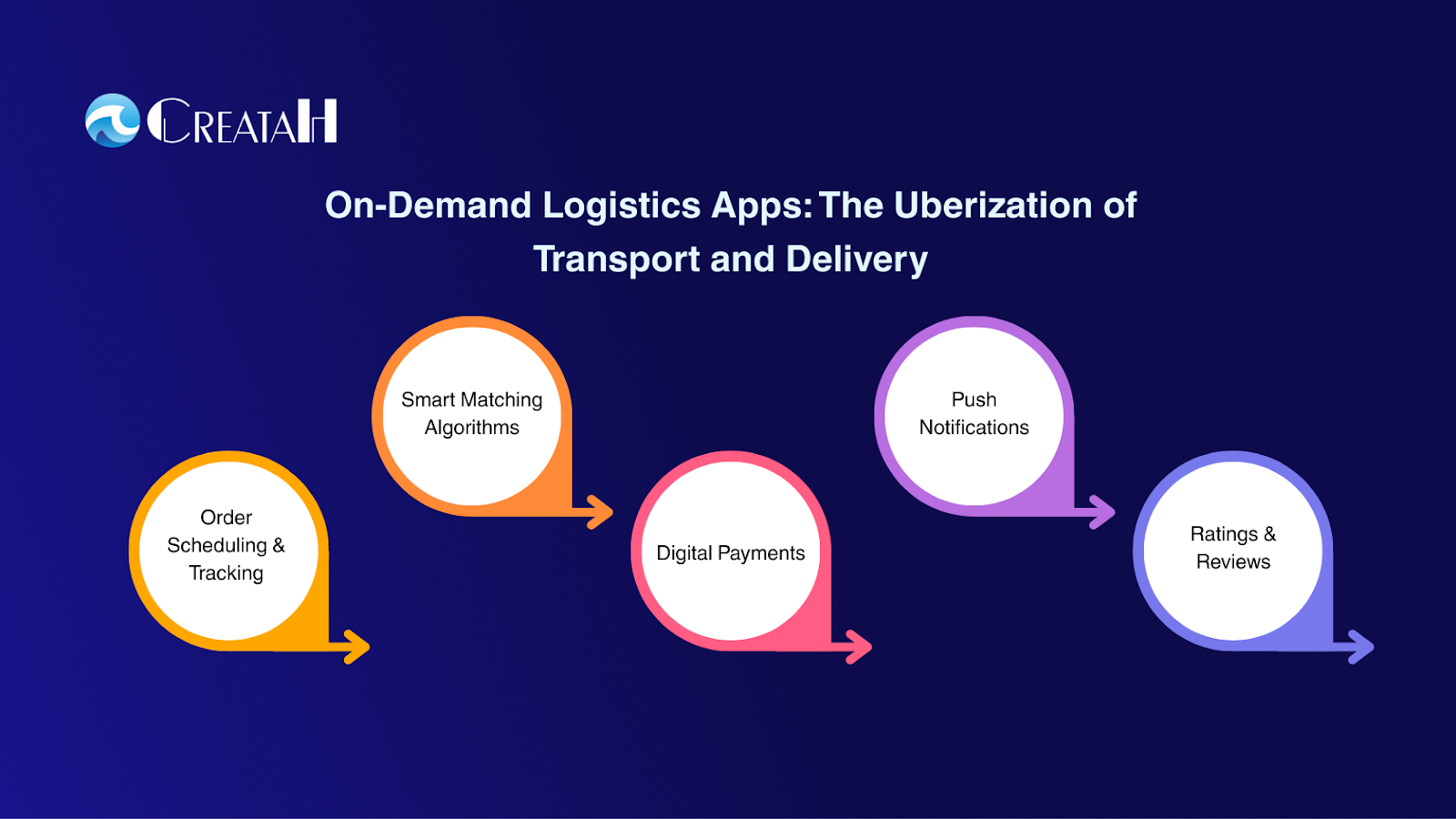
Order Scheduling & Tracking: Customers can schedule a pickup of their orders and track shipments on the go.
Smart Matching Algorithms: Automatically assign the nearest driver reducing wait time and improving service reliability.
Digital Payments: Very secure payment options that can be integrated into the app easily.
Push Notifications: Customer feedback including order delivery status, estimated time of arrival, and notice of delays to manage expectations.
Ratings & Reviews: A two-way channel for transparent performance feedback.
Analytics Dashboard: Businesses can monitor their fleet performance, operations performance, customer satisfaction, and logistics KPI’s in real-time.
Benefits of On-Demand Logistics Apps
The advent of app-based logistics has generated immense value throughout the logistics sector.
- For Customers:
Faster and more reliable delivery
Real-time visibility and tracking
Transparent pricing and payment options - For Businesses:
Reduced operating costs through route optimization
Improved customer satisfaction and repeat sales
Scalable systems that accommodate peak demand seamlessly - For Drivers/Couriers:
Increased jobs and reduced idle time in delivering
Fair pricing model with a guarantee that they will get their pay as soon as they take a job
Flexible work on-demand
Industries Adopting On-Demand Logistics
This app phenomenon is not only restricted to one industry, but many industries are exploiting the model for logistics as well.
- E-commerce: Same or next-day delivery service for online shopping.
- Food & Grocery: Platforms that provide quick commerce for essential items with delivery in hours.
- Healthcare: Critical logistics to deliver drugs, reports, and medical equipment.
- Retail: Streamlined last-mile delivery on behalf of local stores.
- Manufacturing: Movement of raw materials and finished products throughout the supply chain.
Challenges to Overcome
Despite the opportunities, on-demand logistics still faces hurdles:
- Regulatory Compliance: Complying with first, second transportation and labor laws in various regions.
- Data Security: Securing sensitive shipment and customer information.
- Driver Reliability: Ensuring consistent service quality.
- Tech Investment: Upfront costs about building a strong platform that scale for complexity.
Addressing these obstacles will demand not just leading-edge technology, but smart operational tactics and partnerships.
The Future of On-Demand Logistics Apps
The future of on-demand logistics apps is looking even more disruptive with the introduction of AI, IoT, blockchain, and autonomous vehicles in the logistics sector. Some predictions include:
- Drone & Autonomous Deliveries: Reducing delivery times for urban and remote locations.
- Predictive Analytics: Anticipating demand spikes and sending resources to prepare well in advance.
- Blockchain Tracking: Immutable ledgers, creating transparent global supply chains.
- Sustainability Goals: Electric vehicles and eco-friendly delivery options.
These developments will help make logistics faster, cheaper, greener, and more reliable.
On-demand logistics applications are perhaps the most notable trend in the digital economy. These applications are “uberizing” transportation and delivery by providing businesses with real-time visibility, optimized delivery, and customer-friendly solutions. Businesses that embrace the shift to disruptive on-demand logistics applications can reduce costs, improve trust from customers, and grow quickly in the competitive marketplace.
At Creatah, we design and build logistics applications that are scalable and help businesses remain competitive. Our strong experience in mobile application development is key to helping brands rethink their supply chain and provide the best experience possible to their customers.
