
How Flutter Reduces App Development Time and Cost
In a fast-moving digital economy, speed and efficiency have become the new currency of success. Businesses looking to launch a mobile app no longer have the luxury of spending months or even a year on development. They need to build faster, launch sooner, and iterate continuously. This is exactly where Flutter app development excels, enabling companies to create high-performance, cross-platform apps quickly while maintaining a seamless user experience.
Developed by Google, Flutter is an open-source framework that allows developers to create high-quality cross-platform applications using a single codebase. From startups to enterprises, many have adopted Flutter as their go-to framework to cut costs, reduce timelines, and deliver consistent user experiences across Android and iOS.
Let’s dive into how Flutter effectively reduces both app development time and overall project cost without compromising on performance or quality.
1. Single Codebase for Multiple Platforms
Traditionally, mobile apps required separate codebases for Android and iOS — meaning two different teams, two different timelines, and double the cost. Flutter eliminates this inefficiency by offering a single codebase approach.
With Flutter app development, you can write once and deploy across Android, iOS, web, and even desktop platforms. This drastically cuts down the amount of development effort needed, reducing both time and cost by nearly 40-50% in many cases.
For example, instead of maintaining two teams for Swift and Kotlin, a single Flutter developer can handle both platforms. Updates and bug fixes also become faster since you only need to make the change once.
2. Hot Reload: Rapid Iteration and Debugging
Flutter’s Hot Reload feature is one of its biggest time-saving advantages. Developers can instantly view changes made to the code whether it’s UI tweaks, logic updates, or bug fixes without restarting the entire app.
This capability speeds up the entire development cycle, allowing for real-time experimentation and immediate visual feedback. Designers and developers can collaborate seamlessly, test different UI ideas on the spot, and fine-tune the app quickly.
In a typical native development setup, every minor UI change would take minutes or even hours to rebuild and test. But with Flutter, this process happens in seconds — directly translating to saved developer hours and reduced cost.
3. Ready-Made Widgets and UI Consistency
Another major reason Flutter app development is cost-efficient is its rich collection of pre-built widgets. These widgets follow Google’s Material Design and Apple’s Cupertino design principles, ensuring a native-like experience across devices.
Instead of writing custom UI components from scratch, developers can easily integrate Flutter’s widget sets to design visually appealing interfaces with minimal effort. This not only saves development time but also ensures a consistent and polished user experience across platforms.
Consistency is often a hidden cost in app development when apps look and behave differently on iOS and Android, it increases QA and maintenance time. Flutter eliminates this problem entirely.
4. High Performance Without a Bridge
Unlike other cross-platform frameworks like React Native or Cordova, Flutter doesn’t rely on a JavaScript bridge to communicate with native components. Instead, it uses the Dart programming language, which compiles directly into native ARM code.
This means Flutter apps perform almost as fast as native apps. Businesses can achieve native-like performance without hiring separate native teams, which again brings down overall cost.
Performance issues like lag, UI jank, or slow animations are minimized, which reduces the time spent on performance optimization and testing before launch.
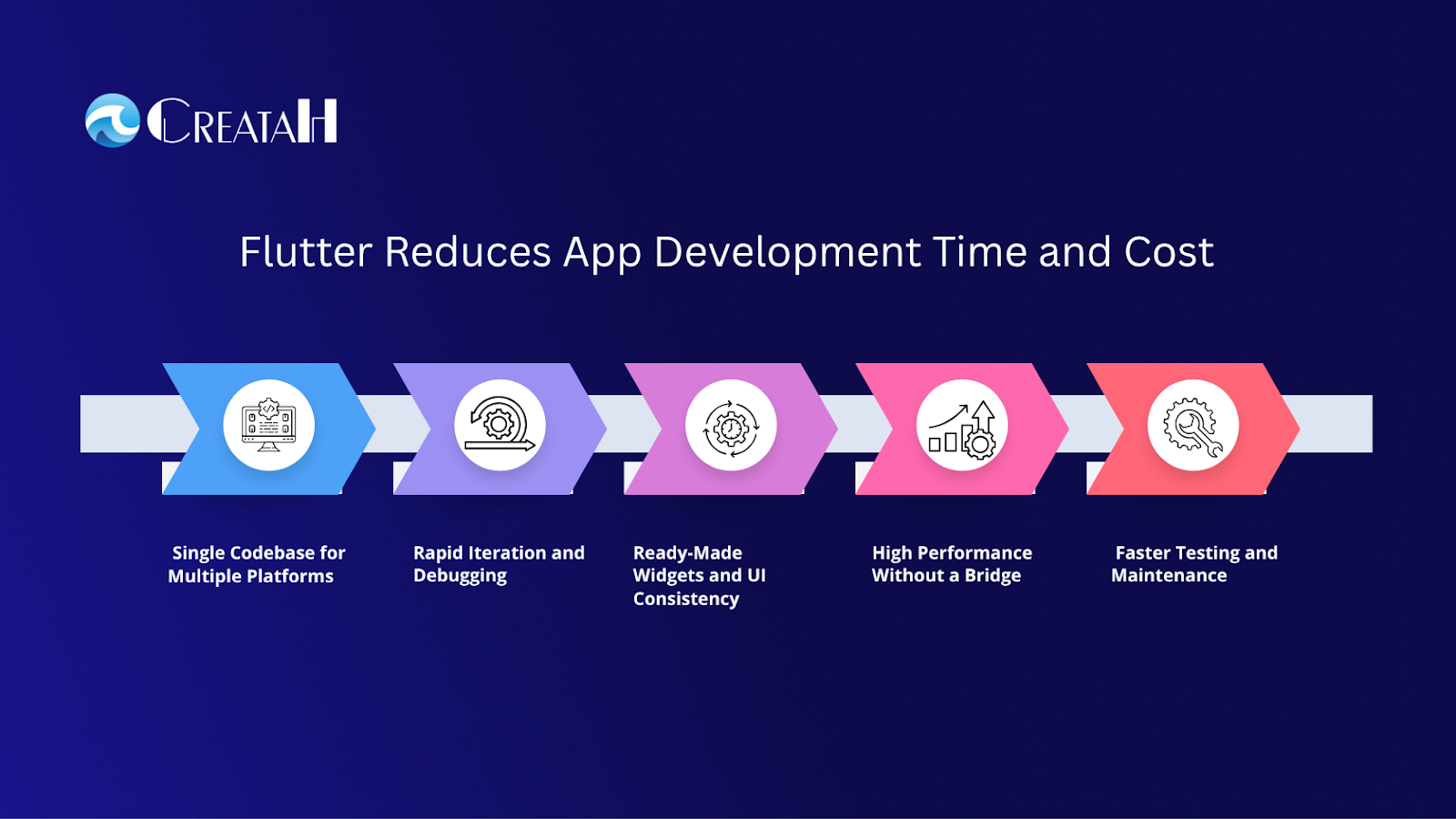
5. Faster Testing and Maintenance
Since Flutter apps share a single codebase, quality assurance (QA) becoes much easier and faster. Testers don’t have to run through separate test cycles for Android and iOS; a single testing process ensures both platforms perform correctly.
Furthermore, maintaining the app post-launch is significantly simpler. When a new feature or fix is introduced, you only need to update one codebase. This cuts maintenance time by up to 60% compared to traditional native development.
Long-term, this streamlined maintenance process saves businesses substantial operational costs — especially those managing multiple app versions.
6. Open-Source Ecosystem and Community Support
Flutter’s open-source nature provides access to a vast library of free packages, plugins, and community-built tools. Developers can integrate APIs, animations, and backend services without building them from scratch.
For startups or small businesses operating on limited budgets, this is a game-changer. You can leverage pre-built open-source solutions instead of paying for expensive custom components — again saving both money and development time.
The Flutter app development community is active and growing rapidly, meaning new tools, UI kits, and updates are constantly released to simplify development even further.
7. Scalability and Future-Readiness
When your business grows, your app needs to grow with it. Flutter allows for effortless scalability because it supports modular development. You can easily add new features or integrate third-party tools without breaking the existing structure.
Its compatibility with Firebase (Google’s backend-as-a-service) makes it ideal for projects that need to scale quickly while keeping costs predictable.
This makes Flutter particularly appealing for businesses planning minimum viable products (MVPs) allowing them to launch fast, validate the idea, and then expand later with minimal rework.
8. Real-World Examples of Flutter Efficiency
Global brands like Alibaba, BMW, eBay, and Google Pay have all adopted Flutter to streamline app delivery. They’ve publicly shared how Flutter helped reduce development cycles, testing efforts, and maintenance overhead while maintaining top-tier user experience.
For startups and SMEs, this means they can now achieve enterprise-level app quality without enterprise-level budgets.
The Smart Choice for Modern Businesses
In an era where time-to-market defines competitive advantage, Flutter stands out as a smart, cost-effective solution. With its single codebase, native-level performance, pre-built widgets, and rapid development cycle, it allows companies to launch faster, spend less, and scale efficiently.
For businesses looking to build high-quality apps without inflating costs, partnering with the right Flutter development team makes all the difference.
At Creatah Software Technology, we specialize in mobile app development that blends speed, performance, and scalability. Whether you’re a startup testing your MVP or an enterprise scaling your digital ecosystem, our Flutter expertise helps you build faster, smarter, and more efficiently without compromising on quality.
