

Business needs don’t stay still for long. What worked for a five-person team running everything off spreadsheets stops working the moment that team hits fifty people, opens a second location, or needs systems that actually talk to each other instead of living in separate silos. That’s usually the point where “off-the-shelf” starts to feel like a compromise, and businesses start looking for the best custom software development company in Chennai that can build around how they actually operate, not just sell them another subscription.
This article walks through what modern business requirements really look like, why custom software tends to fit them better than generic tools, and what to look for in a development partner in Chennai.
What “Modern Business Requirements” Actually Means
It’s a phrase that gets thrown around a lot, so it’s worth being specific. In practice, it usually comes down to a handful of things: systems that connect to each other instead of sitting in isolation, software that can scale as the team or data volume grows, remote and hybrid teams needing access to the same tools from different places, faster reporting without manual data entry between platforms, and security or compliance needs that vary depending on the industry, especially healthcare and finance.
None of this is exotic. It’s just the normal friction that shows up once a business grows past its early, simpler stage, and it’s exactly where custom software tends to earn its keep.
Why Off-the-Shelf Software Starts to Fall Short
Generic software is built to serve as many businesses as possible, which means it’s designed around the average case, not your case. That works fine early on. The trouble starts once your workflow drifts from that average and an approval process with an extra step, a reporting format specific to your industry, and a customer journey that doesn’t quite match the tool’s assumptions.
At that point, most businesses do one of two things: force their process to fit the software or stack on workarounds spreadsheets, manual exports, and a second tool bolted on to cover the gap. Both work for a while. Neither works forever.
Benefits of Choosing Custom Software Solutions
Custom software solutions solve this by starting from the business’s actual workflow rather than a generic template.
The obvious benefit is that the software fits the software to do what your business needs, in the order your business needs it done, without extra steps that don’t apply to you. But honestly, the less obvious benefits tend to matter more over time. You own the system outright, so there’s no vendor quietly deciding your roadmap for you. It scales the way your business actually scales, not the way a SaaS pricing tier assumes you will. And it can integrate cleanly with the tools you’re already using, instead of relying on manual bridges between systems that were never meant to connect in the first place.
Cost works a bit differently too. There’s a real upfront investment, and yes, it’s higher than a monthly subscription. But there’s no recurring per-seat fee piling up as the team grows, which tends to even things out, sometimes in the business’s favour, over a few years.
What Makes a Company the Right Fit for Modern Requirements
Not every development company is actually set up to handle modern, integration-heavy, scalable software; some are still built for smaller, standalone projects. A few things tend to separate the ones that are.
Experience Beyond a Single Type of Project
A company that’s only ever built simple, static websites is a different animal from one that’s handled complex integrations, real-time data, or multi-location systems. Ask specifically about projects similar in complexity to yours, not just similar in industry.
Comfort With Integrations
Modern requirements almost always mean connecting new software to existing systems: CRMs, payment gateways, inventory platforms, whatever the business already runs on. A good company should be able to talk concretely about how they approach this, not just say they “do integrations” and leave it there.
Scalability From Day One
Ask how the architecture handles growth before it actually becomes a problem. A system that works fine for a hundred users but falls over at ten thousand wasn’t really built with scale in mind, even if it launched just fine.
Security Built In, Not Bolted On
Security shouldn’t be something tacked on at the end. It should shape decisions from the start how data is stored, how access is controlled, and and what happens if something goes wrong. This matters even more if you’re handling customer data, payments, or anything regulated.
Transparent Communication
You want a partner who tells you when something’s running behind before you have to ask, who explains trade-offs in plain terms, and who doesn’t go quiet between milestones.
A Real Support Plan After Launch
Modern software needs upkeep, new integrations, changing regulations, and a growing user base. Ask what support actually looks like six months after launch, not just what gets promised at signing.
Custom Software Development Services to Expect
A capable custom software development company in Chennai should be able to speak to the full life cycle of a project, even if your specific need only touches part of it. That means discovery and requirements planning up front, UI/UX design that reflects how your users actually work, the core back end and application build, integrations with your existing systems, thorough testing before anything goes live, and ongoing support once it has.
Software development services in Chennai that only cover the build itself with no real plan for what happens after tend to leave businesses stuck the moment something needs to change six months down the line.
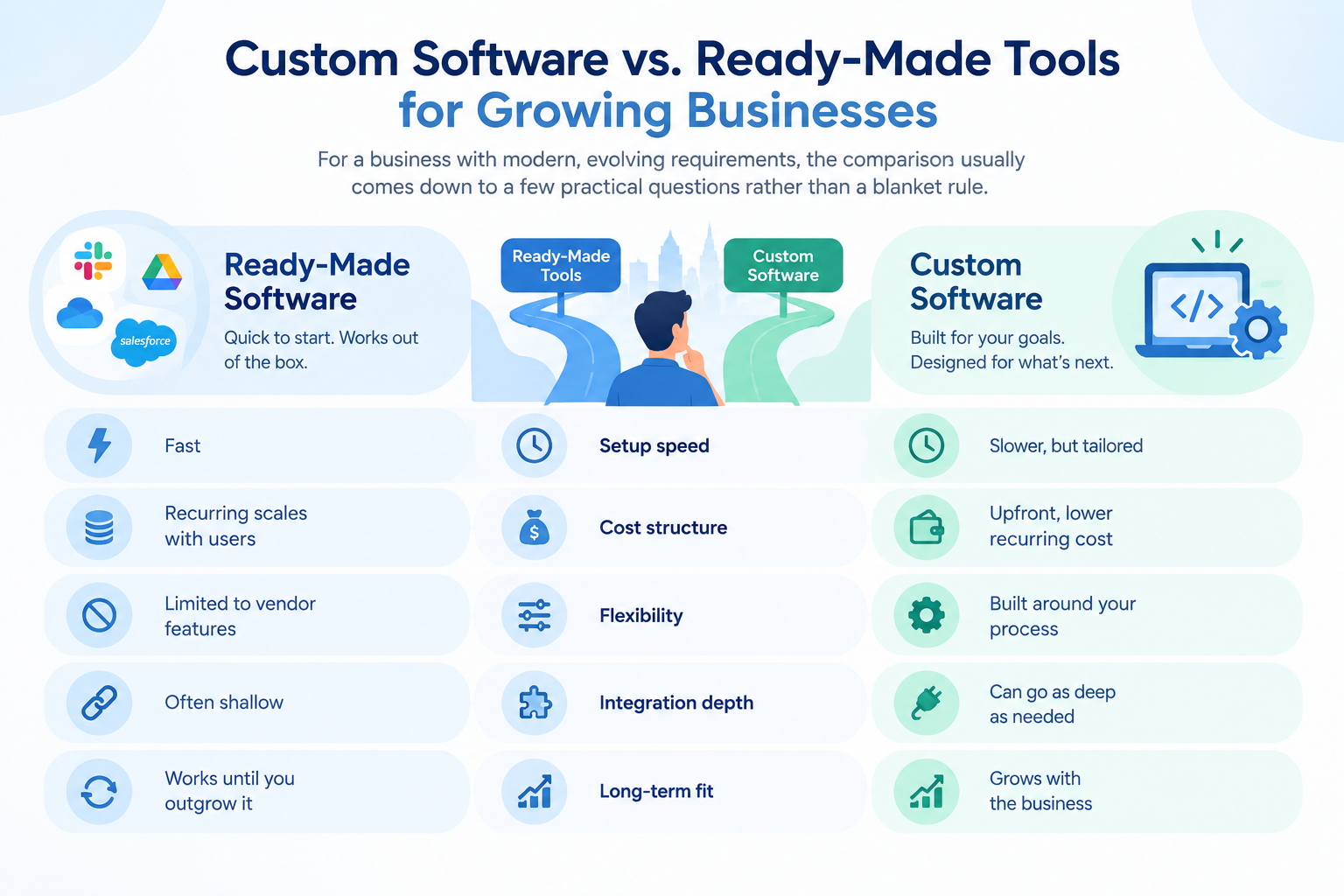
Custom Software vs. Ready-Made Tools for Growing Businesses
For a business with modern, evolving requirements, the comparison usually comes down to a few practical questions rather than a blanket rule.
| Ready-Made Software | Custom Software | |
| Setup speed | Fast | Slower, but tailored |
| Cost structure | Recurring scales with users | Upfront, lower recurring cost |
| Flexibility | Limited to vendor features | Built around your process |
| Integration depth | Often shallow | Can go as deep as needed |
| Long-term fit | Works until you outgrow it | Grows with the business |
A business still figuring out its process might do just fine with ready-made tools for a while. One with established, specific workflows or one juggling several systems that need to talk to each other is usually where custom development starts to make more sense.
Why This Comes Up So Often for Chennai Businesses
Chennai’s mix of manufacturing, healthcare, IT services, and logistics companies tends to produce workflows that generic software was never really built around. Add in businesses expanding to Coimbatore, Madurai, Trichy, or Bengaluru, and the need for systems that behave consistently across locations stops being theoretical and starts being just… practical.
Working with a software development company in Chennai, rather than a distant or overseas vendor, also makes coordination easier in ways that add up fewer time-zone gaps, more in-person conversations when they’re actually needed, and a partner who already understands the local business landscape.
Questions Worth Asking Before You Commit
A few questions tend to separate a strong partner from a risky one:
- Have you built systems with similar integration or scale requirements before?
- How do you handle a requirement that changes mid-project?
- What’s your actual testing process, beyond “we test it”?
- Who owns the code, the data, and the infrastructure once it’s built?
- What does support look like a year after launch?
- How will you keep us updated as the project progresses?
- How would this system handle significantly more users or data than we have today?
Clear, specific answers here tend to matter a lot more than a polished pitch deck.
How the Right Partner Supports Long-Term Growth
Modern business requirements don’t stay fixed once the software launches; new integrations come up, teams grow, regulations shift, and the system has to keep pace. The businesses that get the most out of custom software; tend to be the ones with a partner still around for that next stage, not just the initial build.
Creatah works with Chennai businesses on custom software development built with this in mind, alongside related services like mobile app development for iOS, Android, and Flutter systems designed to hold up as requirements change, not just at the point of launch.
Choosing the Right Partner
There’s no single company that’s automatically the best fit for every business; it depends on your industry, your existing systems, and how much your requirements are likely to shift. What tends to matter most is whether a company can speak specifically to integrations, scalability, and security, and whether they’re still around to support the system once it’s actually live.
Contact us today to discuss your custom software development requirements.
