
Most startups don’t have the luxury of building two apps at once. There’s rarely enough budget or time to hire a separate iOS team and Android team, run them in parallel, and keep both versions in sync every time a feature changes. And yet the market doesn’t really care about that constraint; customers expect an app that works properly on whatever phone they happen to be holding.
That’s the gap React Native app development tends to fill. Instead of building and maintaining two completely separate codebases, a team can write most of the app once and ship it to both iOS and Android, without the experience feeling like an obvious compromise on either platform. For a startup trying to get a product in front of users quickly, or a growing business that needs to move without doubling its engineering costs, that trade-off usually works out in their favor.
This article looks at what React Native actually is, why it’s become such a common choice for early-stage and scaling businesses, and where it does and doesn’t make sense.
What Is React Native?
React Native is an open-source framework, built by Meta, that lets developers write mobile apps using JavaScript and React while still producing genuinely native iOS and Android apps not a web page wrapped in an app shell.
The distinction matters. Older cross-platform tools often rendered a webview inside a native container, which usually showed in sluggish scrolling or UI that never quite felt right. React Native compiles down to native components, so the app behaves like a native app because, under the hood, a lot of it actually is one.
Why React Native Makes Sense for Startups and Growing Businesses
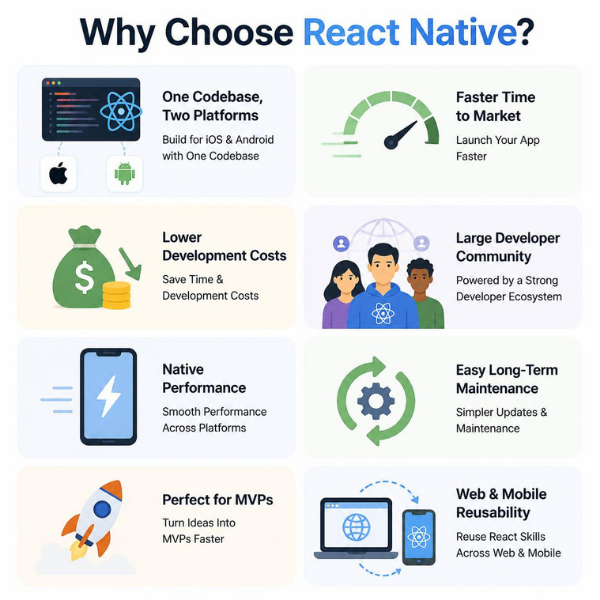
1. One Codebase, Two Platforms
This is the headline reason most startups look at cross-platform mobile development in the first place. A single codebase covers both iOS and Android, which means one team builds one app instead of two teams building two apps that need to stay in sync every release.
For a startup with five engineers, that’s the difference between shipping a feature in a week and shipping it in two, because there’s no second implementation waiting behind the first.
2. Faster Time to Market
Speed matters more for a startup than it does for an established company sitting on a stable user base. Being first to test an idea, or first to respond when a competitor moves, often counts for more than being marginally more polished. React Native’s shared codebase, combined with a large ecosystem of pre-built components, generally shortens the road from idea to a working, installable app.
3. Lower Development Costs
Building and maintaining one codebase instead of two naturally costs less: fewer developers are are needed, there is less duplicated QA effort, and there are fewer places for the same bug to hide twice. It’s not free, and it’s not always dramatically cheaper depending on how complex the app is, but for most startups with limited runway, the cost difference is real enough to matter.
4. Access to a Large, Active Developer Community
React Native has been around long enough and is used by enough companies that most common problems already have a documented answer somewhere. Libraries exist for navigation, state management, push notifications, and most of the other pieces a typical app needs, which means a development team spends less time reinventing basic infrastructure and more time building whatever’s actually unique about the product.
5. Native Performance Where It Counts
React Native isn’t a compromise dressed up as a solution. Because it renders actual native UI components rather than simulating them inside a browser view, performance for most business apps e-commerce, booking platforms, internal tools, and content-driven apps holds up well against a fully native build. Extremely graphics-intensive apps, like high-end games, are usually still better served by native development, but that’s a narrow slice of what most startups are building.
6. Easier Long-Term Maintenance
Bug fixes and feature updates only need to happen once, not twice. A pricing change, a new screen, an API update all of it gets built and tested in one place and pushed to both platforms. For a growing business already juggling product, marketing, and everything else that comes with scaling, one codebase to maintain is genuinely one less thing to manage.
7. Strong Fit for MVPs and Early-Stage Products
Startups validating an idea usually don’t need or want to over-invest in infrastructure before they know if the product will stick. React Native lets a team build a functional, genuinely usable mobile MVP without committing to the cost of two full native builds, which keeps the option open to rebuild in native code later if the product actually takes off and specific performance needs demand it.
8. Reusability Across Web and Mobile
Teams already working with React on the web often find some of that logic, business rules, state management patterns, and even some components with libraries like React Native Web carry over to the mobile app. It’s not a total shortcut, but it does reduce duplicated work for teams already invested in the React ecosystem.
When Native Development Might Make More Sense
React Native isn’t the right call for everything, and it’s worth saying that plainly. Apps that lean heavily on complex animations, real-time graphics, or deep integration with platform-specific hardware — think advanced camera processing, AR features, or high-performance gaming — often still benefit from a fully native build. So do apps where every last bit of platform-specific performance is the actual product, not just a feature of it.
For most business apps, though, booking systems, marketplaces, service apps, internal tools, and content platforms, the difference is rarely large enough to justify the added cost of building and maintaining two separate native apps.
How to Choose the Right React Native App Development Company
Look for a team with real production experience shipping React Native apps, not just tutorials completed. Check their portfolio, ask how they handle native modules when something needs custom platform code, and confirm what support looks like after launch.
A few practical things worth checking before committing to a development partner:
- Portfolio of shipped apps — live apps in the App Store and Play Store, not just prototypes.
- Experience with native modules — some features still need custom native code bridged in; ask how they handle that.
- Performance optimization experience — React Native apps can lag if built carelessly; has the team actually dealt with that?
- Post-launch support — app store updates, OS compatibility changes, and bug fixes don’t stop after version one.
- Understanding of your business goals — a team that asks about your users and your roadmap, not just your feature list.
Creatah gets asked most of these same questions by founders evaluating us, which is generally a sign they’re the right questions to be asking anyone.
Is React Native Right for Your Business?
If you’re a startup validating an idea, a small team without the budget for two parallel native builds, or a growing business that needs to move fast across both platforms without doubling engineering headcount, React Native is usually a solid fit. If your app depends on cutting-edge graphics, deep hardware integration, or performance margins that only fully native code can deliver, that’s a narrower case where native development is probably worth the extra cost.
For most startups building a standard business app and that’s the large majority of them React Native tends to get the product to market faster, for less, without asking users to notice the difference.
Startups rarely have the resources to build twice. React Native gives founders and growing businesses a practical way to reach both iOS and Android users from a single codebase, without the compromises that older cross-platform tools were known for. It won’t be the right call for every app, but for the kind of product most startups are actually building, it tends to be the faster, more cost-effective path to a real, working app in people’s hands.
If the software behind the app needs its own attention too, it is usually the next piece of that conversation.
If you’re weighing React Native against native development for your next app, it’s worth talking through what your product actually needs before deciding either way.
Reach out to Creatah to go over your requirements and figure out the right approach for where your business is headed.
Creatah helps businesses turn their software ideas into practical, scalable digital solutions.
