
There’s one logistics company that we’ve seen more than once in different avatars. Different name, same story. In Chennai. Strong team. Expanding client base. But the entire operation is run on spreadsheets and WhatsApp messages. Each night, someone takes shipment updates and copies them into Excel manually. Month end invoice reconciliation (by hand, sometimes with someone staying late to get the numbers to match).
Nobody built the business to operate like this. It just… ended up here, one quick fix at a time, until the quick fixes were the system.
And that is usually the point where a business starts looking for a custom software development company in Chennai. It’s not that the tools they’re using are bad, per se; it’s just that those tools were built for everybody, which in practice means they weren’t really built for anybody.
This is what growth does to business. At 50 it begins to creak. What worked for 10 employees works fine. What worked for a few hundred customers will not work for a few thousand. There comes a point where “we’ll fix it later” isn’t an option anymore.
Why Choose a Custom Software Development Company in Chennai?
Chennai has established itself as one of India’s leading technology and software development hubs. Home to renowned IT parks such as TIDEL Park, DLF Cybercity, and a thriving ecosystem of global enterprises, startups, and skilled engineering professionals, the city offers businesses access to world-class software development expertise. Whether you’re a startup looking to build an innovative digital product or an enterprise seeking to modernize operations, partnering with a custom software development company in Chennai gives you access to experienced developers, cutting-edge technologies, and cost-effective solutions tailored to your business goals.
What Is a Custom Software Development Company in Chennai?
A custom software development company in Chennai specializes in designing, developing, and maintaining software solutions built specifically for your organization’s unique requirements. Unlike off-the-shelf software that forces businesses to adapt to predefined features and workflows, custom software is created around your processes, objectives, and long-term growth plans.
From enterprise software and CRM systems to ERP platforms, mobile applications, web portals, and cloud-based solutions, a custom software development company develops scalable, secure, and high-performance applications that help businesses improve efficiency, automate workflows, and deliver better customer experiences. By choosing a trusted software development partner in Chennai, businesses gain technology solutions that evolve with their operations and provide a competitive advantage in today’s digital marketplace.
Custom Software vs. Off-the-Shelf Software
Off-the-shelf tools – the generic CRMs, the standard accounting platforms, the inventory systems everyone’s used at least once – exist because they work for thousands of businesses at once. That’s the whole idea: cheap, quick to install, good enough for most people.
The ‘good enough for most people’ catch never means ‘good for you.’ You pay for features you’ll never use while missing out on the one thing you actually needed.
Custom software is the opposite. It’s based on how your team already works, not the other way around.
| Factoring | Software From the Shelf | Tailor-Made Software |
| Fitting to Business Process | Forces adaptation, general | Designed for your exact workflow |
| Scalability | Restricted by vendor roadmap | Grows with you |
| Integration | Often limiting | Extensive integration with existing systems |
| Property rights | Leased, Licensed | Wholly owned by your business |
| Cost in the long term | Stacking up annual license fees | Higher long-term cost, lower upfront |
Custom Software Types
- Internal Enterprise Software to Scale
- CRM systems based on your real sales process
- ERP platforms that link departments together rather than isolating them
- SaaS products built to be sold, not just used internally
- Mobile apps (iOS, Android, or both)
- Web applications for browser access
- API-based integrations to connect your existing tools together
Who Is This For, Really?
Eventually, almost everybody. The industries are many. Hospitals, manufacturers, logistics firms, schools, retailers, and banks. But the reason is usually the same. Generic tools stop scaling before the business does.
Ready for Custom Software? Signs Your Business Needs It
Not all businesses need this today. But there are a few patterns that tend to emerge just before companies decide it’s time
Excel Is Your Database, Basically
If your “CRM,” your “inventory tracker,” and your “reporting system” are all just tabs in one giant spreadsheet, that’s not a workflow that’s a time bomb. One corrupted file or one person leaving the company and you lose institutional knowledge overnight.
Someone Is Doing the Same Job Manually, Every Week
Manual data entry involves copying and pasting between three different tools. Automatically generating reports, as opposed to building reports from scratch. It’s a few hours no one’s counting and money no one’s aware they’re losing.
Nothing Speaks To Anything Else
Five apps. No integrations. Support doesn’t know what support is working on. Finance is double-checking numbers in 3 different systems, as they don’t match.
It Worked Fine… Until It Didn’t
Slow load times at peak hours. Traffic surges and collapses. Systems that were “fine” at last year’s volume and are clearly struggling now.
Security Feels Like an Afterthought
Usually generic software means generic security. If you’re dealing with customer payment data, health records, or anything that really has compliance weight, a one-size-fits-all solution may just not be enough.
Everything Takes Longer Than It Should
Approvals that should take minutes are taking days. Welcoming a new customer is like running an obstacle race. Somewhere in there are outdated systems, not your people; that is the bottleneck.
Customers See the Gap
Today’s consumers want fast, personalized digital experiences. If your platform can’t deliver that, they will quietly go find someone whose platform can.
The Org Chart Has Outgrown the tools.
More people, more departments, and more coordination are required, and the tools you started with were simply not designed for that level of complexity.
Compliance Is No Longer an Option
Healthcare, finance, legal – these industries have regulatory requirements that generic software can’t always meet.
If two or three of these ring uncomfortably true, you should probably have a chat with a custom software development company in Chennai.
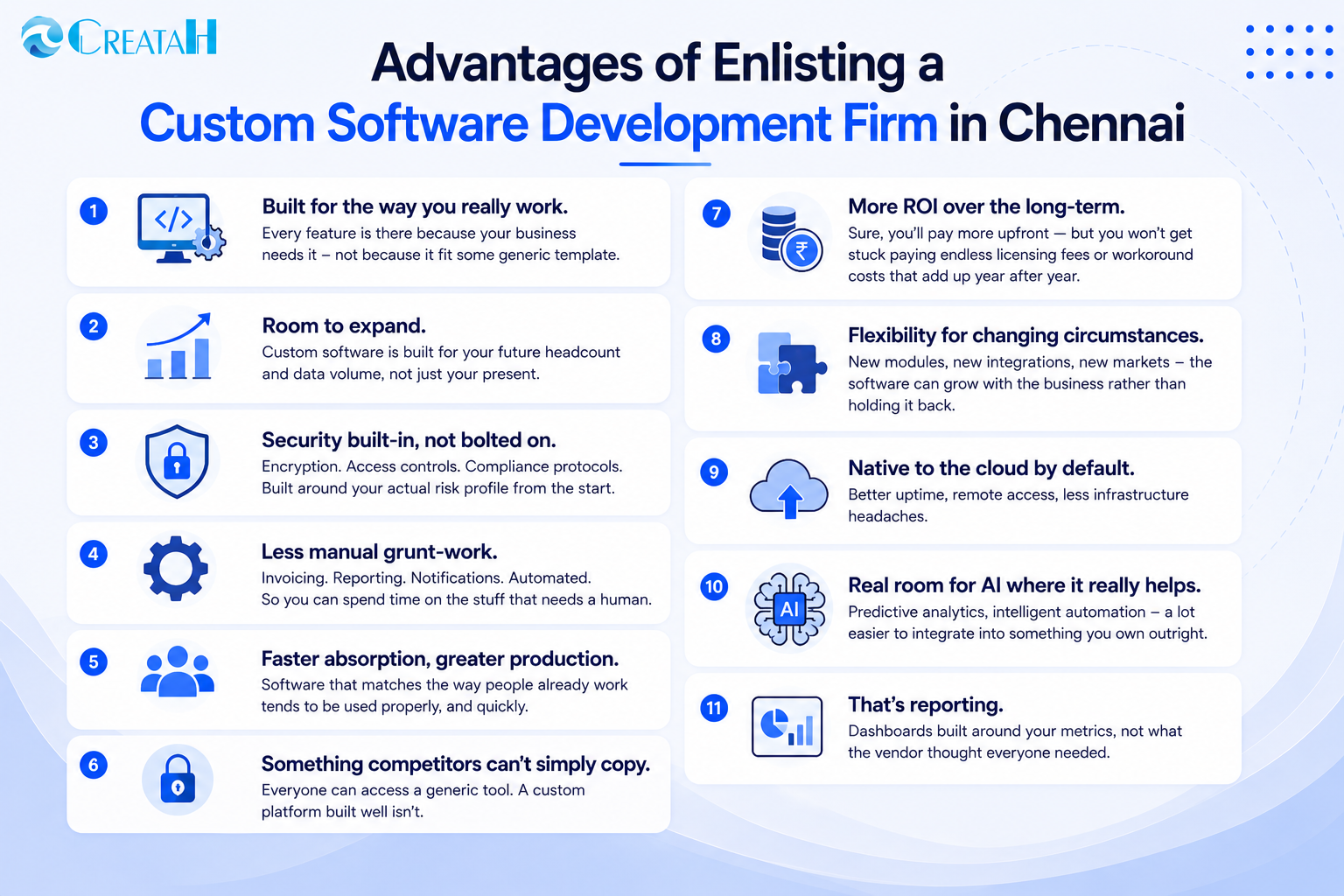
Advantages of Enlisting a Custom Software Development company in Chennai
- Built for the way you really work. Every feature is there because your business needs it, not because it fits some generic template.
- Room to expand. Custom software is built for your future headcount and data volume, not just your present.
- Security built-in, not bolted on. Encryption. Access controls. Compliance protocols. Built around your actual risk profile from the start.
- Less manual grunt work. Invoicing. Reporting. Notifications. Automated. So you can spend time on the stuff that needs a human.
- Faster absorption, greater production. Software that matches the way people already work tends to be used properly and quickly.
- Something competitors can’t simply copy. Everyone can access a generic tool. A custom platform built well isn’t.
- More ROI over the long term. Sure, you’ll pay more upfront — but you won’t get stuck paying endless licensing fees or workaround costs that add up year after year.
- Flexibility for changing circumstances. New modules, new integrations, new markets – the software can grow with the business rather than holding it back.
- Native to the cloud by default. Better uptime, remote access, and fewer infrastructure headaches.
- Real room for AI where it really helps. Predictive analytics and intelligent automation a lot easier to integrate into something you own outright.
- That’s reporting. Dashboards built around your metrics, not what the vendor thought everyone needed.
Industries That Gain from Custom Software
- Healthcare – Patient management, appointment booking, telemedicine, EHR integrations that really fit clinical workflows.
- Finance — Secure transaction platforms, fraud detection, and compliance reporting without three workarounds.
- Logistics – Real-time fleet tracking, route optimization, and warehouse systems that communicate.
- Manufacturing — Production scheduling, inventory management, IoT-enabled equipment monitoring.
- Retail — Omnichannel inventory, POS integrations, personalization without guesswork.
- Education — Learning management systems, student portals, virtual classroom tools.
- Real Estate – Property management, lead tracking CRMs, virtual tour integrations.
- Travel – Dynamic pricing, itinerary management, booking engines.
- Hospitality – Guest experience apps, staff scheduling, reservations.
- E-commerce – Custom shopfronts, inventory sync, and recommendation engines that really match your catalogue.
What Should a Custom Software Development Company Offer?
A team worth hiring should be doing more than writing code:
- Enterprise software development for large internal systems
- Sales pipelines & customer relationships: custom CRM development
- ERP software development for integrated finance, HR, and operations
- Multi-tenant subscription-based platforms development in SaaS
- Android & iOS Mobile App Development
- Web application development for browser platform
- AWS, Azure or GCP cloud application development
- API integration to link existing tools
- Legacy software modernization — upgrade without starting from scratch
- UI/UX design, because functional != usable
- Test and QA things before they go to production, not after
- DevOps for continuous deployment and infrastructure management
- AI integration with automation, chat and predictive capabilities
- Continuous maintenance and support post-launch
If a company can’t speak confidently about most of this list, then that’s worth noting.
Why a Custom Software Development Company in Chennai?
Chennai’s reputation as a serious tech hub was no accident.
- Good developer skills. The strong engineering institutions have churned out a really large pool of experienced developers across several technology stacks.
- Pricing that works. The value here is much better than in Western markets without compromising on quality.
- International shipping experience. Many Chennai-based teams are already servicing international clients and adhering to international quality standards.
- Agile as the standard, not the exception. Iterative delivery and faster time-to-market are not differentiators but table stakes now.
- Range, technical. The skillset here covers a lot of ground, from legacy enterprise systems to modern cloud-native builds.
- A startup culture that keeps teams on their toes. A lot of Chennai-based developers are used to building fast and lean.
- A real passion for new technology. Being close to India’s larger IT ecosystem keeps teams informed.
- Real communication. Good English and a reasonable overlap with global working hours make collaboration easier than people expect.
- Relationships, not projects. Many of the companies here are organized for long-term client relationships, not quick turnaround jobs.
How to Pick the Right Development Partner
Before you sign anything, read this:
- Portfolio – Have they created something similar to what you need?
- Experience in the industry – Do they understand the nuances of your sector?
- Tech stack – Modern and well-supported, or aging and awkward?
- Expertise in the team – Are developers available or experienced?
- Certifications – Security or technology certifications?
- Agile practices — Structured, iterative process or just vibes?
- Reviews – What do actual previous clients say?
- Post-launch support – Will they be around after delivery?
- Security standards – How serious are they about data protection?
- Transparent Pricing – Clear breakdown or vague estimates?
- Communication Style – Responsive, or slow to respond even now?
- Delivery process – Fixed workflow or make-it-as-you-go?
Questions to Ask Before You Hire
- Have you ever built software for companies such as mine?
- Can I get some case studies or talk to past clients directly?
- Realistic timetable for a project of this size?
- Who owns the source code and IP upon delivery?
- What tech stack would you recommend and why that one?
- How do you manage projects and handle day-to-day communication?
- Walk me through your process for QA and testing.
- How do you ensure data security and compliance?
- What if the requirements change halfway through?
- Do you offer post-launch support & maintenance?
- Fixed, milestone-based, hourly pricing model?
- Who will be working on my project on a day-to-day basis?
- How does the architecture scale with growth?
- What do you do when something breaks after you go live?
- Can you submit a detailed proposal with clear milestones?
Custom Software Development Trends 2026
- AI-powered features are quickly becoming the norm, not the exception.
- Generative AI is transforming not just the way software is built but also what it can do.
- Low-code/no-code platforms are accelerating the easier builds, allowing developers to focus on the truly complex bits.
- Anything that needs to scale is, by default, cloud-native architecture.
- IoT integration is transforming connected devices into real-time decision-making tools.
- Microservices break down big apps into smaller, independent pieces so they can be scaled and maintained more easily.
- Beyond the hype cycle, blockchain is being used for practical applications like supply chain transparency and identity verification.
- Security-first development is building protection in from day one, not patching it in later.
- Intelligent automation combines process automation and AI to reduce manual work across departments.
- Predictive analytics is enabling companies to plan ahead rather than react to what already happened.
Why Creatah Is the Best Choice
Choosing a development partner is as much about trust as skill. We try to earn that by actually understanding the business first—not just skimming the brief and jumping into a build.
Our team has direct experience working with clients in healthcare, retail, tech, and services in enterprise software, CRM, ERP, SaaS, and mobile and web apps. We work in Agile sprints so you can see real progress in stages, rather than waiting months for one big reveal at the end.
Throughout the project we keep communication transparent. You’ll know where the project is, what’s around the corner, and why we made the decisions we made. The architecture is designed for scale from the ground up, so what you launch with can scale into what you actually need a few years down the road.
And we don’t vanish when the project ships either. Long-term engagement with clients is how we operate, not an upsell tacked on after.
We’re happy to have that conversation honestly; no pressure either way if you’re still trying to decide if custom software makes sense at your current stage of business.
Not every business needs custom software, and not at every stage of its development. But if you’re struggling with manual workflows, disconnected tools, scaling issues, or customers who expect more than your current platform can deliver, it’s generally worth a serious look.
If any of the signs we’ve discussed the spreadsheet dependency, the security gaps, or the operations that take longer than they should sound like your business, that conversation is probably overdue.
Chennai has the developer talent, the pricing, and the delivery experience to make that conversation worth having.
Is your business ready for custom software? Find out now!
Contact Creatah today for a free consultation, and we’ll help you find what the next step looks like.
