
The Role of Blockchain in Mobile App Security
Mobile apps are now paramount to today’s digital experiences. From online banking to electronic health records, to online shopping to social media engagement, mobile apps are interfacing with users utilizing highly sensitive data on a daily basis. Increasing acceptance of these types of apps has rendered mobile app security a mission-critical issue for developers, brands, and the user community. Most standard security models are unlikely to fully address such quality-of-usage challenges as data tampering, identity theft, and cyberattacks. This is where Blockchain in mobile app security has emerged as an opportunity for original technology use.
Why Security in Mobile Apps Is More Critical Than Ever
The mobile ecosystem in the modern age is nearly limitless and intimately connected. Users download apps that request access to contacts, photos, location, and even biometric data. Hackers are relentless in their quest to exploit vulnerability in poorly protected systems. Cybersecurity studies have identified millions of apps on popular app stores that contain loopholes, which lead to a data breach of some kind.
Traditional centralized security models rely too heavily on the single server or authority and are susceptible to the issues of Distributed Denial of Service (DDoS) attacks, and open to database breach situations. Once the central-based authority is breached, the attacker has access to vast amounts of user information. This endless scenario has recently led to a different and innovative way of thinking about security models. The decentralized nature of Blockchain can offer a new way of thinking of the ongoing issues presented.
How Blockchain Works in Mobile App Security
Blockchain is basically a distributed ledger technology (DLT), where every transaction or piece of information is recorded across multiple nodes in a network. Instead of placing trust within one single authority, blockchain places trust across participating peers.Each entry is encrypted, time-stamped, and connected to the previous block, rendering it virtually infeasible to modify data without the agreement of the entire network.When it comes to security situations in relationship to mobile applications, blockchain will provide the following functionality:
- Decentralized Data Storage: User data is not held in a centralized, vulnerable database, but instead it is stored across several nodes.
- Tamper-proof records: The immutable nature of a blockchain means once a piece of information has been put on it, it cannot be changed.
- Smart Contracts: A smart contract is a contract that is triggered when certain conditions are met automatically, this reduces fraud or human errors.
- Transparency and Traceability: The verifiability of every transaction can be beneficial for auditing and compliance. They provide a secured space in which, even if one node has been attacked, the hacker could not: change or delete any data from the network.
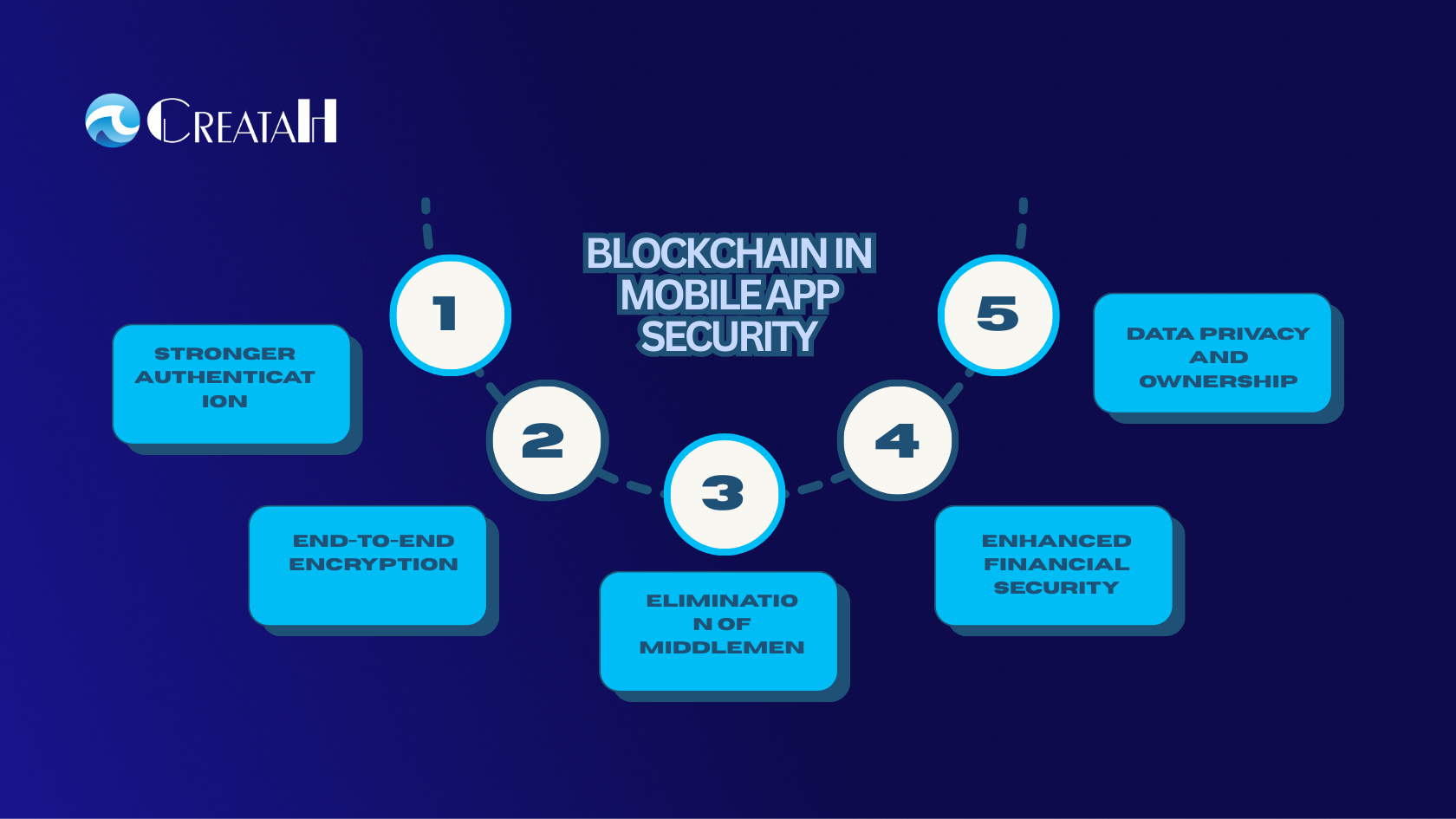
Key Benefits of Blockchain in Mobile App Security
- Stronger Authentication:
Blockchain supports multi-factor and decentralized authentication mechanisms. It removies reliance on solely passwords, adding biometric identifiers, digital signatures, and consensus validation in the same sense. This dramatically reduces possibilities for identity theft. - End-to-End Encryption:
Every data transaction in a mobile app that is powered by blockchain is protected by modern cryptography, and will be inaccessible and unaltered by hackers without the use of a private key. - Elimination of Middlemen:
Many mobile apps establish trust on third parties to verify user claims. In these cases a smart contract can reduce and/or eliminate intermediary parties. These smart contracts make the transaction faster, more reliable and secure. - Enhanced Financial Security:
Blockchain can be extremely beneficial within Fintech, e-commerce, and wallet apps. Payment channels are secure, fraud is more easily detected, and the transaction is recorded and visible to users. - Data Privacy and Ownership:
Companies that develop traditional apps frequently claim consumer data as belonging to them and monetize user data. Users are the rightful owner of their data and control how their data is shared, accessed or posted when using blockchain to store data.
Real-World Applications of Blockchain in Mobile App Security
- Banking & Fintech Apps: Several banks are currently investigating using blockchain as a way to secure digital payments, prevent fraud, and demonstrate compliance with regulations.
- Healthcare Apps: Patient medical records can be secured and shared with approved permission with other healthcare providers, while safeguarding sensitive health data.
- Apps for Supply Chain and Logistics: Blockchain can validate and reinforce product authenticity and offer shipment-specific data, which mitigates risks of fraud and counterfeit.
- Apps for Identity Verification: Decentralized digital identities will allow for secure and tamper-proof access across platforms.
- Apps for Voting and Governance: Blockchain improves election transparency and ensures verifiable results while preventing tampering.
These examples showcase Blockchain’s ability to advance industries dependent on secure digital infrastructure, and demonstrate that it is not simply conceptual.
Challenges in Adopting Blockchain for Mobile App Security
Although the benefits are appealing, there are challenges when adopting and integrating blockchain:
- Scalability – Depending on the blockchain, while it far exceeds the speed of incumbent practices, blockchain may not meet the needs of millions of transaction processing per second.
- Integration Costs – The costs involved in developing and integrating blockchain features into a mobile app can prevent smaller to medium-sized businesses from adopting.
- Regulatory Uncertainty – Governments around the world are only beginning to create regulations for blockchain which may alter the strategy for adopting apps.
- User Education – It is possible that the end user will not fully understand blockchain technology, so it will be important to create user friendly seamless experiences.
Meeting these challenges will require mapping out a strategic plan, having experience developers and a long-term look ahead.
Future of Blockchain in Mobile App Security
With the increase of cyber attacks, ransomware, and most importantly, data breaches, this will lead to mobile apps security framework over time. As technology advances further, lighter weight blockchain applications will emerge and be built around mobile environment technology, and this will drastically improve processing speed, reduce costs and allow for the most seamless integration into apps in the mobile mainstream.
At Creatah, mobile app development is evolving with blockchain, fundamentally shifting how businesses deliver secure apps by introducing decentralization, transparency, and tamper-proofing at scale. While some adoption challenges exist, the benefits from secure authentication to fraud reduction far outweigh the negatives. For businesses looking to build trusted and scalable apps, adopting blockchain is no longer optional; it’s mandatory. Partnering with Creatah in mobile app development ensures the right implementation, creating a significant impact for any organization’s success.
