
Why Businesses Without Mobile Apps Are Falling Behind
In the rapid digital environment, having a mobile-first presence is no longer a luxury; it is a must-have for businesses and consumers alike. Consumer behaviors have shifted dramatically, with more than half of online traffic now coming from smartphones and tablets. This shift means that businesses without a mobile app are not simply missing out on opportunities—they are falling behind.
Still, we will explore why businesses need mobile applications, how they drive growth and profits, and why companies that are slow to adapt and adopt digital technologies will continue to lose ground as competitors.
The Mobile-First World We Live In
Smartphones have become a part of our lives. Whether grocery shopping or booking fitness classes, consumers want the same things: seamless, personalized, and real-time experiences. A mobile-friendly website is no longer sufficient. Consumer apps drive deeper engagement, richer user experience, and allow businesses to be constantly present.
A one-tap app is “stickier” and creates a more memorable brand experience than searching for a website.
Why Businesses Need Mobile Apps
Businesses across a variety of sectors (retail, healthcare, logistics, wellness, and others) are investing heavily in mobile applications to improve customer journeys. The reality is that it makes business sense for any number of reasons:
- Convenience & Accessibility: Apps put your brand in your customer’s pocket at every hour of the day and every day of the week.
- Direct Marketing Channel: Push notifications, personalized offers, and in-app updates are stronger customer touchpoints.
- Customer Loyalty: Features such as rewards, membership, and exclusive content are a way for customers to maintain engagement.Quicker Performance: Apps load almost instantly compared to websites and many offer offline functionality as well.
- Real-Time Analytics: Mobile applications give real time insights into customer actions, providing businesses with analytical tools to make better decisions.
The positive aspects of having a mobile app for your business are apparent. If you’re a business that doesn’t leverage the advantage of equity in mobile app development by your competitors, you will be at a disadvantage and lose market share to mobile-first brands.
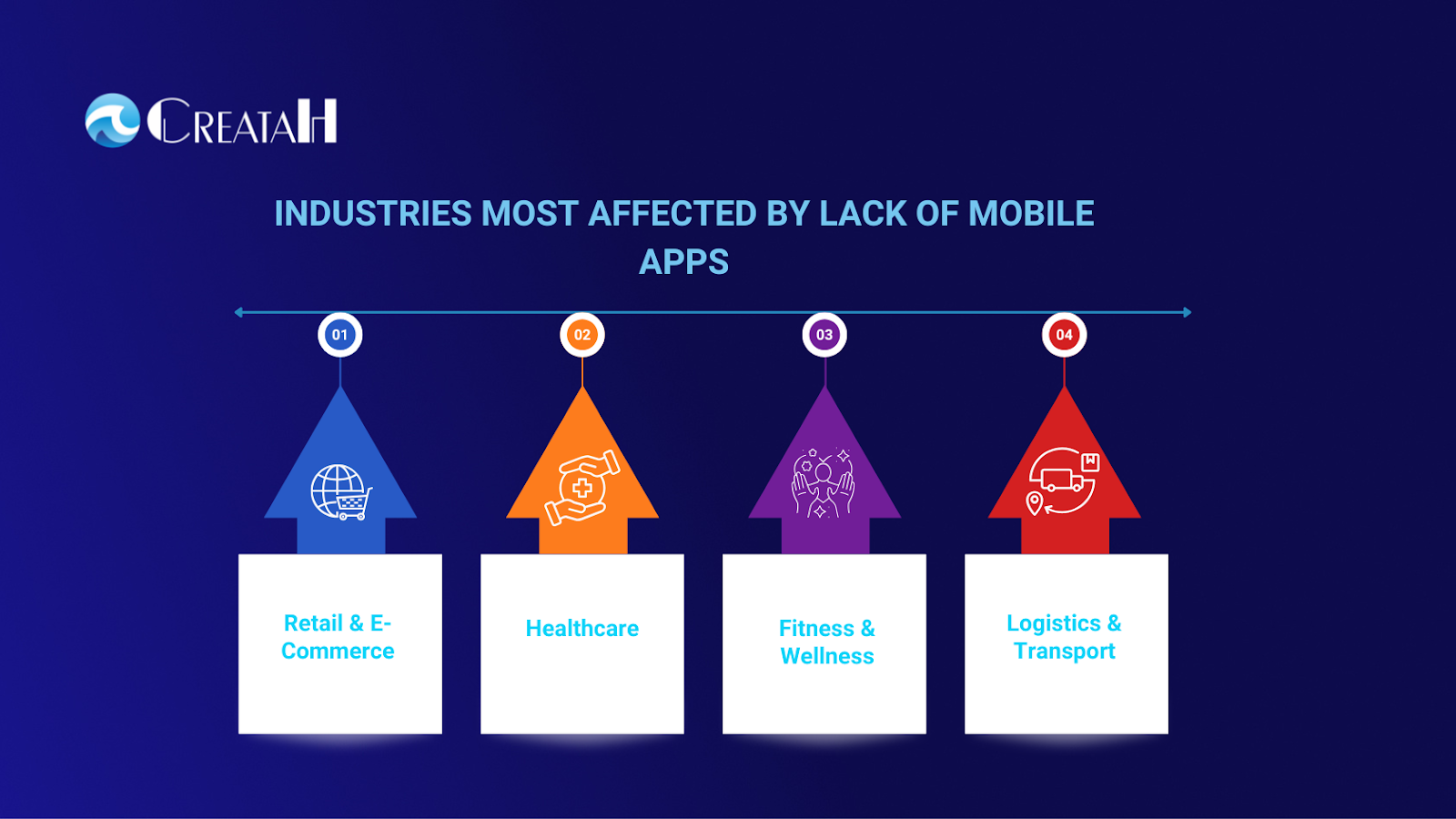
Industries Most Affected by Lack of Mobile Apps
Some industries will feel the impact of not having a mobile app more so than others. Here are examples of the industries that rely on mobile apps to enhance their services:
- Retail & E-Commerce: Customers expect things like one tap checking out, tracking orders and recommendations. If you are a business without an app, chances are, you will not get those customers back.
- Healthcare: Patients expect telemedicine, and booking their appointments on one app, and tracking their health. In clinics where they do not have mobile access, the doctor’s office will lose business to competitors in that space.
- Fitness & Wellness: Gyms, trainers, and yoga instructors are using apps exclusively in most cases for scheduling classes, and client engagement to increase accountability and adherence to the program.
- Logistics & Transport: Fleet tracking, order visibility, and customer updates are done with a mobile app, so maintaining efficiency is important, as well as keeping your customers’ trust.
- Corporate Wellness & HR: Company wellness initiatives are using mobile apps to support employee engagement with wellness programs, and employee communication.
In all of these cases if there is no mobile app functionality, the business will look old, less accessible, and less customer centric.
Customer Expectations Are Evolving
Consumers are more aggressive than ever with respect to their expectations. They want:
- Immediate feedback
- Seamless payment processes
- Personalized recommendations
- Loyalty programs and reward programs that are integrated
- Omnipresence experience (across devices)
The mobile app can drive all of these activities in one application. Businesses that do not meet customer expectations risk becoming irrelevant, even with high-quality products/services.
The Competitive Edge of Mobile Apps
Having a mobile application is not simply about customer convenience, it is about advancing beyond competition. Companies with mobile applications can:
- One of the greatest benefits of mobile apps in a modern world is how they can easily integrate with Business Intelligence (BI) tools. Together the capabilities include:
- Tracking customer journeys in detail.
- Forecasting demand to optimize supply chains.
- Understanding purchasing behavior through analyzing purchasing behavior for promotional campaigns.
- Resource allocation and cost effectiveness.
This story is not just about having an app, it’s about developing a data driven ecosystem where every interaction is used to better future strategies.
Business is changing fast, and customers have limited patience when interactions are slow and out-of-date. Businesses that still use only websites or follow traditional business models will face a struggle for relevance with consumers.
This point is the time to realize, business need mobile apps, this is not a nice-to-have. Apps are at the center of customer engagement, data driven strategies and future life sustaining (survival in case of disrupted competitions).
At Creatah, we build mobile-first solutions that incorporate state-of-the-art mobile app development. This gives companies an edge not just to catch up, but to leap ahead.
