

Tracking Your Progress: How Fitness Apps Help You Reach Your Goals
Setting fitness goals is usually simple. The tougher component, maintaining the goals and tracking the improvements is where most struggle. Fitness goals can be to lose weight, gain muscle, improve endurance, but if you are not tracking those improvements you will not improve. And this is where we see fitness apps demonstrate an advantage in terms of tracking goals specifically.
In the age of technology, fitness apps are the combination of a personal trainer, nutritionist, and accountability partners.
Fitness apps aid in tracking your workouts, diet, and recovery, and feedback in realtime.
Let’s take a deeper dive into how they help you track goals easier, more effectively and more motivating.
1.The personalization of a specific and measurable goal
Fitness apps can take vague aspirations (to get fit) and help you build out manageable, and trackable goals.
How does that help you:
- You can create compelling goals like “lose 2 kg in 4 weeks” or “run 5 km under 30 minutes”
- Most apps will have preset goal templates based on your fitness baseline & preferences.
- Visual motivation (achievement badges, progress bars, performance charts) is clear and readily available to measure your process toward your next goal, especially when you get into the habit of measuring and tracking
2.Personal track on your lifestyle
Everyone experiences fitness and or training differently; it’s rare that if a method learned/ practiced in a fitness class, for example, it will work for everyone, that’s exactly why personalization is important.
Newer apps allows the use of ai-driven algorithms to determine different patterns you have, including your habits and sleep pattern to analyze and make adjustments to your meal and workout plans.
For example,
You missed a workout today, so the app adjusts your weekly intensity accordingly, or the app might decide based on your recovery metrics to propose rest days.Some applications will also sync with wearables such as smartwatches for more precise health analytics.
This flexible technology keeps the fitness goals tracking linked to your life outside the gym.
3.Real-Time Progress Analytics
The days of handwriting your workout in a notebook are done. Now every rep, and step taken, as well as how many calories burned can now be tracked in real time. Some benchmarks include the following:
- Workout summaries: time, calories burned, and targeted muscle groups.
- Heart rate monitoring: the performance zone and recovery time.
- Sleep quality: The ratio of deep sleep to light sleep, which can be used to plan for recovery sleep.
Step counters can track daily levels of activity outside the gym
Visual charts and summaries each week will allow for easy visualization of progress or lack thereof.
4.Food Tracking and Nutritional Suggestions
Fitness isn’t solely for fitness exercise; what you eat plays a critical role in fitness goals. Fitness apps build in tools for food logging, tracking not only macros (protein, carbs, fat) but also calories.
- Some benefits of tracking food intake include:
- Barcode scanners to simplify logging meals that have been prepared and packaged.
- Provide meal plans based on dietary goals (i.e.keto, vegan, or high protein)
- Reminders to drink enough water in a day ie hydration.
All of this will keep the diet + activity tracking that will create the full wellness loop, making sure to see your gym efforts recreate something in the visible world.
5.Motivation Through Gamification or Community
Motivation can be a challenge, particularly when some goals take time to see real results.That’s why many applications have moved to gamification – converting exercise into an enjoyable, rewarding situation.
Ways to motivate include:
- Achievements for consistency (for example “7-Day Workout Streak”).
- Points, badges or rewards for goal progress.
- Feeling part of a group by being part of a leaderboard or challenges with friends.
- Many options have community areas to share wins, gamification, tips and encouragement.
This has social accountability and makes going through the process together easier.
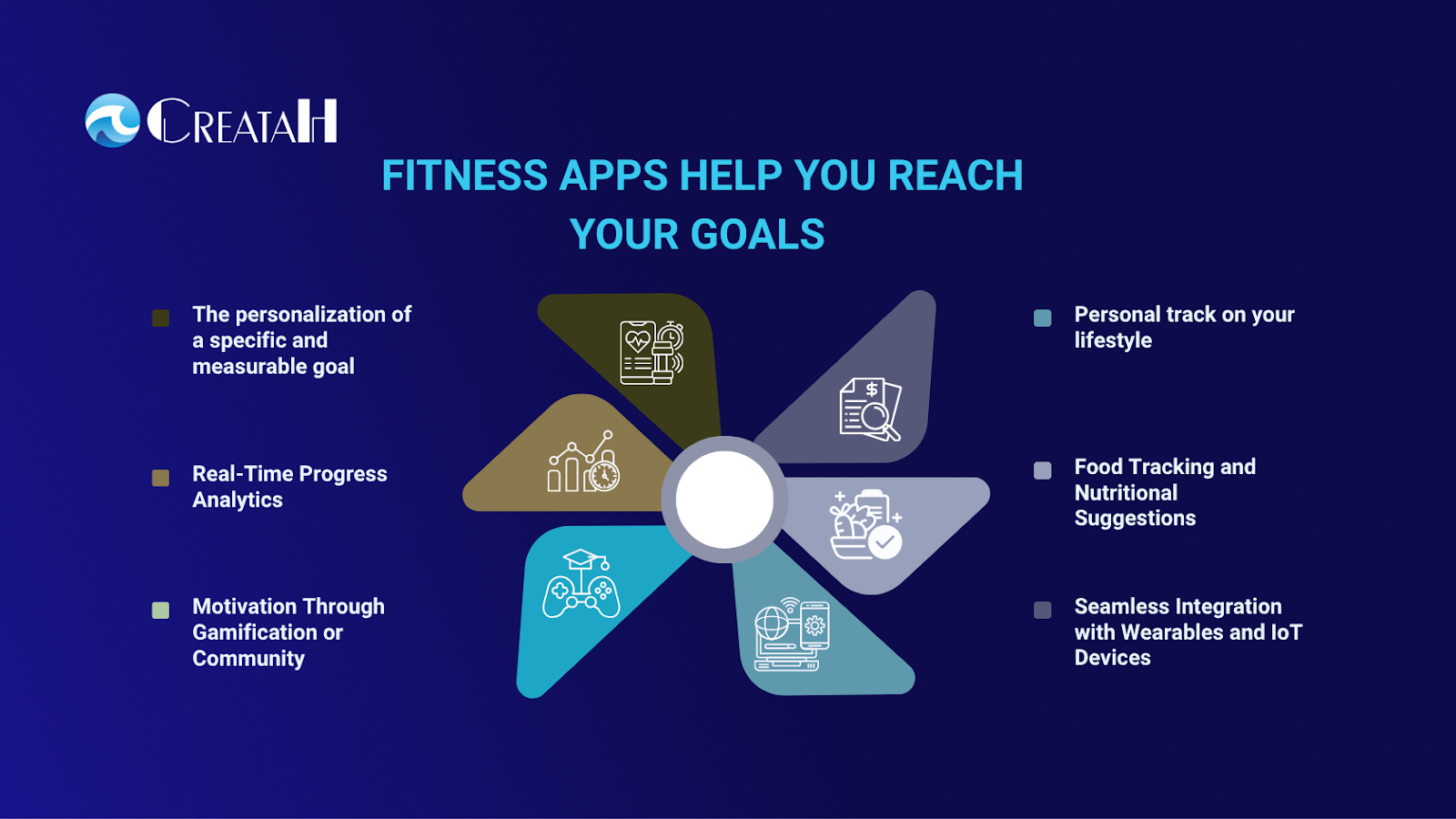
6.Seamless Integration with Wearables and IoT Devices
Your smart watch, heart-rate band, even your smart weighing scale are now able to talk to your fitness application.
Tracked integration provides:
- Real-time syncing of data (steps count, heart-rate, calories).
- Auto log workouts and sleep.
- Notifications of progress or inactivity in real-time.
- And that’s what you get – a 360-degree view of health status, time-free data entry!
7.Performance Feedback and Adjustment
- The best applications not just collect data, they interpret it well.
- AI-based feedback systems can identify if your performance dips or plateau’s and then recommends how to fix it.
For example:
- “Your average pace was down 10% this week – add in one rest day.”
- “Increase your protein intake to recover faster.”
- “Try a lighter session tomorrow to avoid fatigue.”
This is proactive insight into fitness goal tracking, they build intelligence and results.
8.Long-term Insights and Habit Creation
- The true “magic” of tracking development is in your commitment – or consistency of time.
- Your logging of workouts and meal for the long haul compose behaviours of value.
Benefits:
- Recognise what works best for your body type.
- Identify your mechanisms (triggers) for missed workouts or poor nutrition.
- Check yearly graphics of any changes or transformations.
- Ultimately, this creates long-term exercise goals – not just a new year’s resolution.
9.Tracking Mental Health and Recovery
- You can forget fitness without your mind.
- Some of more extensive applications track mood or stress levels, or even mindfulness routines around your workout.
Features include:
- A meditation session integrated into your workout.
- Breathing exercises to assist affect the stress hormone system in your body.
- HRV (heart-rate variability) data for recovery recording.
- A holistic approach to well-being assures you’ve not only initiating more fit, but more healthy inside.
Consistent tracking or re-goaling of fitness work marries your ambitions with the results. Tracking the guesswork to data-driven methods of progress makes you faster and smarter at improving. From calorie counters to sophisticated, data-powered analytics, provided applications are redefining the way we approach wellness and exercise.
If you’re considering building or enhancing an application in fitness or well-being, the secret is about people’s psychology – not some ramshackle integration of technology. The tracking must be “effortless, motivating and results driven and data”, consistent through an achievable goal (realistic).
Creatah Software Technologies specializes in developing mobile Application Development, enabled by a tracking purpose, to enable a meaningful Transformational experience with accessible UI/UX and engagement mechanism and AI-integrated analytics.
Today is proud to be part of the transformation ecosystem, creating next-generation application experiences where innovation meets impact in collaboration with Creatah Software Technologies.
