
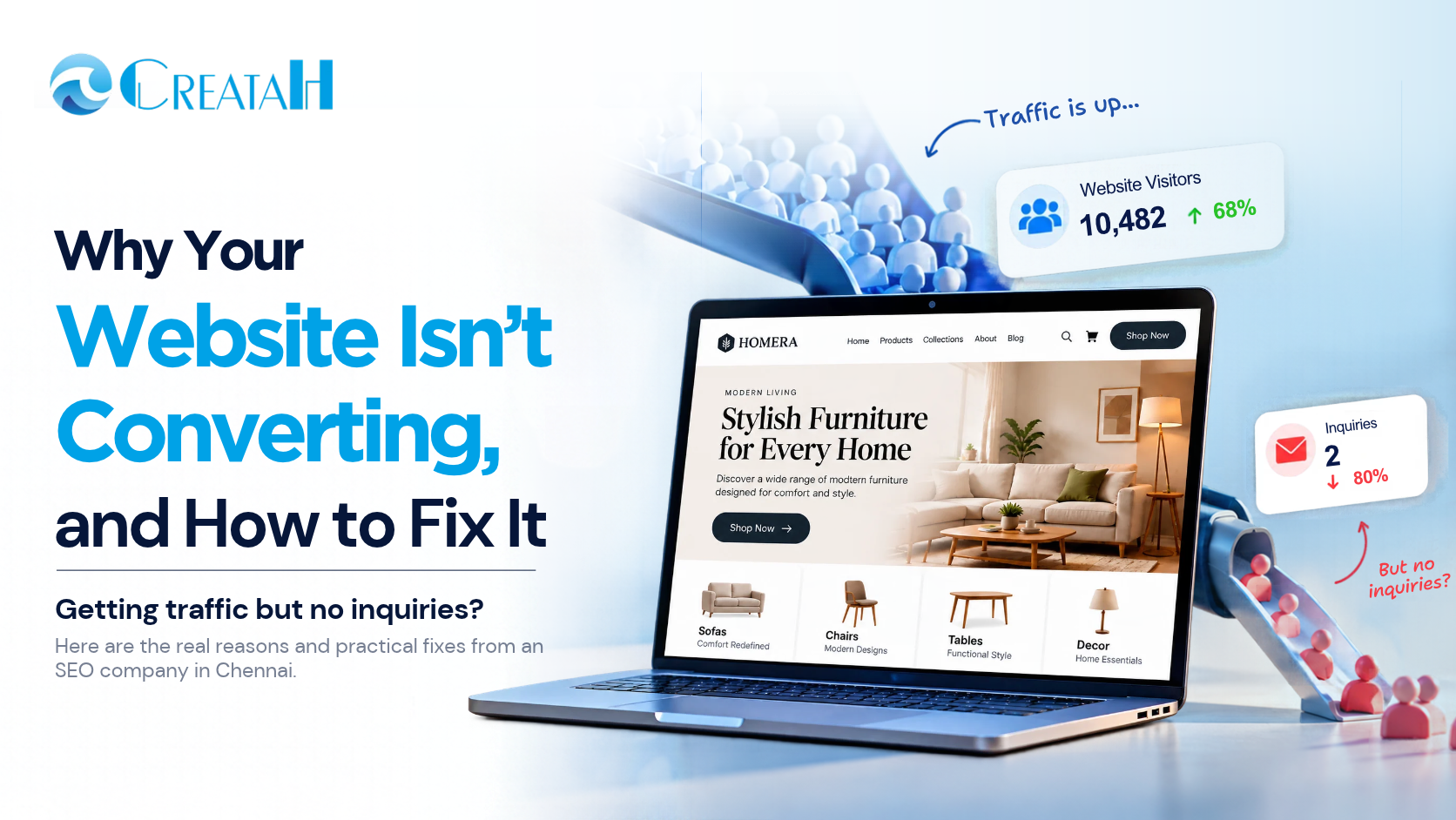
You check your analytics on Monday morning, and the numbers look decent. Visitors are up, a few keywords are climbing, and your agency’s report is full of green arrows. Then you check your inbox. Two inquiries. One of them is spam.
If that sounds familiar, you’re not alone. As an SEO company in Chennai working with businesses across India and the USA for nearly a decade, this is the conversation we have most often: “We’re getting traffic. Why isn’t anyone buying, booking, or calling?”
The good news is that a website that doesn’t convert is rarely broken beyond repair. Usually it’s a handful of fixable problems hiding in plain sight. Let’s go through them.
1. You’re attracting the wrong visitors
This is the one nobody likes to hear, because traffic feels like progress. But 10,000 visitors who were never going to buy from you are worth less than 300 who were ready to.
It happens when SEO is built around broad, high-volume keywords instead of keywords that signal intent. Someone searching “what is a mobile app” is curious. Someone searching “mobile app development company in Chennai” is shopping.
How to fix it:
- Review which pages bring in the most traffic and which of them actually lead to inquiries.
- Prioritize keywords with commercial intent, such as “company”, “services”, “cost”, “near me”, and “best”.
- Add local intent where it matters. A good SEO company in Chennai will tell you that location-based keywords often convert two to three times better than generic ones.
2. Your page doesn’t match what the visitor expected
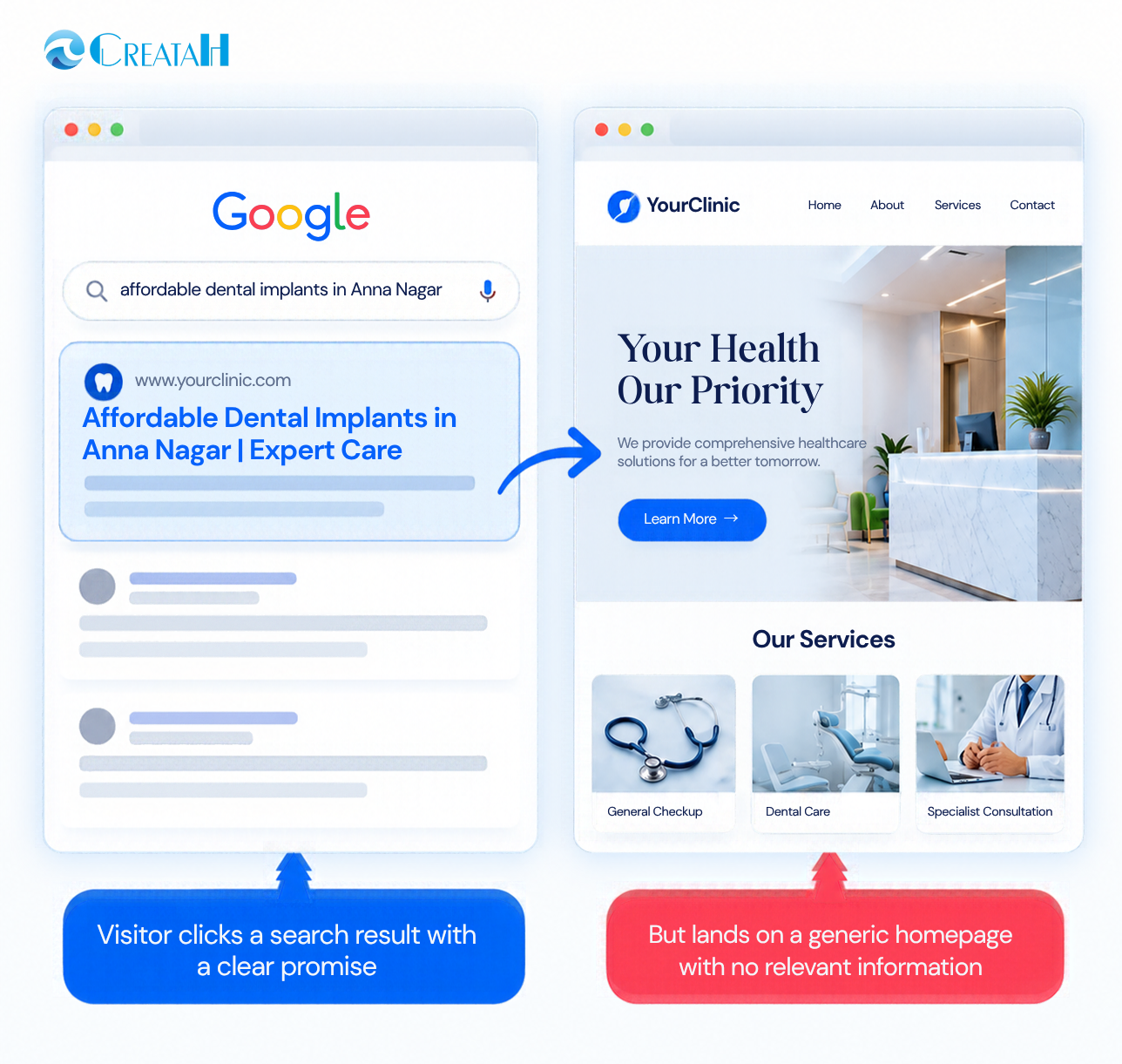
Imagine someone clicks a search result promising “affordable dental implants in Anna Nagar” and lands on a generic homepage with a stock photo and a vague tagline. They leave in about four seconds.
This mismatch between the promise (the search result or ad) and the delivery (the landing page) is one of the biggest silent conversion killers.
How to fix it:
- Make sure the headline repeats the promise that earned the click.
- Give each key service its own page instead of squeezing everything onto one.
- Put the answer to the visitor’s main question above the fold, not three scrolls down.
3. Your site is slow (and people won’t wait)
Most of your visitors are on mobile, often on average network speeds. If your page takes more than three seconds to load, a large share of them are already gone. Google notices this too, so speed hurts both rankings and conversions.
How to fix it:
- Compress images and use modern formats like WebP.
- Cut unnecessary plugins, scripts and tracking tags.
- Use good hosting and caching.
- Test with Google PageSpeed Insights and fix the red items first.
4. Your call to action is vague, hidden, or missing
We’ve audited sites where the only way to get in touch was a tiny “Contact” link in the footer. That’s not a website; that’s a hiding place.
People don’t convert because they’re not told what to do next or because the next step feels like too much work.
How to fix it:
- Use one clear primary action per page, such as “Get a Free SEO Audit” or “Book a Consultation.”
- Make it specific. “Submit” tells nobody anything. “Get my free quote” does.
- Repeat the CTA at natural points: top of the page, middle, and end.
- On mobile, add a tap-to-call button and a WhatsApp option. For Indian audiences especially, this alone can lift inquiries noticeably.
5. Your forms ask for too much
Every extra field is a reason to quit. If you ask for name, email, phone, company, budget, timeline, and how they heard about you, you’re asking a stranger to fill out a questionnaire.
How to fix it:
- Start with name, phone or email, and one optional message field.
- Collect the rest on the first call, not on the form.
- Test a shorter form against your current one. The difference is often dramatic.
6. There’s no proof that you’re trustworthy
Think about how you decide to trust a business you’ve never used. You look for reviews, real photos, case studies, familiar client names, certifications. Your visitors do exactly the same.
A site with no testimonials, no results, and no real faces behind it feels risky.
How to fix it:
- Add genuine client testimonials, ideally with names, photos or Google review screenshots.
- Publish case studies with real numbers: “increased organic inquiries by 62% in five months” beats “we deliver great results”.
- Show your team, your address, your years in business, and your client logos (with permission).
7. Your content talks about you, not about them
Read your homepage out loud. How many sentences begin with “We”? If it’s most of them, your visitor is probably tuning out.
People arrive with a problem. They want to know you understand it and can solve it. Lists of services and company history come later.
How to fix it:
- Open with the visitor’s problem, then show your solution.
- Use plain language. Skip the jargon and buzzwords.
- Answer the questions they’re actually asking: How much does it cost? How long will it take? What happens next?
8. The mobile experience is an afterthought
A site that “works” on mobile isn’t the same as one that’s pleasant on mobile. Tiny buttons, pop-ups that can’t be closed, text you have to pinch to read, forms that are painful to fill in with a thumb: each one quietly costs you leads.
How to fix it:
- Design for the phone first, then scale up to desktop.
- Make buttons large enough to tap easily.
- Get rid of intrusive pop-ups, especially ones that appear the moment someone lands.
9. You’re not tracking what’s actually happening
If you don’t know where people drop off, you’re guessing. Many businesses only look at traffic and rankings, never at behavior.
How to fix it:
- Set up conversion tracking in Google Analytics 4 for form submissions, calls, WhatsApp clicks, and bookings.
- Use heat maps and session recordings (Microsoft Clarity is free) to see where people hesitate or leave.
- Review the data monthly and change one thing at a time so you know what worked.
10. Your SEO and your conversion strategy aren’t talking to each other
This is the root of most of the problems above. SEO brings people to the door. Conversion optimization decides whether they walk in. When the two are handled by separate teams or ignored in favor of rankings alone, you get exactly the situation we started with: traffic without results.
The best SEO company in Chennai for your business won’t just promise page-one rankings. It will ask what happens after the click and build the strategy around leads, calls, and revenue, not just visits.
A quick checklist to start with this week
- Do my top-ranking pages target buyers or browsers?
- Does each page’s headline match what the visitor searched for?
- Does my site load in under three seconds on mobile?
- Is there one clear, visible call to action on every key page?
- Is my contact form short?
- Do I show real reviews, results, and faces?
- Am I tracking calls, forms, and WhatsApp clicks as conversions?
If you answered “no” or “not sure” to more than two of these, you’ve probably found where your leads are leaking.
Frequently asked questions
How long does it take to improve website conversions?
Simple fixes like clearer CTAs, shorter forms, and faster load times can show results within weeks. Bigger improvements tied to SEO and content usually take three to six months to build momentum.
What is a good website conversion rate?
It varies by industry, but most service businesses see between 2% and 5%. If you’re well below that and traffic is healthy, there’s room to improve.
Can an SEO company in Chennai help with conversions, not just rankings?
A good one should. Rankings only matter if they lead to inquiries, so look for an agency that talks about leads, tracking, and user experience, not just keyword positions.
Should I redesign my website or just fix the problems?
Usually, fix first. An audit will tell you whether you have a few leaks or a genuinely broken foundation. Redesigning without data often repeats the same mistakes in a prettier package.
Ready to turn your traffic into customers?
At Creatah Digital Marketing, we’ve spent nearly nine years helping businesses in Chennai, across India, and in the USA get found on Google and turn those visitors into real inquiries. If your website is getting visits but not results, we’d be glad to take a look.
Get a free website and SEO audit from Creatah, a trusted SEO company in Chennai, and find out exactly where your leads are slipping away.
