
How We Build High-performance Applications Help Brands?
In a technologically-driven world, no brand can afford to have an app that runs slowly, glitches out, is confusing in design, or otherwise performs poorly. Consumers expect an application on their phone to have an instantaneous feel and to be seamless across all mobile devices. This is where high-performance React Native app development can help companies expand quickly while still creating an amazing experience for the user at all levels.
Not only has Facebook/Meta launched major consumer brands, including Instagram, Walmart, Tesla, and Shopify, using the React Native platform, but the most significant key to creating a successful mobile application using React Native lies in the architecture of the application, the optimization of its performance, and how you build it to load fast and work well.
At Creatah, we take a performance-first engineering approach to high-performance React Native application development. Below is our step-by-step process for building high-performance React Native applications for modern brands.
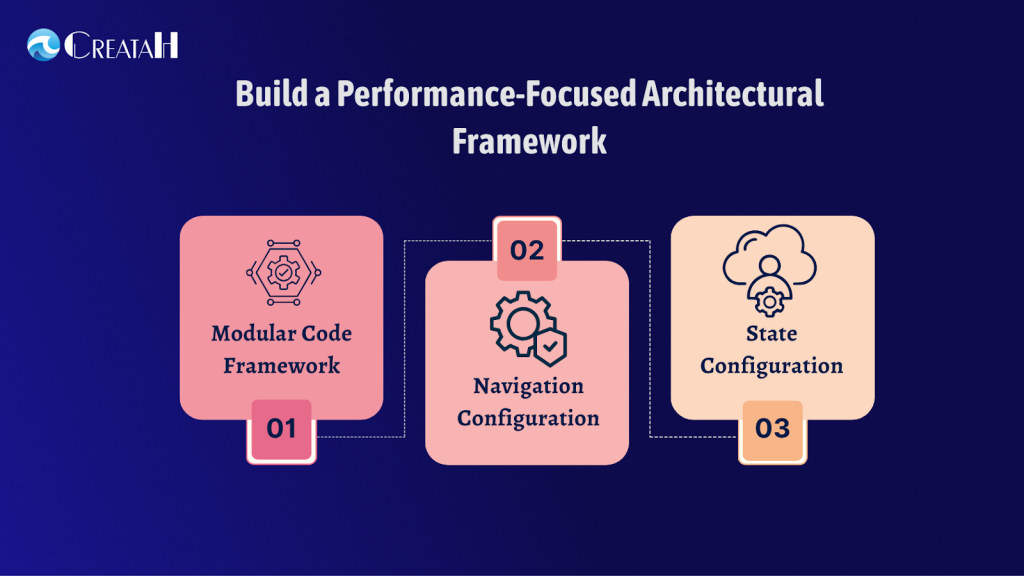
Build a Performance-Focused Architectural Framework
When creating a high-performance React Native application, the technical foundation on which you build your application is extremely important.
Our engineering team carefully makes critical decisions regarding the architecture before any code is written. An example of some of the key decisions they make include:
Modular Code Framework
The ability to build a mobile application using a modular code structure creates separate “modules” of independent code for each feature of the application. This allows for faster loading of the application and accelerated builds because there is less overall code that needs to be compiled. It also allows for easier maintenance and modifications to the application, since each module contains only the data and code necessary to operate that particular feature.
Navigation Configuration
The type of navigation utilized in a React Native application directly impacts its performance. For instance, if the application has heavy animations, high levels of complexity in its transition from one screen to another or requires support for large screen sizes, there are optimal navigation configurations. An app designed for heavy animations would be best suited to use Reanimated Navigation for the smoothest possible interaction. Conversely, an app that has minimal loading time and no animations would do best to use Bottom Sheet, Gesture Handler, and Native Stack navigation frameworks.
State Configuration
Finally, state management is critical to the operation of your application. A poorly designed state management architecture can severely limit the speed of your mobile application and, in many cases, even cause it to break down while in use.When developing applications, our goal is to deliver the best performance while balancing the requirements of the client. We take an individual approach to each project and evaluate the best method for accomplishing our goals with the recommended tools.
For complex data flow to the screen, we use Redux Toolkit. For fast, light-weight, and super-fast apps, we utilize either Jotai or Zustand. For UI that is constantly being pushed to the screen (real-time data), we leverage Recoil to create the best performance possible.
By evaluating our projects with the aforementioned techniques in mind, we can prevent unnecessary re-renders while optimizing how fast the app will load onto the user’s device.
We’re not limited to JavaScript for performance-critical tasks with RN. Hybrid frameworks such as React Native are generally slower than native frameworks due to the overhead created by having to run both in the same thread. However, for performance-critical tasks such as video processing, Bluetooth, sensor data collection and processing, background tasks, and file uploads/downloads, we integrate Swift and Kotlin native modules into our mobile app development process.
This integration of native modules allows us to create the best of both worlds: React Native development’s speed of delivery and native-level performance.
Reducing app size and load time are also important in creating a great user experience. Users don’t want to download an app that loads slowly or takes up a lot of storage space on their device.
To keep apps light and fast on the user’s device, we implement the following techniques:
* Use of Code Splitting and Lazy Loading – Only load one screen at a time and only load the features that the user needs at the time of use.
* Use of Hermes Engine Optimizations – Hermes significantly improves the start-up time, reduces memory requirements, and delivers better JavaScript performance.
We configure and fine-tune the settings of the Hermes engine to achieve a 30-50% reduction in app load time.
* Use of image and asset optimization tools– such as WebP, Dynamic Scaling, and CDNs for High-Quality Media – Heavy images slow down the overall performance of your app. Using image and asset optimization tools reduces the weight of the images while allowing them to look sharp on the display without adding significant loading time.Our user interface designs feature high-end, buttery-smooth animations of 60 frames per second (fps), including high-velocity gestures and seamless transitions. However, as branded applications become increasingly sophisticated, they need to be able to provide their users with the smoothest and most seamless interface designs (including bottom-sheet navigation, swipe-off animations, carousels, swipe-able modal sheets, etc.) possible to compete within their marketplace.
To achieve a “buttery” smooth 60 fps animation experience, we utilize:
- Reanimated 3 to provide “Near-Native Animation” performance.
- Gesture Handler library to deliver responsive touch responses to gestures.
- Skia to design and render custom graphics and animations.
- Bottom Sheet and FlashList libraries to deliver fast and low-overhead user-driven UI lists.
When combined, these tools improve the animation rendering latency, prevent dropped frames, and provide users with a near-native-level premium user experience.
Performance-Proven Components
One of the biggest issues with traditional FlatLists when it comes to building applications with large datasets and/or data-heavy applications is that FlatLists are too slow and laggy. FlashList is a new library created by Shopify to help speed up your app loading times as it is over 10 times faster than FlatList.
In addition to FlashList, we also utilize:
- FastImage for transparent image caching.
- MMKV, which will provide lightning-speed storage for the application data.
- React Query allows for API caching and synchronizing responses.
- SQLite/WatermelonDB allows your application to scale its offline data processing.
When combined, these performance-proven components allow for exceptional speed/responsiveness for applications that require significant data (including fitness tracker applications, e-commerce, logistics/delivery, real-time dashboards, social networking applications, etc.).
Performance Proof Testing Across All Devices
During QA (quality assurance), we do not just test the functional features of our applications; we also thoroughly evaluate their performance, including: launch time, memory usage, performance of the JavaScript thread, loading of the UI thread, stability of the frames per second, API response times and battery consumption both online and offline on low-end Android devices). By running tests on low-end Android devices, we are able to ensure that applications will maintain a smooth and seamless performance on all devices.
Focus on Scalability
To ensure that high-performance applications remain stable as they grow in users (10,000+ to 100,000+), as features are added and as media/content is uploaded/integrated simultaneously, we concentrate on the following key components:
- Microservices-ready back-end infrastructure.
- API Optimizations for Caching and Pagination.
- Real-time Updates through the WebSocket Protocol.
- Predictive Data Fetching Techniques.
Continuous Integration/Continuous Deployment (CI/CD) for seamless updates of our applications.
By employing these techniques, we will guarantee that our application never suffers from a performance drop at scale.
Focus on Delivering the True Experience of the Brand, Not Just the Code
The performance of an application is not just a technical issue, it is also a personal issue to a Brand and their Customers. Brands need to be confident in the performance of their products, which is why we provide:
Quick and Smooth User Onboarding with Minimal Clicks to Experience the Core Value of their application.
User-Friendly User Interface (UI) Accessibility throughout the application, with Optimized Typography and Smooth Transitions between flows.
Combining well-performing products with a Premium User Experience creates Greater Brand Growth, Success, and Longevity.
Through our Excellence in Engineering and UI/UX Development, and Performance Proven Techniques to Create High-Performance React Native Applications, We Ensure That Every Application We Develop Provides User Experience with a Sense of Speed, Fluidity, And Future-Ready Performance.
If your brand is interested in developing high-performance, scalable, and highly functional React Native applications, Creatah would love to work with you on the next major product you develop.
