
The Role of AI and Predictive Analytics in Digital 360 Transformation
Digital 360 transformation is about more than “going digital.” It’s about building a connected, intelligent ecosystem where every touchpoint website, mobile app, CRM, operations, and marketing communicates with each other and learns continuously. AI and predictive analytics are fundamentally transforming this process, quietly turning raw data into real-time decisions.
AI is synonymous with Digital 360 Transformation because when people talk about AI and Digital 360 Transformation, they are really talking about one thing: using data to look into the future and take action before the customer thinks to ask.
Digital 360 transformation means looking at your entire business in a full circle. This includes all aspects of the business: customers, operations, marketing, sales, service, and technology. Digital 360 transformation will integrate all of the aspects of the business into a single unified digital experience.
Digital 360 transformation is not just:
- Building a website
- Running some ads or a series of ads
- Launching a mobile app
Digital 360 transformation is about:
- Tracking user behavior across all of the channels
- Building connections across backend systems (CRM, ERP, support tools)
- Incorporating AI to analyze data and make predictions and decisions
In this case, AI is the “brain” in the Digital 360 transformation because it enables businesses to move from reactive to proactive business.
Where AI Fits in the 360 Journey
AI is no longer just a shiny add-on. AI is embedded into critical parts of the digital journey because it’s easy to think about ONLY from marketing and advertising. Actually, AI adds value across the entire Digital 360 experience, but understanding and segmentation of customers is a great starting point.
AI takes information from a variety of online sources (website visits, usage of the mobile app, financial and purchase history, customer support chat logs), and provides in-depth analyses of customers.
AI groups or “clusters” users into user segments called “loyal buyers,” “at-risk users,” “price-sensitive customers,” and on and on. AI allows businesses to run highly targeted and segmented marketing campaigns instead of shotgun marketing campaigns where they may (or may not) reach the target audience. Customized Experiences Across Channels
Once you infuse AI and machine learning capabilities into your website, mobile app, and CRM, you can:
- Provide customized product recommendations.
- Customize content based on interest, topic, or past actions.
- Customize prices, offers, and bundles dynamically.
This is where mobile app development becomes potent because the app is not a static piece of software, but a dynamic, AI-driven experience for every user.
Intelligent Marketing & Campaigns
AI can help make predictions such as:
- Who will most likely be a buyer this month?
- Which campaign will produce a higher ROI?
- Which users are slipping away and need proximal effort to re-engage?
Predictive analytics allows us to score leads based on probability, predicatively analyze churn, and allocate budgets to the channels that ultimately convert.
Predictive Analytics: From Data to Prediction
Predictive analytics is the foundational layer of AI in the Digital 360 transformation. It relies on historical data as well as predictive machine learning models to predict:
- Who is likely to churn
- Who is likely to buy a specific product
- What time a user is likely to take an action
- Which regions or audiences are likely to do the best for a product launch.
Some practical examples:
Churn Prediction
If a user has not opened your mobile app in 10 days, reduced their session times, or no longer engage with your notifications, predictive models can flag a user as “at risk.” Then the opportunity arises to automatically trigger:
- a personalized offer
- a simple reminder
- a value-based message (tips, guides, freebies)
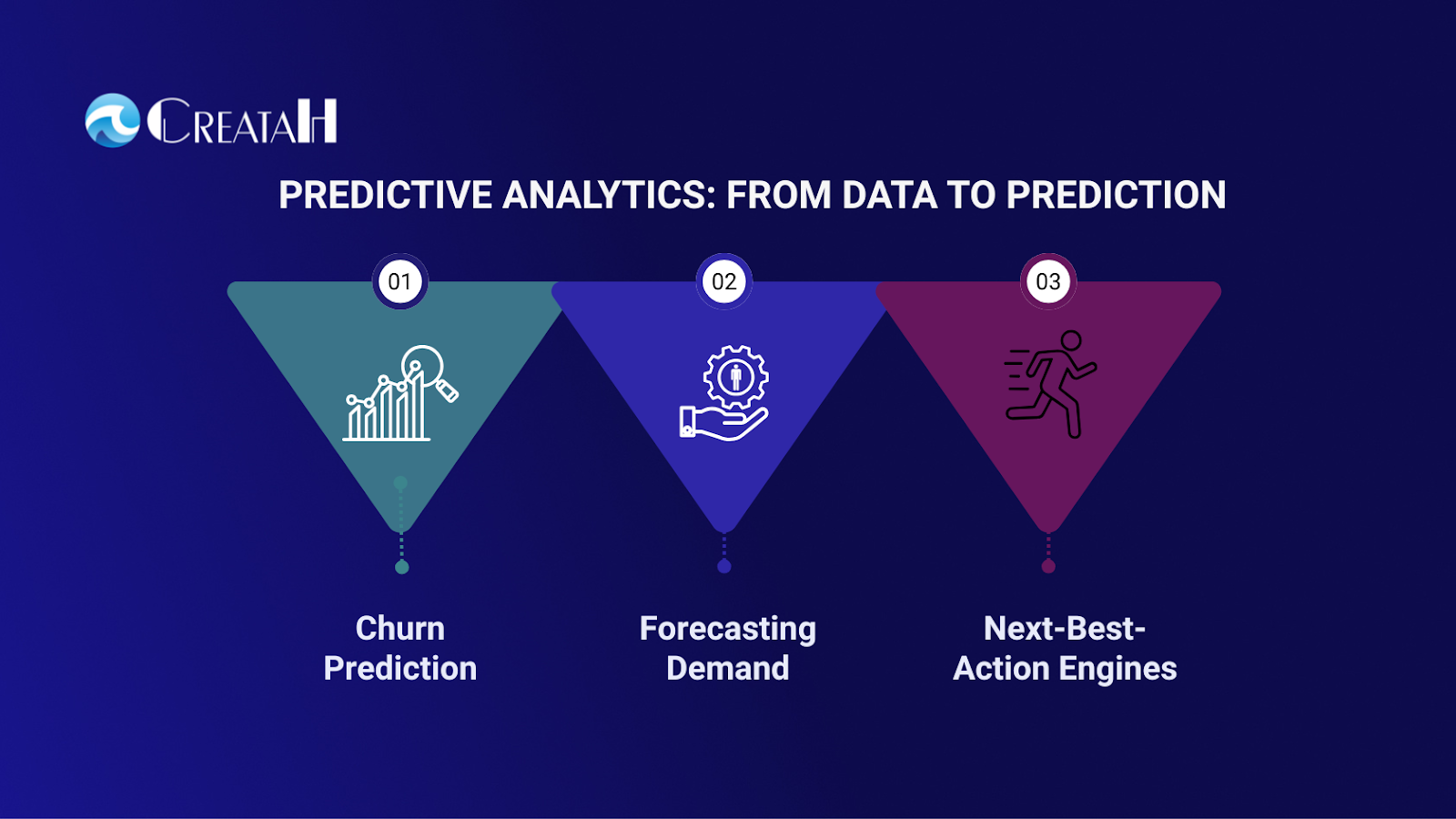
Forecasting Demand
For e-commerce, health care and/or services predictive analytics can be used to forecast demand for:
- specific products
- time slots
- categories of service
This helps you manage inventory, staff levels, or resources to fulfill demand.
Next-Best-Action Engines
Instead of waiting for your team to guess “What do we offer next?” AI-driven engines can recommend:
- next best product
- next best message
- next best channel (sms, push, email, WhatsApp)
This makes a more powerful Digital 360 framework sharper and more profitable.
Role of Mobile App Development in an AI-1st 360 Strategy
Lots of businesses still approach mobile applications as simply another “channel.” However, in a true Digital 360 strategy the mobile application is one of the most viableCheck out how the mobile app development aspect can help support the rest of your Digital 360 transformation with AI:
Real-time behavior tracking Clicks, scroll depth, session time, screen paths, abandoned flows.
Personalized UI Home screens, offers, notifications, journeys while adapting from previous behavior.
Context aware experiences Using time, location, and past behavior/context [insert data] to show the right content at that right time.
Tighter integrate with CRM and analytics Every action in the app feeds your AI models and those model give back smart decisions – to your app, website, marketing tools.
In simplest terms, the better your mobile app is designed and integrated, the better your AI models are, and the more complete your Digital 360 transformation is.
Operational Intelligence – Beyond Just Marketing
AI and predictive analytics are not only for marketing and customer journeys. AI and predictive analytics also work internally:
Support teams AI suggest responses, AI predicts common issues, AI triages/priority support tickets.
Sales teams AI lead scoring, AI deal probability, AI pipeline forecasting.
Management Dashboards that show not only what happened, but what’s likely to happen next.
Inward intelligence is a very important layer of AI in Digital 360 transformation. This inward intelligence means your teams are not only reporting data, they are acting on future-ready insight.
Data to Decisions with AI, Apps and a Good Partner
Digital 360 transformation is about ARC. It’s not about putting more tools in place. It’s about connecting everything together and leveraging AI along with predictive analytics to make smarter and quicker decisions across the entire customer journey and business lifecycle.
When your website, your CRM, your marketing platform, and your mobile app development initiatives come together under an AI driven strategy, you start to move from guess to clarity, from static to adaptive, from reactive to predictive.
If you are interested in crushing AI in Digital 360 transformation into your business – especially with strong, experience driven mobile apps at the centre – then working with a key technology partner will freakishly help.
Creatah has been helping businesses reinvent their digital stack into intelligent, app-led experiences built for the decade, not just the campaign.
