
Emerging Technologies Reshaping Mobile App Development in 2025
Mobile app development in 2025 is no longer just about “having an app.” It is about making intuitive, flexible, and genuinely personalised experiences that users will want to keep on their devices. AI in mobile apps is at the centre of this shift, but it is backed by a potent collection of emerging technologies that include edge computing, 5G, experience redesign, AR/VR, and low-code tools.
We will discuss how these technologies are improving the way apps are conceptualised, developed, and scaled for 2025.
1 AI in Mobile Apps: From Features to Core Engine
A few years ago, most of the AI functions in mobile apps were peripheral features by saying things like, a chatbot here, a recommendation there. In 2025, AI has transitioned from “nice to have” to the core engine underpinning the product experience.
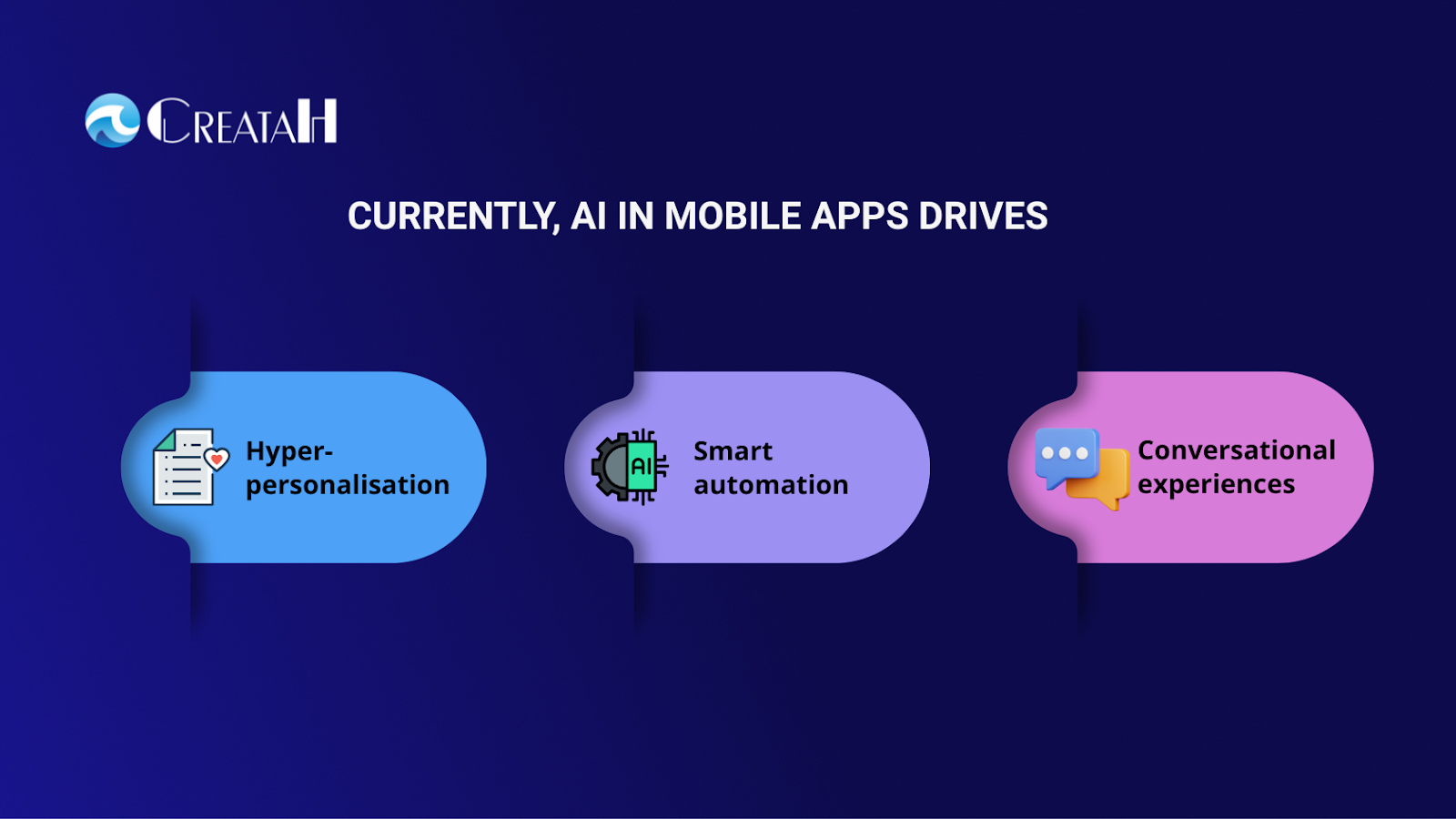
Currently, AI in mobile apps drives;
- Hyper-personalisation: Apps learn from user behaviours, time of use, location, past decisions and even user mood signals (e.g., content consumption patterns) to find ways on serving the right content at precisely the right time.
- Smart automation: Whether in fitness, finance, healthcare, productivity, mobile apps are automating repetitive tasks, communicating intelligently with nudges and reminders, predictions, next Best Action (NBA) decisions.
- Conversational experiences: Large language models (LLMs) voice and chat interfaces are moving apps away from a tool-like experience to an assistant or a guided experience.
Real-time decision facilitation: AI models are processing data instantaneously inlogistics, telemedicine, and mobility for support in dynamic pricing, routing, triage, and risk assessment decision facilitation.In the current era of mobile app development, AI is not viewed as a separate component, but inseparable from the design thinking at the beginning, the back-end architecture and the product road mapping strategy.
2 On-Device Intelligence and Edge Computing
Today data privacy, latency and performance are all important issues. Because of this on-device AI and edge computing are becoming standard.
- Rather than sending everything to the cloud, many apps are now able to:
- Run AI models directly on the device, (for examples image processing, predictions, voice recognition).
- Reduce reliance on network speed and server uptime.
- Provide better privacy by keeping sensitive user data local.
For example, a health or wellness app can analyze patterns in activity or sleep locally and then only send aggregated insights to the cloud. This makes the use of AI in mobile apps faster, safer, and more reliable, especially in areas with unreliable internet.
3 5G and Real-Time, High-Fidelity Experiences
Assuming that 5G continues to be adopted in more places, mobile app development in 2025 can anticipate:
- Lower latency
- Higher bandwidth
- Smoother real-time interactive experiences
These open up experiences and features that were not practical previously:
- Live, interactive coaching (fitness, education, therapy) utilizing high-definition video with real-time utilization.
- Multi-player AR/VR environments for gaming, events, training, and retail.
- Real-time IoT controlled dashboards for factories, hospitals, and smart homes.
- Once 5G is more broadly available, AI is even more valuable in mobile apps. Models that utilize a mix of on-device and cloud capabilities can be utilized intelligently for performance and cost.
4 Augmented Reality (AR), Virtual Reality (VR), and Spatial Experiences
- Mobile screens are being transformed from flat interfaces to spatial experiences. AR (Augmented Reality) and VR (Virtual Reality) are being integrated into everyday applications:
- Retail applications enable users to visualize clothing, furniture, or décor in their own environments.
- Educational applications allow users to conceptualize complex subjects as interactive 3D models.
- Fitness and wellness applications provide targeted immersive coaching in sessions or meditative settings.
- Again, the facilitation of AR and VR in mobile applications has a significant role for AI:
- AI can apply observations of user gestures and data from the environment; it can personalize based upon surroundings, user comfort, user engagement, and/or performance.

5 Low-Code & No-Code: Accelerated Prototyping, Intelligent Backends
Business teams do not want to wait 6 to 12 months to see if an idea works any more. Low-code and no-code platforms are changing the speed with which something can go from idea to a prototype.
2025:
Founders and non-technical teams are going to use low-code tools to validate user flows, onboarding experiences, and even the creation of internal tools.
Developers will focus on the core context intelligence, designs that require more complex logic, integration into their AI models, or scale rather than building out base components that are standard.
Backends will rely upon more modular, API driven, and AI enabled methodologies.
When combined with AI, these tools can even recommend UX flows, generate boilerplate code and recommend screen optimizations all before someone even engages, thus making mobile app development even more efficient and strategic.
6 Data Privacy, Security, and Ethical AI
As AI becomes embedded into mainstream mobile apps, users are now increasingly aware of and skeptical of:
- Where their data goes
- How the data is processed
- What data is collected and tracked
- So, as we enter in 2025, any app will need to be built around:
- Transparent and clear permission and consent flows
- Clear language of any & all data collection and usage processes
- Compliance with regulations in their regions (GDPR, HIPAA- esq, etc.)
- Ethical practices to address bias, build explainable platforms, and readily provide audit logs
At this point, security, privacy and trust have become core product features from a design and engineering standpoint not just boxes to check.
What Does This Mean for Businesses in 2025
The message for businesses in 2025 is simple:
If your mobile application is still just an online brochure, or a digital version of your website, you are already behind.
Users now expect:
- A personalized journey
- Intelligent recommendations
- Continuity across multiple devices
- Instant responsiveness in real time
- A feeling of understanding from the application
To meet user expectation, mobile application development will need to be planned and code for AI from day one not as an add-on, but rather at the foundational layer of the app.
Building the Next Wave of Intelligent Apps with Creatah
Entering 2025, the winners in the mobile application space will be the businesses that embrace AI into the mobile app, operate the emerging technologies of 5G, AR/VR, edge computing, and treat personal data security and user trust as non-negotiable.
Regardless of vertical; fitness, healthcare, logistics, education, retail, your app experience can become more than just the tool of the customers experience it can become an intelligent companion in the users experience.
If you’re looking to bring thoughtfulness and intelligence into the experience of your digital products from the initial idea to final execution (and everything in between) consider Creatah. Our team lives and works at the intersection of AI and mobile application development, helping businesses bridge the gap between a concept (whether for funding or scaling) and a smart, scalable mobile app that delivers a seamless user experience built for the future
