
5 Signs It’s Time to Upgrade Your Old System with Custom Software
In a fast-paced digital space, organizations can’t afford their outdated systems to slow them down. However, many continue to operate with old software that used to work well, but now it leads people to be delayed, make mistakes, and operate inefficiently.
It’s solely an upgrade to customized software, it’s not a luxury if you want agility, future competitiveness and scalability; it is a must for your organization to upgrade.
When your team starts hearing yourself saying “let’s wait for the system to load”, or “we will just do it manually later”; it may be time to revisit your upgrade.
Here are 5 unmistakable signs your organization needs custom software, and what it could change specifically for your organization.
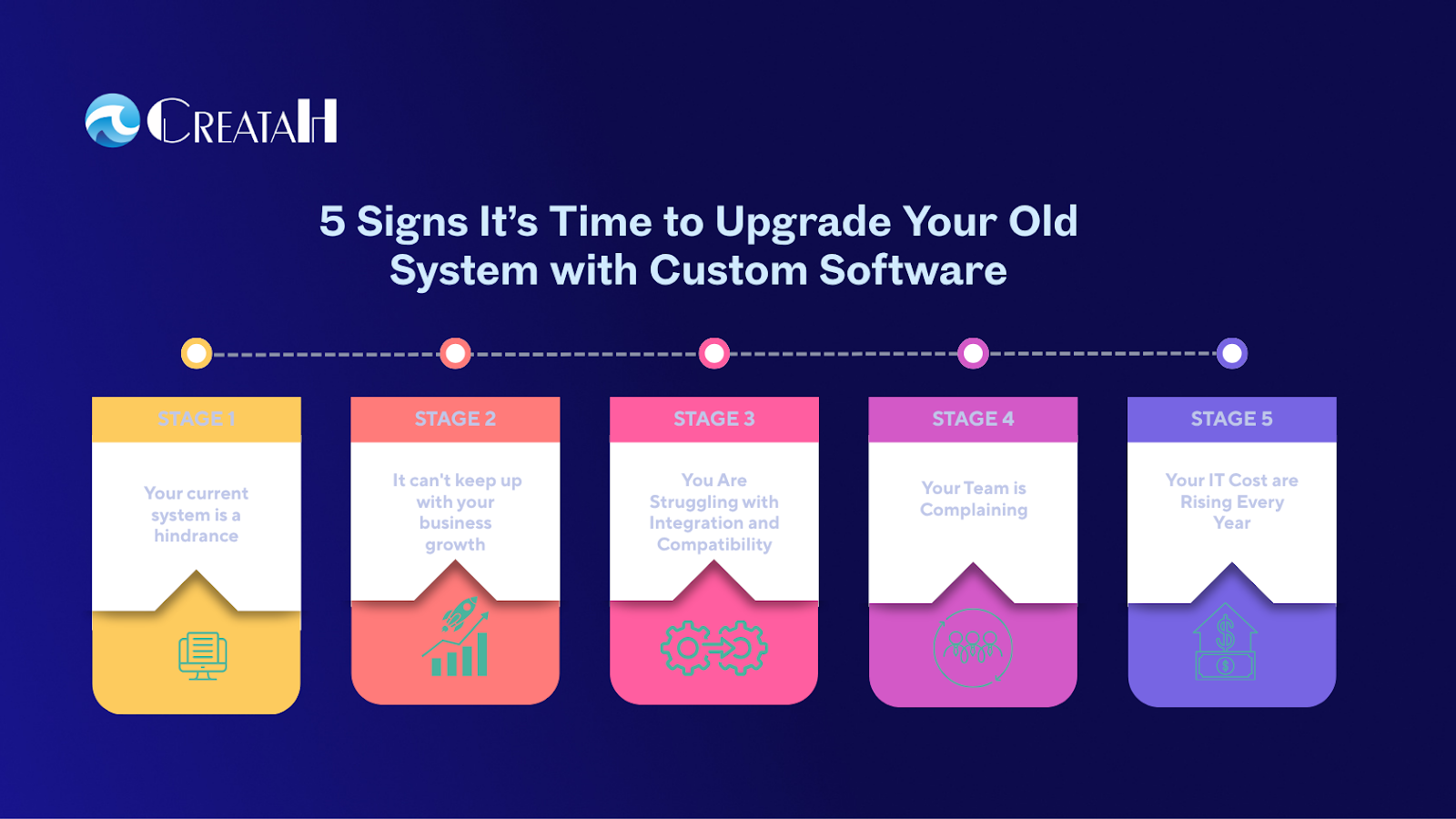
1.Your current system is a hindrance
Your current software is a hurdle rather than a system for your support. It is a real risk.
Slow system speeds and crashes and dated UI all impact efficiency and productivity.
Some signs may include:
– Employees have to enter the data into the system or troubleshoot compatibility, several times;
– It takes the system entirely too long to complete a simple task;
– You are using several tools to make one workflow work;
– You have system downtime during normal business hours.
Custom software allows one modern platform and faster capabilities so usual tasks can be automated with reduced human error. Furthermore, modern architecture and APIs an built to play nicely with CRMs, ERPs and cloud services.
2.It can’t keep up with your business growth.
Software developed a long time ago is not built for your organization’s size for today.As your customer base, team, or organization gets bigger, your old system may start to reveal its shortcomings.
Here are some signs you have outgrown the old system:
– Your software can no longer handle larger data sets,
– The reporting tools are limited and outdated,
– You cannot add new users or new locations,
– Your system crashes or slows down from peak usage.
A custom software upgrade can bring you both technical and functional scalability. The system can grow with you in your business regardless of whether you have 10 users or 10,000. This scalability can ensure that your digital foundation does not limit or threaten you in the future.
3.You Are Struggling with Integration and Compatibility
Old systems do not “talk” to modern applications very well. As you begin to bring in new tools – cloud storage, CRMs, analytics dashboards – your legacy systems become the bottleneck.
You may notice:
– Your older system never sends across the data to other tools
– You depend on a manual import/export
– You have significant inconsistencies in data from work team to work team
– There is security risk from using older unsupported technology
Upgrading to a custom software will facilitate a more seamless integration into its current digital ecosystem; it allows for the business to connect data across all tools – CRM, accounting, logistics, marketing automation, and more – to gain a 360 degree view of operations.
4.Your Team is Complaining (and so are your Customers)
When your team is always raising the red flag with bugs, lagging performance, or missing features, this will negatively impact the customer experience. When you have slow processes internally, slow reactions, poor user experience, and ultimately leads to lost customers.Indicators That It’s Having a Business Impact:
Frequent complaints by staff about slow systems. Judicial processing may cause delayed communication or support with clients. Poor user experience in customer-facing portals. Difficulty generating accurate report and invoices.
A modern custom software upgrade drastically improves the backend performance and a better front-end experience for the user in the front. An intuitive dashboard, faster workflows, and automation gives the opportunity for the team to focus on movement of processes and not repairs.
5.Your IT Cost are Rising Every Year.
Old systems are expensive to maintain, and it’s not due to licensing, it is due to inefficiency. Outdated technology has just had way more hours added on hours of development; patching thousands of issues for one month of downtime. Are you seeing any of these trends? When costs seem to increase year over year, problems with having to find a developer that can find support for your problems year-over-year, issuing security patches whether you can or cannot complete. You are forced to continue using outdated hardware or outdated operating systems just to keep it afloat.
Investing in a custom upgrade appears costly upfront but it can pay for itself over and over again through less downtime, with fewer technical maintenance bills due to inefficiencies, and through performance. There is no more systems that just do patches, instead systems that are doing or creating long-run value.
The Benefits of Using a Custom Software Upgrade
When a software upgrade is completed, there is a much larger effect of upgrading technology that effect occurs inside how the business is run as a whole.
Here is what you can expect:
Increased efficiency. Your automation works on for filling volumes of repetitive tasks over time or for eliminating errors due to manual entry of data.
- Greater Security. Your built using modern frameworks and secured enough to follow compliance.
- Data Accuracy. A more modern system and able to perform at real-time synchronization across all departments.
- Better User Experience. Your users will always participate at faster, smoother, and intuitively workflows.
- Future-Ready Foundation. The end product will always be built scalable, and designed to adapt and adopt to new technologies easier.
Consistent syncing and upgrading for greater productivity, happier employees, and a satisfied clients. These builds a long-term sustainable growth for the business that integrates all three key pillars.
How to Approach a Custom Software Upgrade
Before jumping into a development of a software upgrade it is important to consider and assess what are the current issues, what their goals are next and who is going to partner in the tech development.
Take the following steps:
- Take a full audit of your software.
- Determine what are the peak bottlenecks, and inefficiencies that are noted.
- Clarify what features are must-haves and what features are a nice-to-have.
- Find the best partner to help you with the software, your students and your niche experience with your work, should be evident.
- Make sure scalability and future proofing is part of the architectural frame work.
Upgrade Today and Transform Tomorrow at Creatah.
Your software should provide opportunities for growth, not outcome disappointments.
If it feels old and tough to keep it alive, and tough to maintain, and rigid, that is when it is the right time to decide to invest in a new software upgrade.
At Creatah Software Technology, we create scalable, safe, and more functional future-ready software, suited exactly for your needs.
From creating and modernizing legacy software systems to creating enterprise-grade custom software for you company, our specialty is supporting your transition as smoothly as possible, with no downtime and maximum ROI.
